

The End Of A Profound Intellectual Era
The demise of Jürgen Habermas (June 18, 1929 – March 14, 2026), the German Philosopher and Social Theorist in the tradition of Critical Theory and Pragmatism whose works addressed Communicative Rationality and the Public Sphere, has marked the end of a profound intellectual era that has influenced modern sociology, philosophy and political thoughts for nearly a century. Very few philosophers have been able to bridge the gap between philosophy, sociology, political theory and public life so consistently. Remaining intimately engaged with the moral and political crises of his time; Habermas carefully nurtured the possibility of reason-based discourse. He did it at a time when ideological rigidity, technology-driven (socio-political) control and the decline of democracy prompted people to lose faith in humanity.
Born in Düsseldorf on June 18, 1929, Habermas grew up against the backdrop of the ruins of Nazi Germany and its moral re-evaluation. He experienced the immediate post-war zero hour (Stunde Null) as a profound moral rupture. Like many of his generation, his intellectual journey was dedicated to answering how a highly modern, culturally advanced and scientifically developed civilisation could fall into the depths of barbarism. Although the anxiety drew him closer to the thinkers of the Frankfurt School, Habermas diverged from their profound pessimism regarding the fate of rationality and modernity. He maintained that the Emancipatory Potential of the Enlightenment and its rationalising project could be salvaged, reconstructing it from a purely instrumental or technocratic tool into a communicative force.
His 1962 publication The Structural Transformation of the Public Sphere established Habermas as a pivotal democratic theorist. In this book, he analysed the historical rise and decline of the bourgeois public sphere as a space for critical, rational debate, apart from exploring how public opinion formed and challenged State Power. His views have influenced democratic theory for decades. He demonstrated how spheres, such as coffeehouses, salons (parlours) and early media, created a space for private individuals to gather as a public, engaging in rational-critical debate on matters of general interest, free from direct state control.
Although Habermas subsequently acknowledged the inherent inequalities within these spheres, his core argument remained intact. Habermas’ Theory of Deliberative Democracy posits that true democratic legitimacy arises not solely from institutional structures (like voting booths or Parliaments), but from the communicative processes that occur in the public sphere. He argued that “political legitimacy is established not through coercion, but through open, reason-based discussions”.
This concept gained further depth in his The Theory of Communicative Action (1981). In this publication, Habermas challenged traditional sociological theories that view human interaction solely through the lens of strategic, goal-oriented or self-interested behaviour. Instead, he argued that the fundamental essence of human interaction is communicative action, which is oriented toward achieving mutual understanding and consensus. His distinction between the Lifeworld (the realm of everyday experience and shared meanings) and the System (comprising of bureaucratic and economic structures) is the central component of The Theory of Communicative Action, designed to explain how modern societies function and where they go wrong. According to Habermas, the central danger in modern society arises from the “colonisation of the lifeworld“. It occurs precisely when instrumental mechanisms – namely, the steering media of money (the market) and power (the administrative state) – intrude into spheres of life that ought to be governed by communicative action, reason and mutual understanding.
Habermas’ philosophical project is largely defined by his attempt to rescue the emancipatory potential of the Enlightenment while acknowledging the valid criticisms of modernity raised by his predecessors in the Frankfurt School and Postmodernists. He achieved this not by abandoning rationalism, but by shifting its foundation from a solitary, subjective consciousness (instrumental reason) to the intersubjective, communicative interaction of social actors (communicative rationality). His development of Discourse Ethics is the cornerstone of his critical theory, fundamentally aiming to ground moral norms in rational argumentation rather than in individual conscience, intuition or tradition. The core assertion of Habermas (that a moral norm is valid only when it secures the rational consent of all parties concerned) is formally structured around a procedural approach to morality. In other words, morality is not a matter of personal belief, but the product of inclusive dialogue.
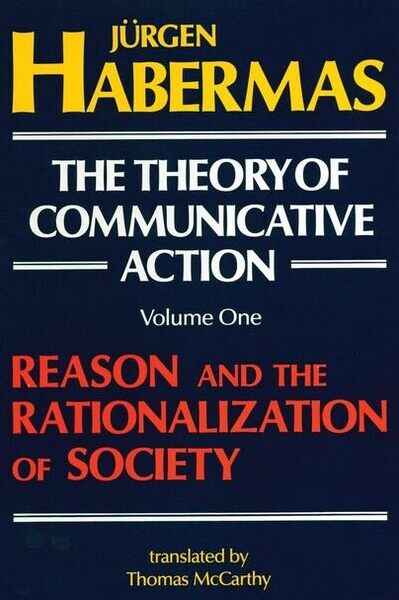
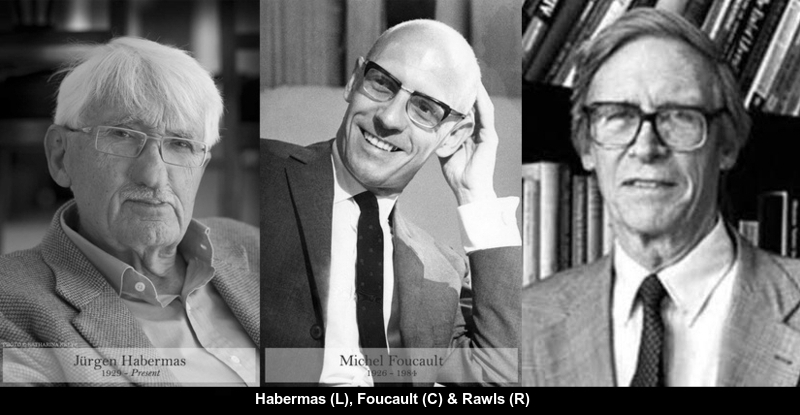
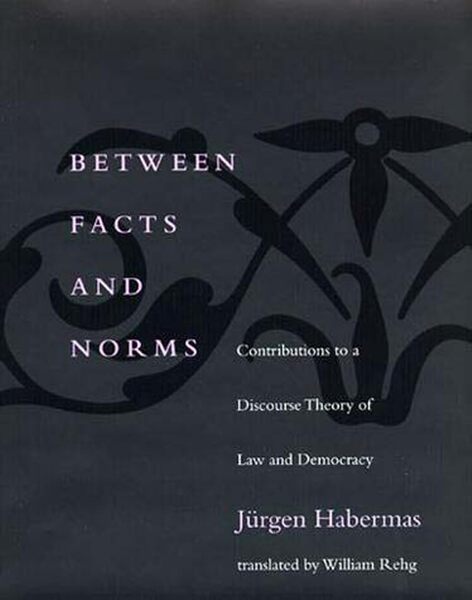
In political theory, this concept takes the form of Deliberative Democracy. In his seminal work Between Facts and Norms (1992), Habermas mentioned that a law is valid only if it can claim legitimacy, and that legitimacy arises from a process of public deliberation among free and equal citizens. This concept is central to his Discourse Theory of Law and Democracy, which posits that democratic procedures are the only source of legitimacy in modern, complex and secular societies. His approach to intellectual dialogue, rooted in communicative action and discourse ethics, becomes clearer when compared with John Bordley Rawls‘ (February 21, 1921 – November 24, 2002) Constructivist Approach to Justice. The core distinction lies in Habermas’ insistence on actual, intersubjective discourse between real people; whereas Rawls utilises a hypothetical thought experiment.
Habermas’ critique of Paul-Michel Foucault (October 15, 1926 – June 25, 1984) is another central component of his defence of Critical Theory and the Enlightenment project, particularly articulated in The Philosophical Discourse of Modernity (1985). While Habermas acknowledged Foucault’s detailed analyses of Disciplinary Power and the Micro-physics of Power, he argued that Foucault’s framework leads to a paradoxical “normative confusion“. Habermas feared that by viewing all knowledge, science and truth-claims as merely “regimes of truth” inextricably linked to power (power/knowledge), Foucault eliminated the possibility of identifying “uncoerced” truth. If all knowledge is just a manifestation of power, then there is no objective ground to criticise power. As the French philosopher denied a universal, context-transcending standpoint, Habermas argued that Foucault could not provide a normative basis for choosing between different forms of power. For example, distinguishing between a democratic law and a totalitarian regime. Habermas used to believe that without the possibility of an “ideal speech situation” (where argument is free from domination), criticism becomes purely stylistic or arbitrary rather than rational. For Habermas, rational discourse is not merely a method of communication; it is the indispensable foundation of justice and freedom, anchoring the legitimation of law and political power in the “unforced force of the better argument“.
Habermas focussed mainly on rational communication within pluralistic societies, the ongoing evolution of religion in a post-secular age and the development of political structures that transcend the Nation-State. He was of the opinion that the global governance system would have to increasingly rely on deliberative legitimacy in order to make its decisions binding and fair as the Nation-State lost its monopoly on political decision-making because of globalisation.
Habermas is widely recognised not only as a pivotal 20th Century philosopher and social theorist, but also as a leading public intellectual in Germany and the European Union. He consistently argued that the memory of the Holocaust was the foundational moral, political and historical obligation of the modern German State. For Habermas, this obligation is central to Germany’s self-understanding, It demands a double duty that encompasses both the fight against antisemitism, and an enduring commitment to the security of the Jewish people and the State of Israel.
Following the October 7, 2023 attacks by the Palestinian Hamas Movement, Habermas and his three colleagues from Frankfurt University issued a statement, titled Principles of Solidarity, on November 13, 2023. This document aimed to outline the ethical foundations for supporting Israel, apart from addressing the protection of Jewish life in Germany and the situation in Gaza. The statement also provided a moral basis for Israel’s military response that was met with both support and intense, widespread criticism. It was inconsistent even in light of his concept of universal morality, as it failed to accord due weight to the violence and indignity inflicted upon the Palestinian people. This conflict demonstrates how difficult it is to apply communicative ethics in case of real political conflict characterised by unequal power.
In the era of technological change, geopolitical rivalry and democratic crisis, issues raised by Habermas, such as how rational public discourse will survive and how will legitimacy be established, remain quite relevant. The world of Social Theory and Critical Philosophy has suffered a profound loss with the passing of two truly extraordinary figures – Habermas and André Béteille (September 30, 1934 – February 3, 2026). The discourse initiated by Habermas regarding democracy, reason and communication remains foundational for understanding, as well as navigating, public life, especially in the face of contemporary challenges, like digital fragmentation, fake news and democratic instability.
Meanwhile,





Boundless Ocean of Politics on Facebook
Boundless Ocean of Politics on Twitter
Boundless Ocean of Politics on Linkedin
Contact us: kousdas@gmail.com

 ISMC
ISMC

1 Comment »