

COP30 & The Conflict Of Interest
The 30th UN Climate Conference (COP30), held in the Brazilian port city of Belém on November 10-21, 2025, concluded without a consensus on a concrete roadmap or explicit language in the final agreement on the phasing out of fossil fuels. Reports suggest that the oil-producing nations resisted any binding language on this particular issue, despite significant pressure from over 80 countries.
Although the long-term average of global temperature rise has not yet officially breached the Paris Agreement‘s (an international treaty on climate change that was signed in 2016) 1.5-degree Celsius limit, recent evidence indicates the world is likely to exceed this target around 2030 if greenhouse gas emissions are not cut drastically. Several reports suggest that the 1.5-degree Celsius limit may have already been passed, given recent consecutive months and years of warming above this threshold. In other words, the global community has ignored the danger, in spite of knowing it, as each and every country has focussed only on its own interests.
No wonder, fossil fuels are a significant part of the own interest. The Arab world, Russia, the US and several Latin American countries, including Brazil, have substantial petroleum reserves. The economies of some of these countries are heavily dependent on petroleum revenue. On the contrary, rapidly developing countries, like India, are dependent on fossil fuels for their economic growth. Hence, both producers and consumers have objected to the phasing out of fossil fuels primarily due to significant economic reliance, concerns about energy security, as well as affordability, and the practical challenges of a rapid transition to renewable energy sources.
To solve this issue, much more emphasis should be given to alternative energy at least on the demand side. According to experts, the international community should consider all the aspects, from nuclear power to hydrogen fuel. It is also necessary to ensure that the cost of alternative energy should be lower than that of fossil fuels. Most importantly, all these must be done without wasting time, before the average surface temperature of the Earth reaches 2-degree Celsius above pre-industrial levels. The question arises here: Is environmental diplomacy ready to walk that path?
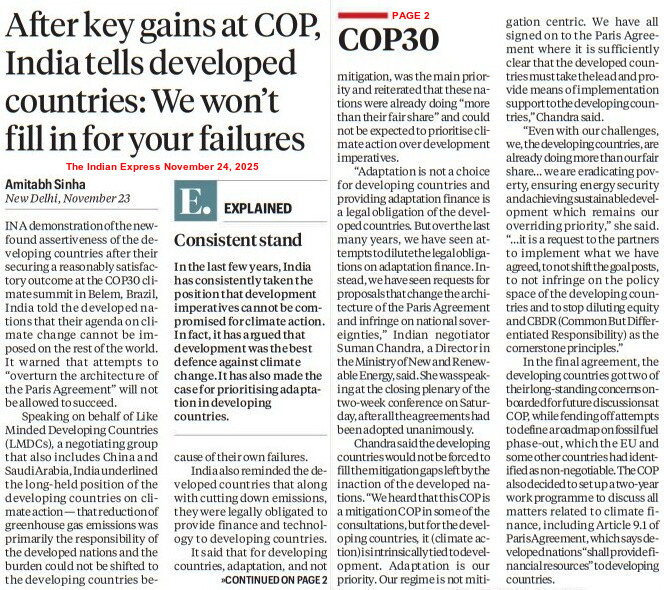
The final statement of the COP30 states that “measures taken to combat climate change, including unilateral ones, should not constitute a means of arbitrary or unjustifiable discrimination or a disguised restriction on international trade”. It can be considered a victory for rapidly developing nations, like India. Policies, like Europe’s Carbon Border Adjustment Mechanism (C-BAM), impose tariffs on imports from countries, like India, based on the carbon emissions from their production process. It makes the products, such as steel, cement, aluminium and fertilisers, less competitive in the European market and India has always opposed such discriminatory policies.
In fact, no one can ignore the legitimacy of India’s position in this regard. According to the Intergovernmental Panel on Climate Change (IPCC), the total amount of warming is directly linked to the cumulative amount of greenhouse gases in the atmosphere. It means that historical emissions from industrialised nations are a major factor in the current global warming. Nearly 80% of historical cumulative fossil fuel CO₂ emissions since 1850 came from G20 countries, with the US, China and the EU having the largest contributions. The Paris Accord acknowledges the principle of Common but Differentiated Responsibilities and Respective Capabilities, recognising that different nations have different historical contributions and abilities to take action. Therefore, if a country, like India, is forced to comply with the current narrow limits on carbon emissions or faces punitive tariffs for not complying, it should be recognised as discrimination.
The international community needs to find ways to force world leaders, like Donald John Trump and other climate change deniers, to adopt environmentally friendly global production and trade policies. The Belém conference concluded with an agreement, calling for adaptation finance to be tripled by 2035, compared to 2025 levels, in order to help vulnerable nations cope with climate change impacts. However, the agreement has been met with some criticism due to a lack of clear mechanisms on who is responsible for providing the funds.
While both adaptation and mitigation are crucial, adaptation is essential for helping countries to overcome the risk of global warming because it allows them to cope with the unavoidable impacts of climate change that are already happening and would continue to happen. Participants in the COP30 rightly realised the importance of giving emphasise on fund-raising.
Meanwhile,
Boundless Ocean of Politics on Facebook
Boundless Ocean of Politics on Twitter
Boundless Ocean of Politics on Linkedin
Contact us: kousdas@gmail.com

 ISMC
ISMC Boundless Ocean Of Politics