

Lost Forever
One can trace the statistics of deaths and injuries in wars, as well as armed conflicts, from the distant past to the postmodern era. However, it is quite difficult to assess the environmental damage due to wars (or the impact of wars on the environment). Experts believe that the socio-economic assessment of environmental damage is almost impossible.
With the help of science and technology, humans destroyed billions of plants and wildlife, apart from killing people, during the American Civil War, First World War, Second World War, the Vietnam War, the Iraq War, Afghan War, the Balkan War, and most recently the Russia-Ukraine War and the Israel-Hamas War. Modern weapons, explosives and chemicals used during armed conflicts cause widespread pollution of water, soil and air. At least 193 case studies on the impact of war on the environment, conducted in various countries from 1914 to 2023, have revealed that wars caused the most deforestation (34%) and land degradation (23%) in the world.

In its latest report, the World Health Organisation (WHO) has mentioned that 179,000 children under the age of five are suffering from severe respiratory infections in Gaza, while 136,000 from diarrhoea mainly because of environmental damage triggered by the Israel-Hamas War. War not only claims the lives of innocent people and animals, but also destroys public health services, natural resources and the environment. According to the WHO, the weapons used in wars cause Global Warming and environmental pollution, leading to Climate Change. Unfortunately, the present, as well as the future, generations would have to pay the price in different ways.
The UN has confirmed that the world experienced more than 170 armed conflicts in 2023! By the end of that year, nearly 120 million people were forcibly uprooted from their own lands. Those conflicts had a great impact on nature and the environment. It may be noted that the estimated death toll in the Second World War ranges from 70 to 85 million. It includes both military and civilian casualties. While approximately 20 million military personnel lost their lives from 1939 to 1945, 40 million civilians perished. The use of nuclear bombs and various chemical weapons began in the 1940s, and it has become almost impossible to deal with the inevitable, as well as lasting, impact of those weapons on the global environment.
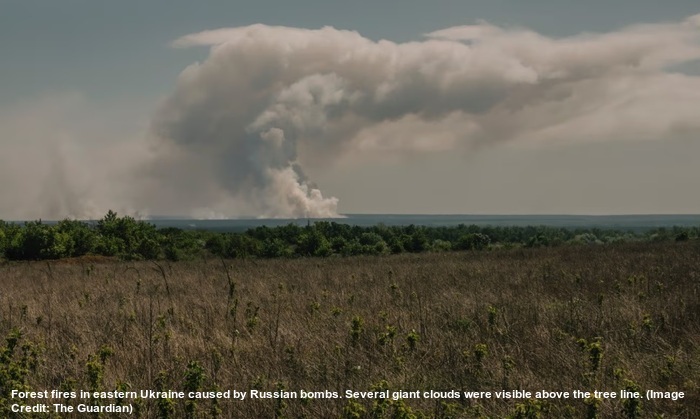
The destruction of forests has devastated the ecosystem in Russia and neighbouring Ukraine, wiping out a vast number of wildlife, including animals and plants. Those whose livelihoods depend on the local forests have lost everything. During war, humans not only kill members of their own species, but also destroy their habitat with extreme cruelty. Hence, Alessio Mamo, a Sicilian photographer based in Catania (Italy) and a regular contributor for The Guardian, has stressed: “War is an extreme example of the violence humans impose on nature.” The two-time World Press Photo winner added: “For decades, we have subjected our environment to stress.” Mamo has been photographing the devastating effects of war on soldiers, civilians and the environment in Sicily, West Asia, the Balkans and Ukraine for a long time.
As per an article recently published by The Guardian, the Russia-Ukraine War is the largest conflict in Europe since the Second World War and it has not only killed more than 46,000 Ukrainian soldiers, but has also prompted millions to flee the country as many cities and villages have been reduced to rubble. The environment, too, is in dire straits, with a significant number of species facing a high risk of extinction.

The World Wildlife Fund (WWF) has revealed that more than three million hectares of forests have been damaged in Ukraine, of which one million hectares are protected forest areas. Dr Bohdan Vykhor, the Executive Director of WWF Ukraine, stressed: “We have lost some parts of nature forever. It is impossible to return. It is an objective reality, unfortunately.” He also said that it might take many decades and “tremendous effort” to de-mine Ukraine, adding: “Until fighting stops, we cannot begin. It is dangerous.” The arrogance of showing military might and aggression during war destroys natural forests, mountains, rivers and seas in different parts of the globe. It is also a fact that nearly 0.2 million Homo Sapiens had destroyed millions of plants and killed thousands of wild animals for their own survival about 50,000 years ago!
Meanwhile, Greenpeacedotorg has claimed that the hymns of Vedic sages (in Indus Valley Civilisation) praised wildlife, as well as nature, to create environmental awareness 5,000 years ago. Once, Zeno of Citium (BCE 334-262), a Hellenistic philosopher from Citium (Cyprus) and the founder of the Stoic School of Philosophy, stated: “The goal of life is to live in harmony with nature.” However, the war frenzy countries and armed terrorist organisations are destroying the environment by polluting the water, soil and air, instead of living in harmony with nature. And, the global community has become a silent spectator of the total destruction of the environment.
Boundless Ocean of Politics on Facebook
Boundless Ocean of Politics on Twitter
Boundless Ocean of Politics on Linkedin
Contact us: kousdas@gmail.com

 ISMC
ISMC Boundless Ocean Of Politics