

Trump Softens Stance, Diplomacy Put To The Test
US President Donald John Trump said on May 25, 2026 that Iran should destroy its highly enriched uranium stockpile under international supervision, if Tehran had any issues handing over the stockpile to Washington DC. “The Enriched Uranium (Nuclear Dust!) will either be immediately turned over to the United States to be brought home and destroyed or, preferably, in conjunction and coordination with the Islamic Republic of Iran, destroyed in place or, at another acceptable location,” he wrote on Truth Social. The President clearly mentioned that the process should take place “in the presence of the Atomic Energy Commission (AEC) or its equivalent”.
Political analysts are not sure whether the US President has softened his stance merely to demonstrate his goodwill regarding a settlement with the Islamic Republic. Earlier, he repeatedly claimed that Tehran must halt its nuclear activities and hand enriched uranium over to the US in order to restore peace. It may be noted that the 21-hour US-Iran peace negotiations in Pakistan ended without an agreement on April 11-12, 2026 due to irreconcilable differences regarding Tehran’s nuclear programme and regional security. The talks collapsed after Washington DC demanded a binding commitment to abandon nuclear weapons, while Tehran rejected these terms as excessive. However, Trump’s May 25 social media post suggests that he is displaying a somewhat flexible attitude towards Iran for the time being.
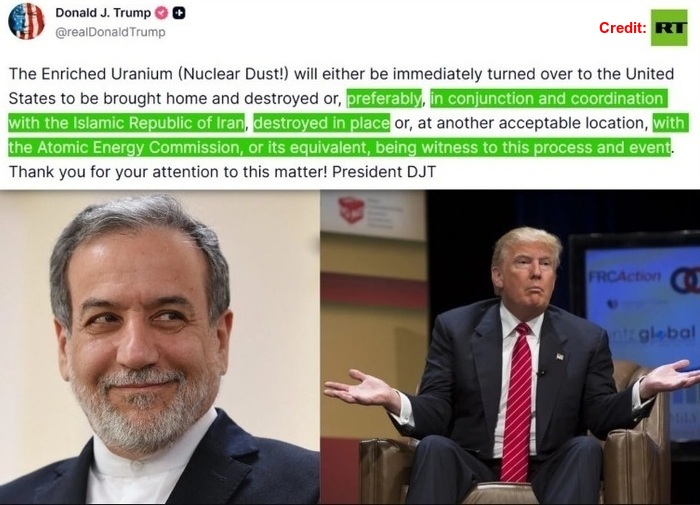
Diplomacy Put To The Test
Executive Intelligence Review; May 28, 2026: Chinese Foreign Minister Wang Yi opened the UN Security Council’s special session on Upholding the Purposes and Principles of the UN Charter and Strengthening the UN-Centred International System on May 26, 2026. During the session, a number of representatives of the Global South stressed that although various aspects of the UN institutions were in need of reform, the greater problem was the failure to uphold its founding principles and the dangers ensuing from the careless disregard for international law.
Wang is scheduled to participate in the Group of Friends of Global Governance meeting – the 43-country coalition, predominantly drawn from the Global South, launched at the UN last December – in New York on May 28 to advance the Global Governance Initiative of President Xi Jinping.
In view of these events, the Schiller Institute and allied forces circulated internationally an open letter – titled To the Governments of the United Nations: A Policy To Bring Peace and Development to Southwest Asia, including at the UN headquarters in New York. The proposal reflects, in part, the results of deliberations at the May 15 Executive Intelligence Review (EIR) Roundtable on the Iran War and the controlled disintegration of the world economy. It includes the four-point regional framework for peace presented at the Roundtable by the former Prime Minister of Turkey Ahmet Davutoğlu, combined with the expanded Oasis Plan put forth by Helga Zepp-LaRouche, the Chairperson of the Schiller Institute, for reversing the desertification of South-West Asia and ensuring the integrated economic development of all countries in the region as the only basis for lasting peace.
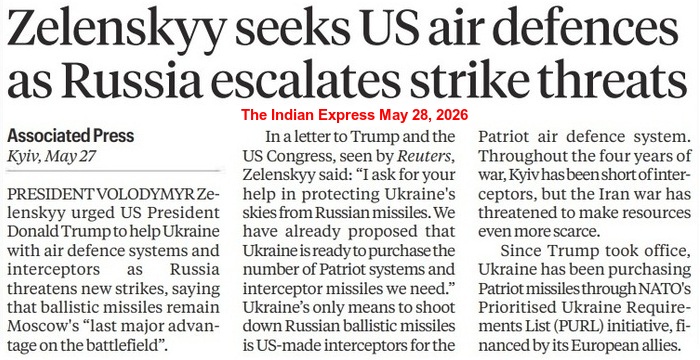
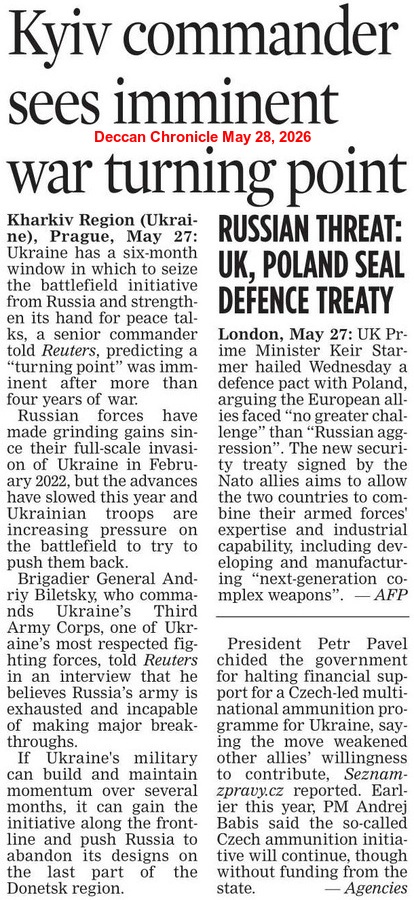
At a time when the world urgently needs a new security and development architecture, European leaders, in collaboration with NATO, push a desperate Volodymyr Oleksandrovych Zelenskyy Regime into ever riskier provocations of Russia, while the Kremlin, refusing to negotiate, has announced a sustained escalation against Ukraine, which could spiral out of control.
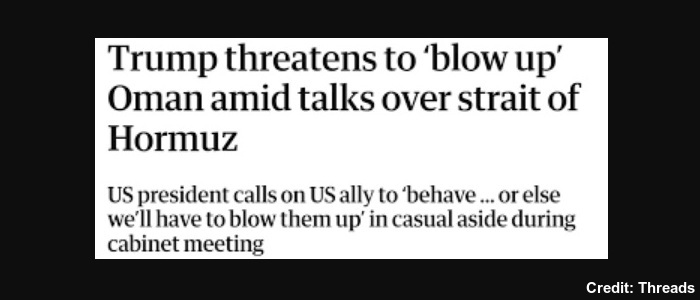
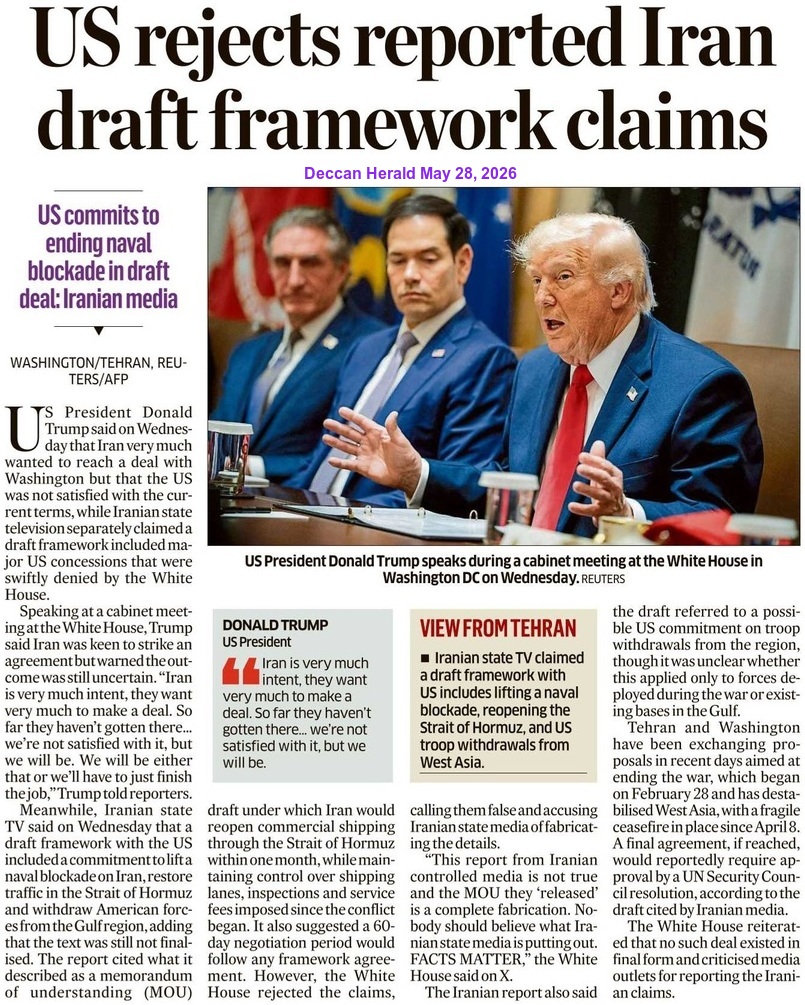
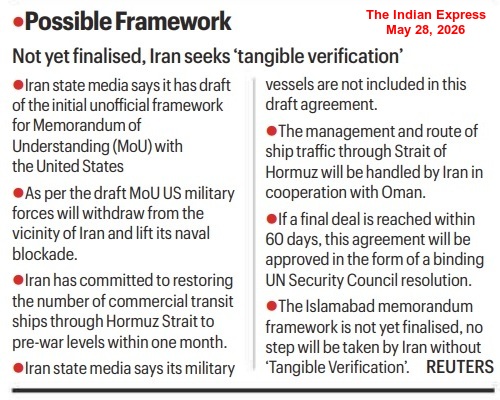
On Iran, negotiations are advancing on a prolongation of the ceasefire, although the Donald Trump Administration, yet again, launched a few air strikes on May 25, 2026 which it claimed were in “self-defence”. Diplomatic efforts continue non-stop, involving several countries in the region, as well as Pakistan, which has taken on a major role as mediator between Washington DC and Tehran. Sources privy to the negotiations have stressed the unique role of China, where the Pakistani Prime Minister just spent several days.
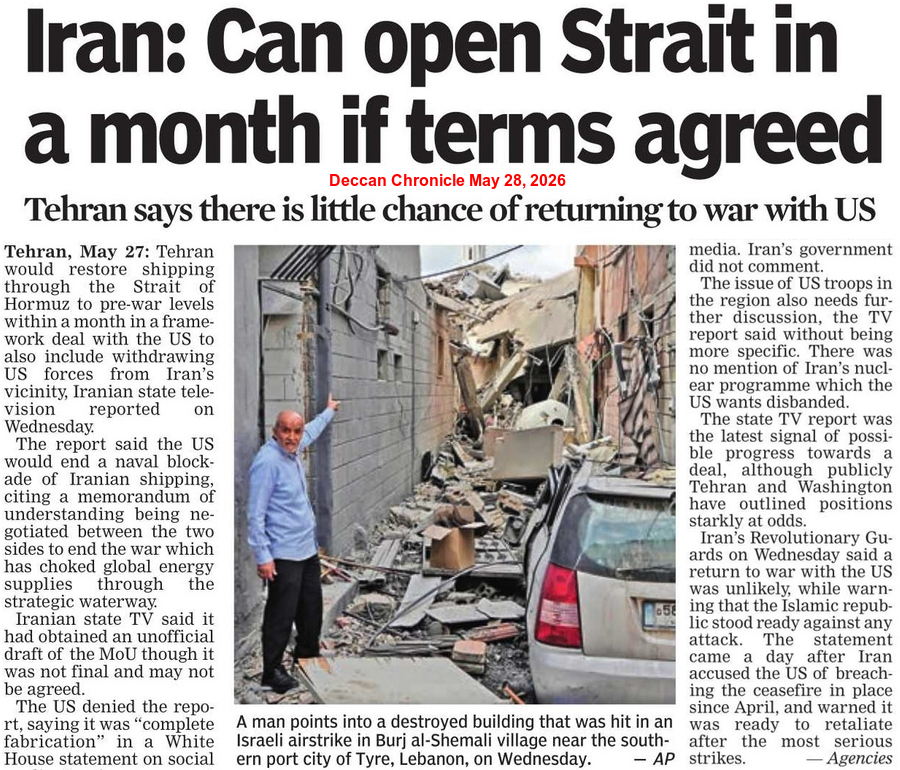
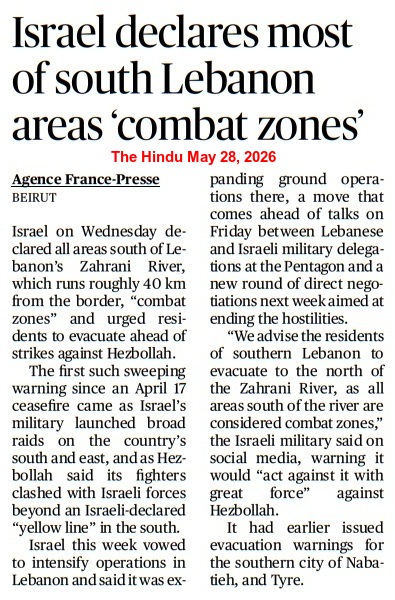
The main points under discussion concern the re-opening of the Strait of Hormuz and an extension of the ceasefire, with a potential postponement of the controversy over Iran’s nuclear programme and the release of Iranian assets frozen abroad. The crazy Israeli Government of Benjamin ‘Bibi’ Netanyahu remains firmly opposed to any ceasefire with Lebanon, which Iran insists, with Washington DC’s agreement, must be included. And Israel, as we know, has a tremendous amount of clout in the US, although it has seriously eroded since the mass killing of Palestinians in Gaza began.
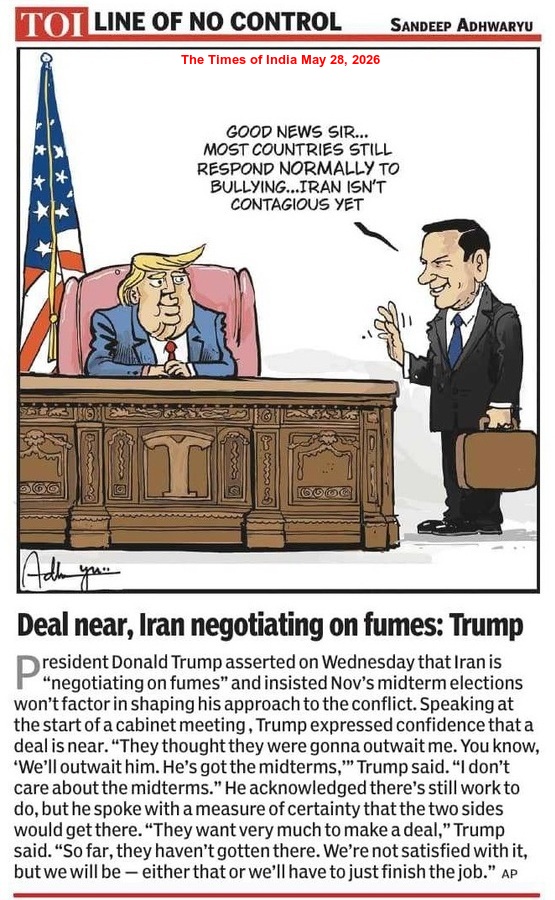
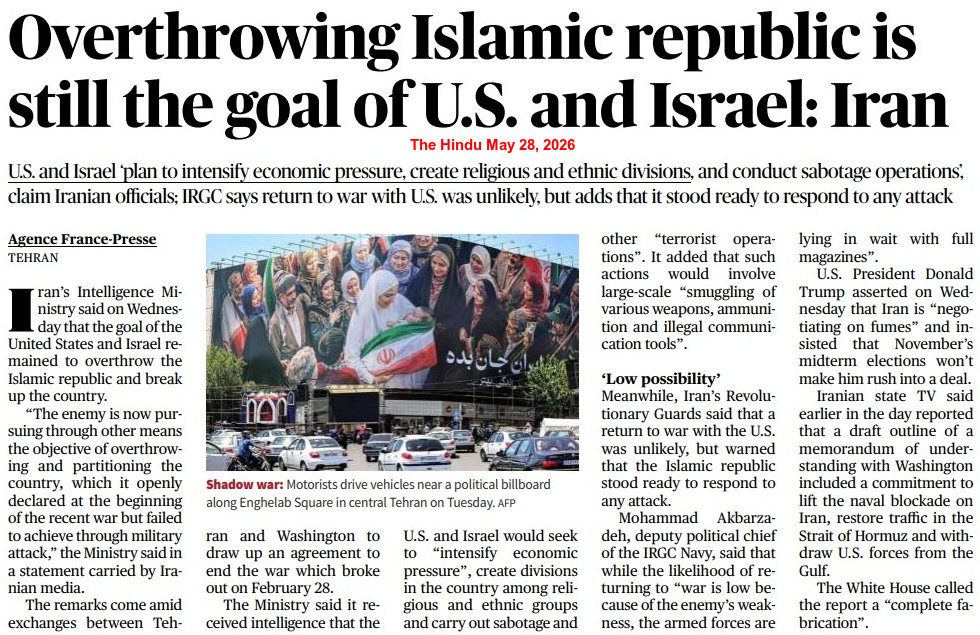
As it now stands, the US and Israel have gained nothing substantial from the illegal war of aggression they launched against Iran on February 28, 2026. As for President Trump, he needs to find a way to declare victory and end the conflict rapidly, if only for his political survival and that of his friends.
Meanwhile,
Boundless Ocean of Politics on Facebook
Boundless Ocean of Politics on Twitter
Boundless Ocean of Politics on Linkedin
Contact us: kousdas@gmail.com

 ISMC
ISMC
