

Another Strategic Blunder…
US President Donald John Trump has backed away from tough choices, yet again. Just a day before the implementation of the Lindsey O Graham Sanctioning Russia and Iran Act of 2026 Bill, he waived sanctions, restrictions and duties on goods from the five largest importers of Russian crude oil and natural gas, including India and China (if they knowingly made new purchases of Russian-origin supplies on or after October 18, 2026). Citing national interests, the President stated in an Executive Order issued on October 16 evening: “I am hereby waiving the application of such sanctions, restrictions and duties provided for in the Graham Act.”
Although President Trump’s decision has brought significant relief to India and China regarding concerns over tariffs, the majority of American lawmakers and politicians view the move simply as a defeat. Members of the opposition Democratic Party, as well as his own Republican Party, have strongly criticised the move, saying that President Trump is a puppet of his Russian counterpart Vladimir Vladimirovich Putin. Some of them are of the opinion that the US President has completely surrendered to the Kremlin.
President Trump signed the Graham Act into law on September 18, 2026 as he was all set to impose “certain sanctions with respect to foreign persons, restrictions with respect to persons, and duties with respect to goods imported into the US from Russia and some other countries”. The main objective of the relevant legislation is to reduce the financial resources available to Russia for waging the war against Ukraine, apart from exposing foreign entities that support the Russian energy sector and military operations (via Russian banks) to risk. Under the measures outlined in the Executive Order, duties on goods from Russia could have increased by 500%. The Order also provided for 100% tariffs on goods from the five largest importers of Russian crude oil and natural gas.
Senator Richard Blumenthal has lashed out at President Trump for backing out at the last minute, calling his decision “shameful and cowardly“. On X, the Senator wrote: “Donald Trump has once again confirmed that he stands with a bloodthirsty thug and those who support the Russian war machine, and against the majority of Americans, their representatives in both chambers of Congress and our European allies.” Blumenthal added: “These waivers have nothing to do with our national security, and everything to do with sucking up to Vladimir Putin. I hope my Republican colleagues will join me in condemning this craven, cowardly action.“
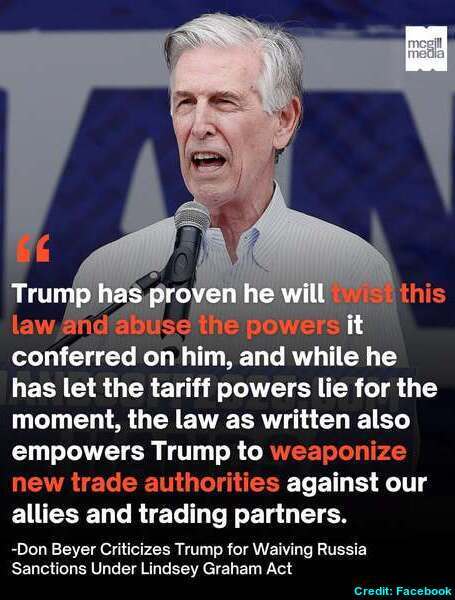
Democratic Representative Don Beyer, too, has strongly criticised the US President for waiving sanctions and tariff provisions under the Lindsey O Graham Sanctioning Russia and Iran Act of 2026, stating: “Trump’s latest surrender to Putin again betrays our Ukrainian partners and defies clear congressional intent of legislation designed to punish Russia for its illegal war of aggression.” He wrote on X: “Trump has proven he will twist this law and abuse the powers it conferred on him, and while he has let the tariff powers lie for the moment, the law as written also empowers Trump to weaponise new trade authorities against our allies and trading partners.” Beyer urged the US Congress to “fix this flawed law to stop Trump from capitulating to Putin and ensure that it truly supports Ukraine“.
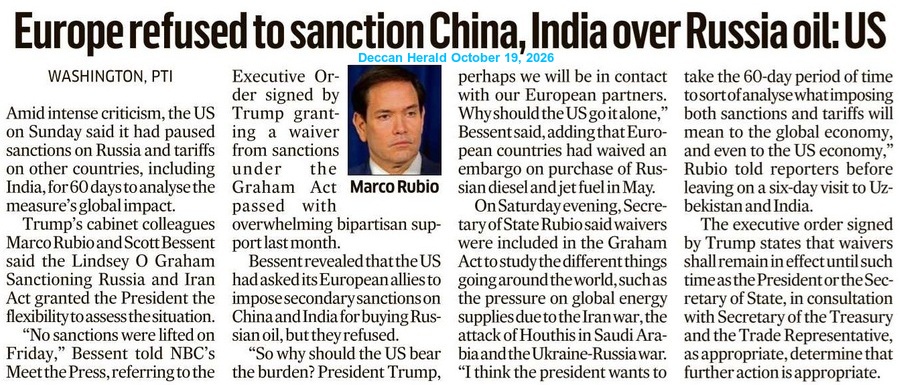
Meanwhile, a section of political analysts has claimed that the US President temporarily waived key provisions of the Graham Act. Marco Rubio, the US Secretary of State, has clearly mentioned that “President Trump wants 60 days to assess how sanctions on Russia and tariffs on countries buying its oil could affect the US and global economies“. Although the temporary waiver offers five economies some relief, Washington DC will get time to weigh its next steps. In other words, the US President’s decision has introduced a new layer of (long-term) uncertainty.
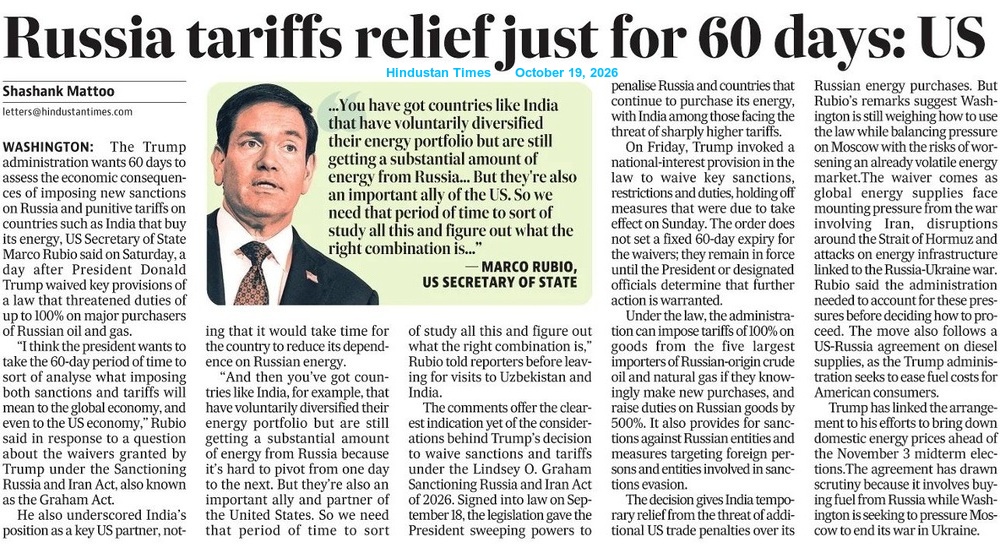
After concluding an agreement with President Putin on October 9, 2026, President Trump announced that Russia would supply over 300,000 metric tonnes (roughly 2.25 million barrels) of diesel immediately to US and global markets. As per the diesel deal between the two Presidents, Moscow would send one million metric tonnes of diesel to Washington DC in the first week of November 2026 and an additional three million metric tonnes thereafter (subject to refinery conditions).
Interestingly, lawmakers from both the Republican and Democratic Parties have been vocal in their criticism of this diesel deal, calling it “a gift to our adversary and a betrayal of our allies“. According to those lawmakers, such an agreement would not only fail to have any significant impact on global energy prices, but would, on the contrary, help Russia continue its war against Ukraine.
Meanwhile,







Boundless Ocean of Politics on Facebook
Boundless Ocean of Politics on Twitter
Boundless Ocean of Politics on Linkedin
Contact us: kousdas@gmail.com

 ISMC

