

The Staged Arrest: Prelude To A Purge?
In the early morning of October 6, 2026, a massive deployment of German Federal Police (BKA), heavily armed and masked, entered the residence of former counterintelligence (BND) head August Hanning and arrested him under the allegation of selling information to a foreign power. This was a staged event, in the strict sense of the term. The media had been informed beforehand, and the BKA agents found reporters and cameras waiting for them on site. Spiegel TV ran video footage of the action.
The operation smells of a fishing expedition. The prosecutor did not specify which foreign intelligence power the charges refer to. The agents seized 2,000 allegedly sensitive documents, which will now be screened. To have sensitive documents at home is no crime, as pointed out by Hans-Georg Maaßen, the former Head of the domestic intelligence agency BfV. Therefore, this is non-news.
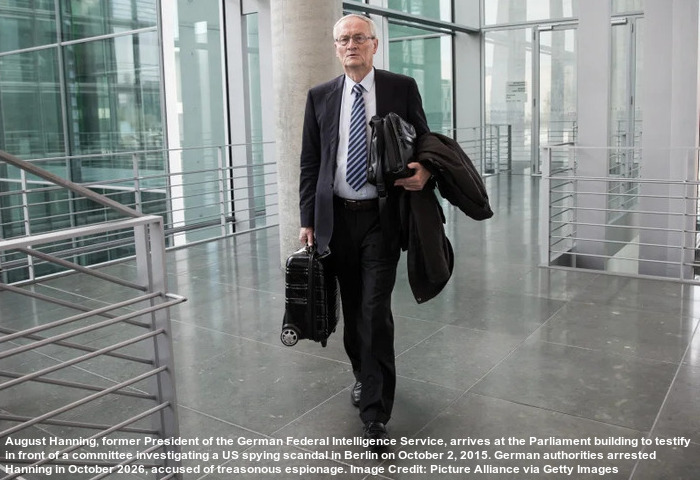
According to Die Welt, weeks before he was arrested, Hanning heard that a former intelligence agent had put together a dossier explicitly accusing him of being a Russian spy. Instead of opening an internal investigation, the BND passed the dossier directly to the State Prosecutor. Hanning wrote a furious letter to current BND Chief Martin Jäger, demanding an explanation, but received no answer. The case has reverberated internationally, with allied agencies under pressure to review their cooperation with the BND.
The Hanning case may well signal the beginning of a purge of the old BND apparatus from the Kohl/Schröder/Merkel era, for the purposes of the Joachim-Friedrich Martin Josef Merz Government’s drive to give the BND and the BfV extensive police, surveillance and covert action powers, ostensibly to better deal with Russia’s hybrid warfare against Germany. The Bundestag has just begun examining the government’s Reform Bill, which would violate the concern of the Fathers of the Constitution of keeping intelligence and police powers separate, after the experience of the Nazi Gestapo.
Hanning indeed is a veteran of the era in which German foreign policy was based on good relations with Russia. Not only was he an Undersecretary of State in the Schröder Government that built the Nord Stream, but after the sabotage of that pipeline, he was an outspoken critic of the government response to it. After the German State prosecution indicted Ukrainian citizens for the terror act, he insisted that they could not have done it without backing from the Ukrainian and Polish Governments, and demanded compensation from the latter.
Last but not the least, Hanning has been in the crosshairs of the US neocon faction since 2003, when he tried to prevent the Government of President George Walker Bush from using phony evidence to accuse Saddam Hussein of developing chemical weapons. When CIA Head George Tenet signalled that he wanted to use a BND informant, named Curveball, to support the accusation, Hanning told him that the BND considered that source to be unreliable. Eventually, Curveball did confess that he had invented his story.
This article was first published in Executive Intelligence Review (EIR) Strategic Alert weekly newsletter (Volume 40, No. 42) on October 15, 2026.
Meanwhile,



Boundless Ocean of Politics on Facebook
Boundless Ocean of Politics on Twitter
Boundless Ocean of Politics on Linkedin
Contact us: kousdas@gmail.com

 ISMC

