

The Growing Assertion Of Global South
Trickiness or deception is a common perception of diplomacy. Hence, it can be said that the 18th BRICS Summit held in the Indian capital of New Delhi on September 12-13, 2026 set a successful example of diplomacy. Indian diplomats deserve a special credit for the New Delhi Declaration adopted at the conclusion of the Summit. With representatives from 11 countries taking part in the Summit, the bloc of major emerging economies and developing countries (Brazil, Russia, India, China, South Africa, Egypt, Ethiopia, Iran, Saudi Arabia, the United Arab Emirates and Indonesia) seemed to attain a sense of mature responsibility.
In 2026, the BRICS faces multifaceted challenges, such as the rampant tariff threats from the US, direct US sanctions imposed against two member-countries (Russia and Iran), India-China tensions, and the deteriorating ties between Iran and Arab nations. Only diplomats know just how difficult it is to craft a unified diplomatic statement while balancing so many different sensitive geopolitical aspects.
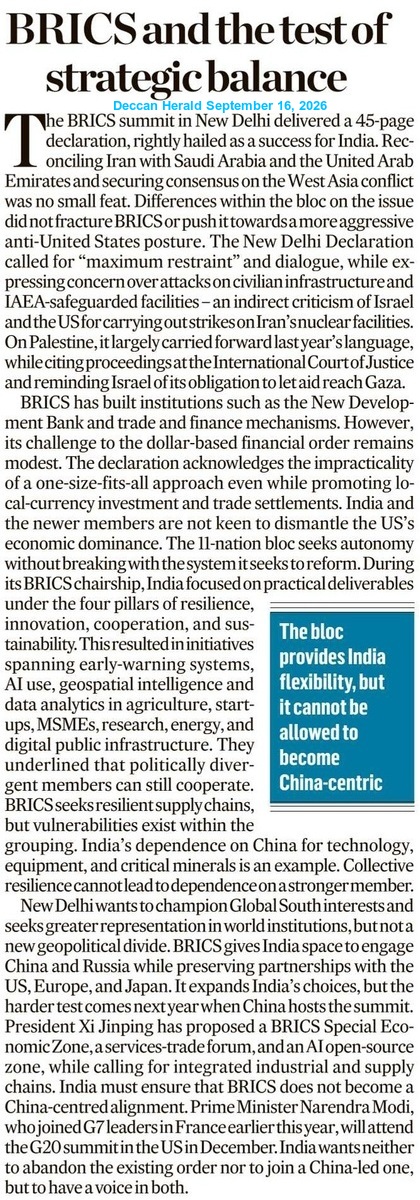
India, as the host nation, ultimately achieved success that is far more significant than the mere adoption of a declaration. It has become possible as the importance of the post-colonial nations of Asia, Africa and Latin America – collectively known as the Global South – has already been recognised across the world. Although China holds primary importance, the Asian Giant is not the only one. There is no room for doubt about how important Arab nations are to Europe and the US. It is also difficult for the Western World to ignore India and its vast market. The successful conclusion of the BRICS Summit has conveyed a defiant message from the Global South to the condescending attitude of advanced Western powers. This development is of immense geopolitical significance.
It is necessary to specifically mention US President Donald John Trump‘s worldview in this context. He has repeatedly warned that Washington DC will raise tariffs by up to 100%, if any alternative bloc proposes using a currency other than the US Dollar for foreign trade. During the BRICS Summit, India’s effort to maintain a balance is particularly noteworthy, with External Affairs Minister Dr Subrahmanyam Jaishankar announcing that “there is no need for any decision regarding a separate currency right now“.
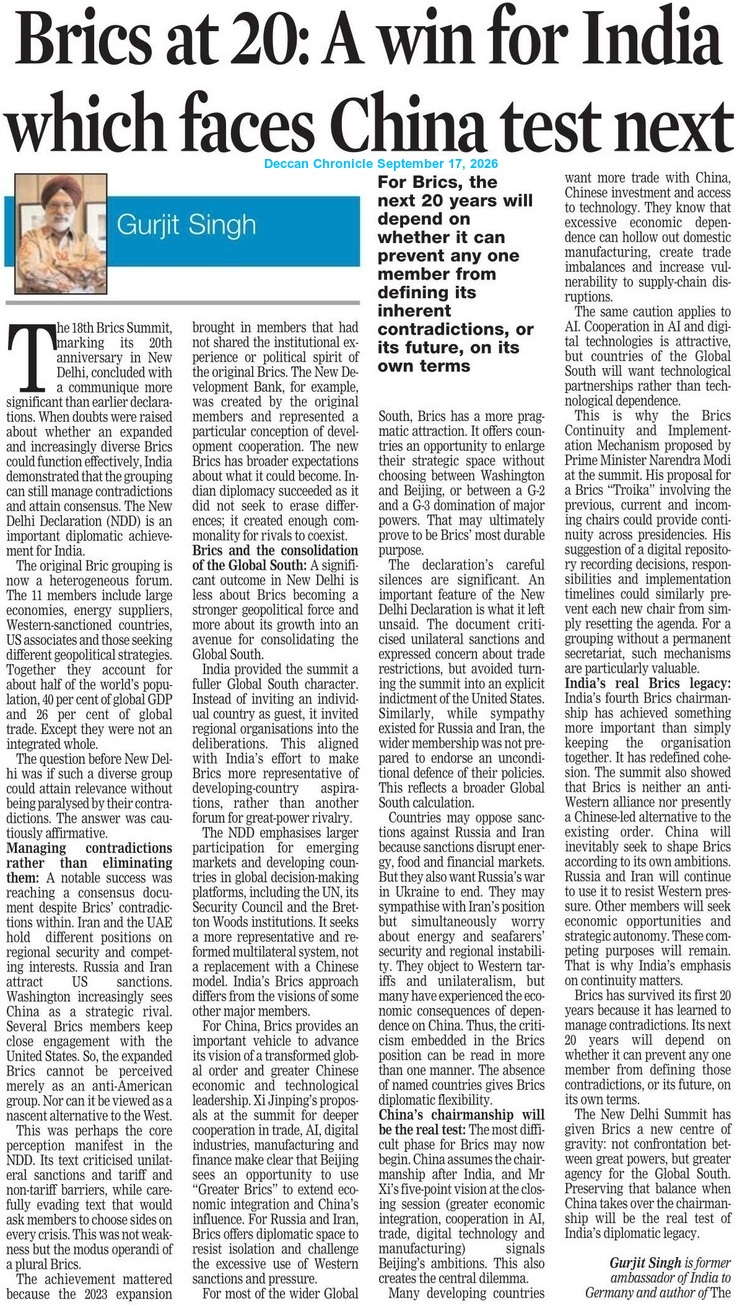
In reality, the task of maintaining balance is not at all easy. It is essential to bring significant diversification to foreign trade. It is also a fact that there is no justification for taking undue risks to achieve diversification. The progress has already been made regarding the terms and conditions for lending, as well as borrowing, by the New Development Bank, creating an opportunity for countries in Africa, Asia and Latin America. It was unimaginable until recently. The BRICS Summit 2026 demonstrates that the recognition and importance of the Global South have been firmly established.
This balancing act was also evident on the Palestine issue as the member-countries used strong, unanimous language on Palestinian Rights while maintaining consensus (among them) with contrasting foreign policy alignments. The BRICS New Delhi Declaration officially reaffirmed the bloc’s support for a sovereign, independent Palestinian State and its full UN membership based on the 1967 borders. The Declaration explicitly opposed the forced displacement of Palestinians and called for unhindered humanitarian aid. The BRICS used explicit and critical language regarding Israeli actions in Gaza and the wider region, apart from expressing deep concern over the humanitarian crisis.
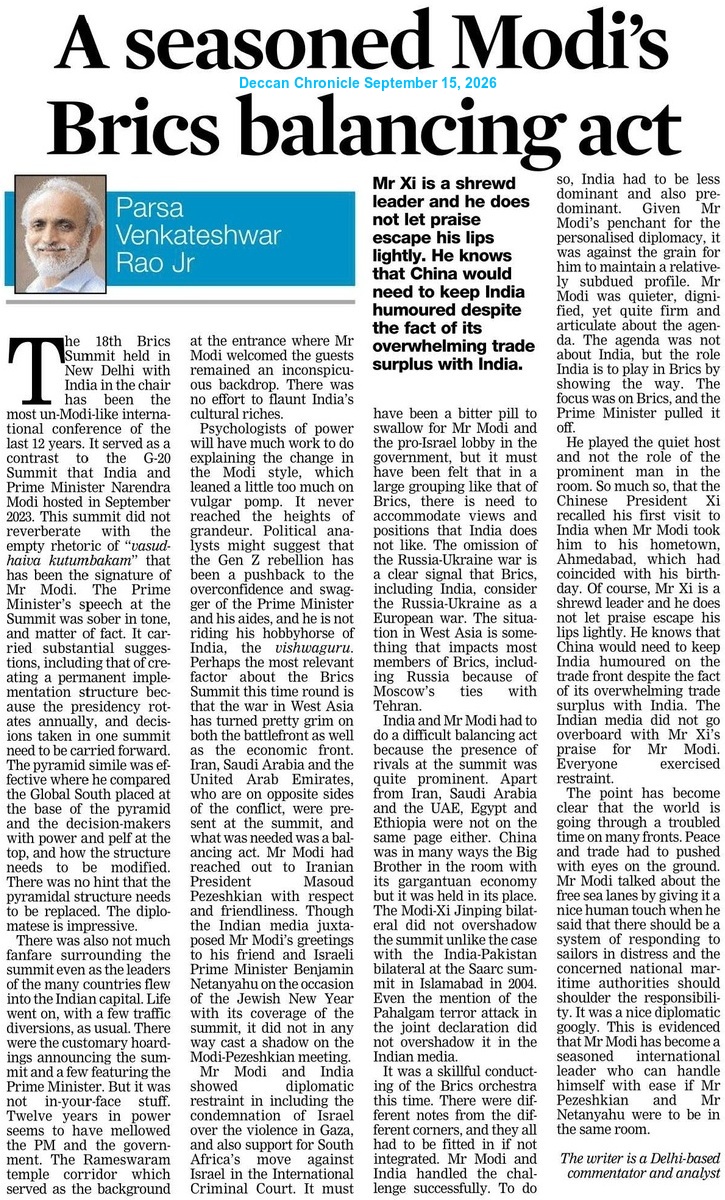
If one strongly protests someone’s actions without explicitly mentioning her/his name, it certainly carries some significance. It is also a part of diplomacy. In India, various political circles have forgotten New Delhi’s traditional position on Palestine and started expressing various contradictory views. Although the BRICS Summit is an international forum, one can assume that it has, and will continue to have, some alignment with national agendas of the participating countries.
Meanwhile,

Boundless Ocean of Politics on Facebook
Boundless Ocean of Politics on Twitter
Boundless Ocean of Politics on Linkedin
Contact us: kousdas@gmail.com

 ISMC
ISMC
