

Indian Foreign Policy Needs A Rejig
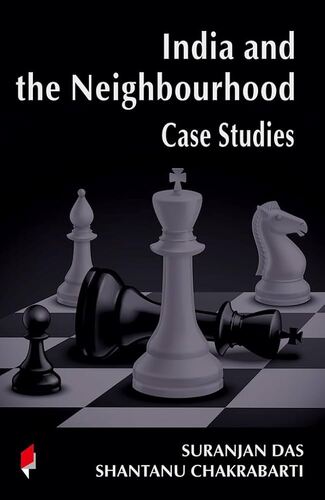
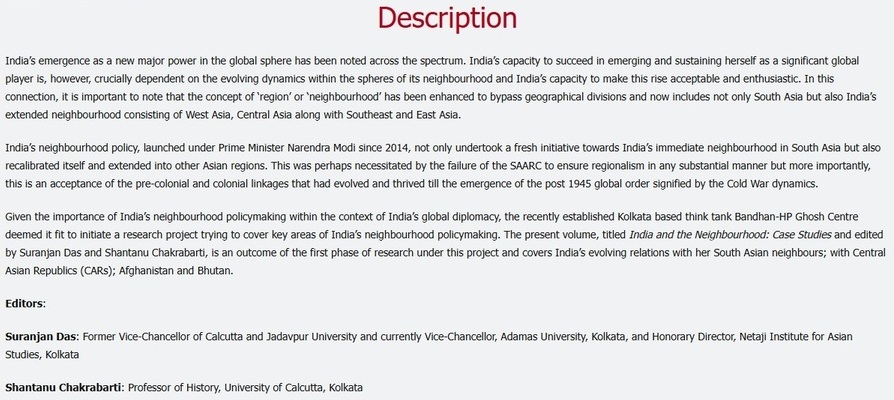
India and the Neighbourhood: Case Studies, the recently published book co-edited by Suranjan Das and Santanu Chakraborty, is a much-needed addition to the analysis of South Asian politics. This publication deals mainly with case studies of India and two of its neighbours. Through various chapters, the authors have shown that the Indian foreign policy has evolved in a certain pattern since the Cold War.
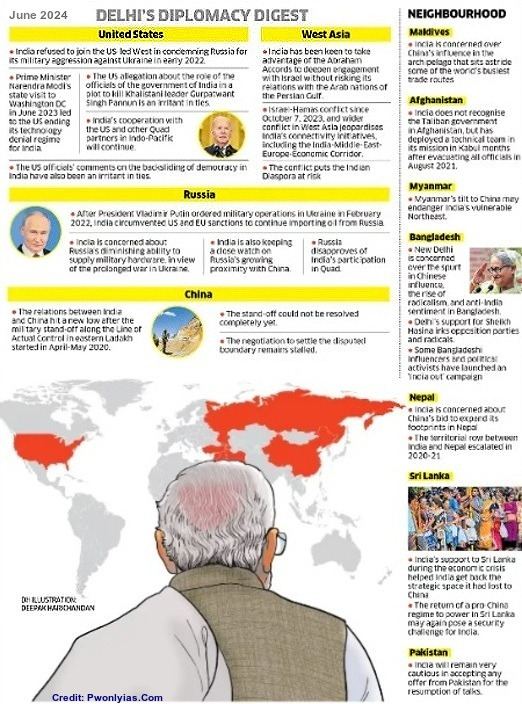
India remains steadfast in its ambition to retain regional leadership in spite of facing challenges posed by external pressures and internal miscalculations. However, the growing influence of China and the current political instability in South Asia have triggered disputes regarding India’s relationships with neighbouring Pakistan and Bangladesh. New Delhi needs to restore relations with neighbours, exploit historical civilisational ties, promote regional economic cooperation at any cost, play an active role in regional organisations and emphasise legitimate leadership, rather than mere regional oversight, on an urgent basis.
The Indian foreign policy has long emphasised its regional priorities. A proper understanding of the Indian Subcontinent and its adjacent regions, as well as appropriate policy making, is crucial for increasing regional and global influence. Unfortunately, lack of rapport with neighbouring countries often creates trouble for the Indian (Subcontinent-centric) foreign policy, limiting New Delhi’s ability to deal with larger regional and global issues. During the Prime Ministership of Narendra Modi, India has adopted a new policy to revive diplomatic and economic ties with the neighbouring countries. India is making a serious attempt to counter the Chinese influence in Asia by strengthening ties with all its neighbours, especially Bhutan. India also needs to restore ties with Afghanistan in spite of the return of the Taliban in Kabul.
Energy security is another key component of India’s foreign policy. As the demand for energy would increase with India’s economic development, the South Asian nation has started making a serious attempt to boost ties with Central Asian countries. India requires support from those countries to play a lead role in representing the Global South in various multilateral fora, such as the UN Security Council, the World Trade Organisation (WTO) and the International Monetary Fund (IMF). Membership of various regional and sub-regional organisations, too, is quite important for a country, like India. Engaging with such organisations adds a regional, as well as sub-regional, dimension to bilateral ties, apart from helping understand the regions holistically. The rich cultural and historical connection of India with its neighbours makes it a soft power that serves as one of the cornerstones of Indian diplomacy. New Delhi is keen to strengthen bilateral and multilateral diplomatic relations by promoting people-to-people ties with a special emphasis on history, heritage and cultural exchange.
The foreign policy of great powers has taken a decidedly civilisational turn in the 21st Century. India can reap the benefits of its global image, if neighbouring countries present it in a proper manner at the world stage. Despite being an ancient civilisation and a contemporary world power, India faces one of its most important foreign policy challenges in maintaining cordial ties with neighbours. Authors of this book believe that the main objective of Indian foreign policy is to increase the country’s global influence and to play a leadership role in Asia.
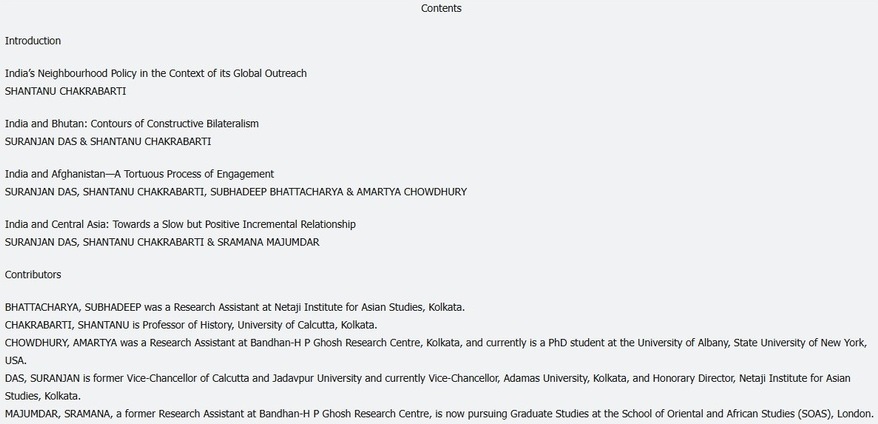
All the chapters of this publication focus mainly on India’s South Asia Policy, relations with Bhutan and Afghanistan, and interactions with Central Asia. Although the book has no conclusion, the chapters have broadly discussed seven important points. The authors have emphasised on India’s historical and cultural links with various countries, as well as regions, mentioning that New Delhi seeks to restore those ties keeping in mind the changing global geopolitical circumstances. Secondly, they have made strong arguments in favour of institutionalisation and a regional perspective in order to understand India’s multifaceted regional constraints and challenges.
Thirdly, the authors have suggested that the best way forward for India is to prioritise joint efforts and to play a more active role in ensuring regional peace while dealing with various issues, such as the militarisation of Afghanistan, the increasingly meddlesome Chinese presence in its neighbourhood, the overall complexity of Asian geopolitics and the growing military competition among the Asian countries. Fourthly, they have advised India to play a constructive role through active participation in the newly-created institutions in different regions.
Fifthly, the authors have argued against interpreting trends in foreign policy-making solely in terms of military strength, although all the chapters have dealt with contemporary military and strategic challenges quite seriously. Authors have relentlessly reminded readers that India needs to sensibly blend elements of power, both military and civil, to realise its diverse national interests. Sixthly, the authors have called for India to take the lead in humanising its foreign policy by recognising human security, and issues related to economy and climate. All these issues can be solved in a collective manner, although the task is a difficult and problematic one. The authors have warned that if aimless geopolitical competition overwhelms the Politics of Cooperation, then it would certainly create a massive economic, as well as environmental, crisis.
Finally, the publication has explained how China has emerged as a major challenge to India’s national interests in every region bordering the South Asian nation. As the two editors are noted historians, they have repeatedly reminded the readers that the Silk Route had flourished in this region once upon a time! Also, the diversity of cultural interactions has enriched the people of Asia in different ways. The book has further highlighted the importance of an Asian alliance in the changing world.
It may be difficult for the geostrategic analysts to accept the arguments of the authors of this book. However, one has to keep in mind that geopolitical conflict does not arise automatically. The international community is currently witnessing violence and bloodshed in different parts of the globe. In such a situation, this publication on foreign policy argues in favour of regionalism, humanitarianism, the rediscovery of historical continuity and cultural cooperation. This effort deserves credit for the novelty of the argument and also for giving inescapable importance to morality.
Boundless Ocean of Politics on Facebook
Boundless Ocean of Politics on Twitter
Boundless Ocean of Politics on Linkedin
Contact: kousdas@gmail.com

 ISMC
ISMC Boundless Ocean Of Politics