

Football & The Language Of Geopolitics
It is unethical to forge ahead – whether individually or collectively – in pursuit of opportunity by overstepping boundaries. In terms of football, such an act is called offside. The offside rule actually existed in football well before the founding of FIFA in 1904. The very first official offside laws were included in the original The Football Association Laws of the Game in 1863. The rule is a staple of the IFAB Laws of the Game (specifically Law 11). However, there have been even more offside situations off the field than on it. Infiltration, or unauthorised border crossing, is a perennial international issue and heavily governed by both sovereign domestic laws and international frameworks in order to balance a nation’s security with global Human Rights. Yet, prominent statesmen have always disregarded those rules for their own convenience.
Benito Mussolini reportedly granted Italian citizenship to infiltrators from Argentina as a gesture of favour. According to experts, while Mussolini’s regime actively cultivated political support among the Italian diaspora in Argentina (the Fasci all’Estero), the granting of citizenship during that era was firmly rooted in Italy’s strict, preexisting bloodline laws (the jus sanguinis of the 1865 Civil Code). Beyond the success in football, the deepest objective of the dictator was to set a precedent for all-round development under a capable leader.
Mussolini even had the World Cup format changed for his vested interest. Alongside the Jules Rimet Cup, he added the Copa del Duce – a symbol of arrogance as he commissioned the massive Coppa del Duce (six times larger than the official FIFA World Cup trophy) to ensure he could personally glorify his Fascist Regime alongside the official tournament in 1934. The Copa del Duce was a direct symbol of authoritarian hubris, emphasising his Win or Die mandate for the Italian national team to project an image of a superior, modernised Italy.
The sport began as chaotic, localised mob football with nearly no rules or referees in the early 19th Century. Factory workers playing football for commercial establishments became common in the mid-to-late 19th Century. Following the Factory Act of 1850, workers gained designated leisure time on Saturday afternoons, prompting mill, railway and factory owners to sponsor sporting activities in order to boost morale, curb drinking and prevent industrial unrest.
The landscape completely transformed in 1863 when the English Football Association codified the first standardised rules, paving the way for modern teams, players and professional leagues. Since then, football has been all about sportswashing for hosts, officials and players. Italian athletes famously made headlines by singing The Red Flag (known in Italian as Bandiera Rossa) at the 1920 Antwerp Summer Olympics. The Italians also sang Giovinezza (the official youth and party anthem of the National Fascist Party) at the 1934 FIFA World Cup. It may be noted that Giovinezza was played at pre-match ceremonies and also during trophy presentations, with Mussolini recognising the World Cup as a massive international propaganda opportunity to project the power and perceived superiority of the Fascist Regime.
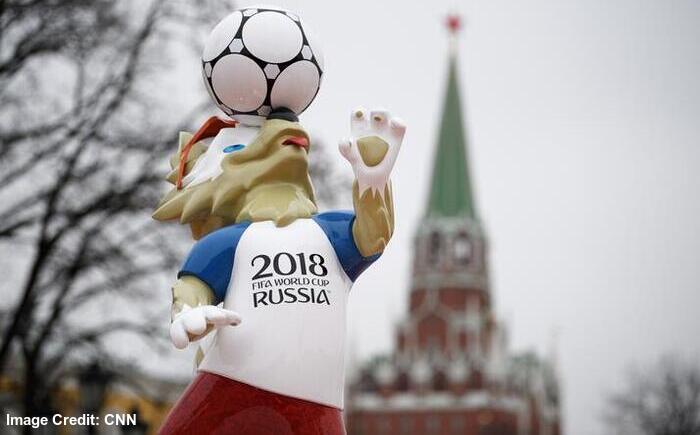
Football has gradually transitioned from an amateur pastime into a multi-billion-dollar global industry. Today, being a professional player involves written contracts, daily training with sports scientists and navigating a massive corporate ecosystem. However, the obsession of the organiser (the host nation or the ruler) has not changed a bit. The 2018 FIFA World Cup in Russia is widely characterised as a modern application of the Roman bread and circuses (panem et circenses) philosophy, where massive government spending provided a grand distraction (circuses), but failed to provide citizens with underlying economic stability (bread). Investigations by international organisations confirmed that labourers constructing 2018 World Cup venues faced severe Human Rights abuses, such as unpaid or delayed wages, life-threatening working conditions in extreme weather and forced labour involving North Korean workers.
Migrant workers faced exploitation during the 2022 Qatar World Cup, as well. Despite some initial labour reforms by the Qatari Government, migrants who built and serviced the 2022 FIFA World Cup infrastructure experienced severe, systemic abuses. Bans were imposed on the OneLove armband, the rainbow flag, and even the attire of female spectators.
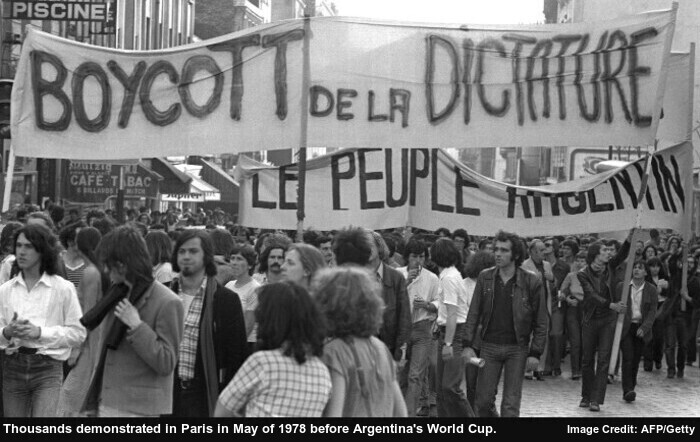
The 1978 FIFA World Cup in Argentina, too, is widely considered one of the most controversial events in sports history. Hosted during a brutal military dictatorship led by General Jorge Rafael Videla, the tournament is heavily criticised for being used as a propaganda tool to whitewash severe Human Rights abuses and state-sponsored terror. The Military Junta eliminated countless leftists, intellectuals, journalists and ordinary people in 1978. Indiscriminate torture took place in various concentration camps, as well. In his 2023 publication Nation Branding and Sports Diplomacy, Yoav Dubinsky mentioned that the intersection of football and geopolitics is a well-documented phenomenon where mega-events serve as powerful instruments for soft power. From hosting tournaments to easing bilateral tensions, the sport has continually been leveraged to alter international perceptions and polish a nation’s image on the global stage.
While the motto of the Olympics is Faster, Higher, Stronger – Together, the motto of the FIFA World Cup is Football Unites the World. However, the host nations have always used the World Cup as soft power. In the post-festival phase, the event often serves as a pinnacle of human welfare by channelling the unified spirit and resources from the festival. Just 10 days before the 1968 Mexico Olympics, the Tlatelolco Massacre took place in the Plaza de las Tres Culturas of Mexico City on October 2, 1968. Mexico failed to restore its global image through the Greatest Show on Earth and had to wait till the 1986 FIFA World Cup for that.
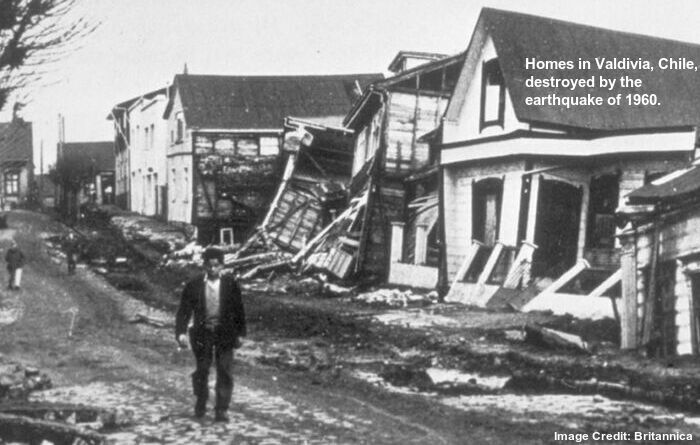
The FIFA World Cup has historically served as a powerful catalyst for socio-psychological recovery and national unity, as the tournament drives tangible reconstruction, foreign investment and economic momentum for disaster-stricken or developing nations. The 1962 FIFA World Cup became a symbol of national resilience for Chile following the devastating 1960 Valdivia earthquake. Despite widespread destruction and immense loss of life, tournament organiser Carlos Dittborn famously declared: “Because we have nothing, we will do everything.“
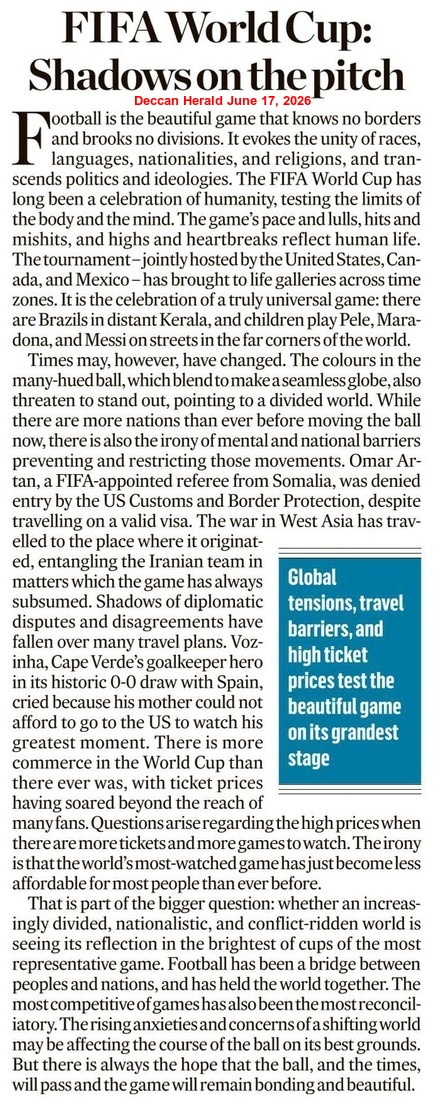
Yet, football’s universal language and minimal equipment requirements create an unmatched equaliser. It transcends barriers of religion and race, unites disparate communities and champions fundamental Human Rights. According to UEFA, the ultimate utility of football lies in requiring nothing more than a ball, making it accessible to anyone, anywhere. Unfortunately, football is frequently utilised as an extension of global politics, acting as a geopolitical arena where state powers project influence and resolve. Perhaps, FIFA is helpless in the face of the politics of discrimination. Human Rights organisations, fans and activists argue that FIFA frequently compromises its own anti-discrimination policies to appease powerful political hosts. They believe FIFA’s calculated approach to governance has inherently politicised modern football, transforming the sport into a high-stakes diplomatic landscape.
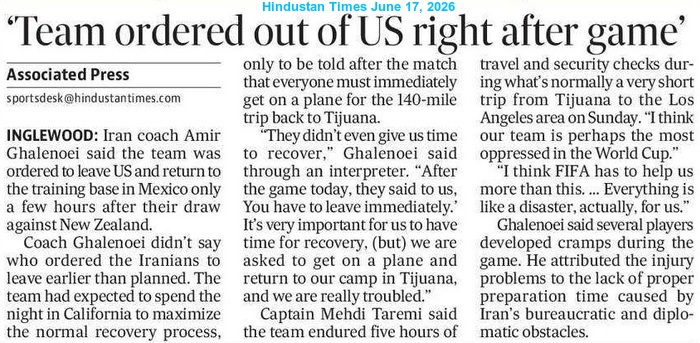
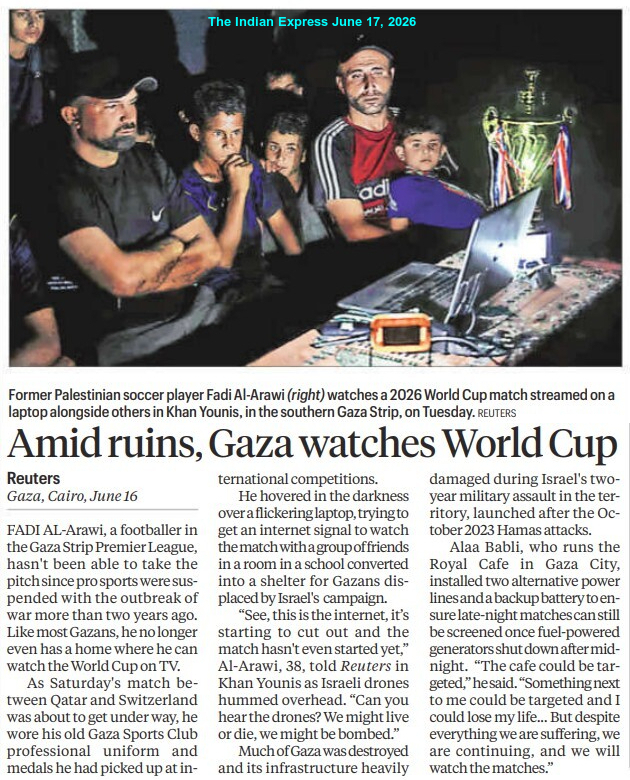
Football has evolved far beyond a game and a cultural cornerstone; it now operates as a powerful mechanism for reconciliation, conflict resolution and compromise. The 21st Century world is navigating a turbulent period. The children, who have survived in Gaza so far, want to play football. FIFA could have formed a refugee team as the sport has the unique power to bring people together in a shared emotion. Jules Rimet, the visionary who founded the FIFA World Cup as its third president, used to believe that the sport could bridge cultural, religious and class divides. By bringing nations together on the football pitch rather than the battlefield, he championed an expanding global civilisation defined by solidarity, peace and mutual understanding.
While FIFA has certainly become far more astute in terms of power, excellence and strategy over the past 122 years, it must rise above petty politics to truly fulfil its role as the unofficial arbiter of the world’s most popular sport.
Meanwhile,
Boundless Ocean of Politics on Facebook
Boundless Ocean of Politics on Twitter
Boundless Ocean of Politics on Linkedin
Contact us: kousdas@gmail.com

 ISMC
ISMC
