

Indian Prime Minister’s Media Panic
Asking questions is the driving force behind the role of the media as the watchdog of a society. By interrogating facts, policies and power, journalists translate complex issues into public understanding and hold democratically-elected leaders accountable. Unfortunately, the Indian media have never got an opportunity to ask tough questions to Prime Minister Narendra Modi, who has set a dubious record of never holding an open press conference or taking direct, unfiltered questions from the press.
It is not that Prime Minister Modi is an introvert; rather, he speaks a bit too much. Political analysts frequently describe him as an ambivert. His public communication strategy defines his political style, marked by a high frequency of speeches and curated direct addresses. He consistently addresses the nation on diverse issues, balancing extensive oratorical frequency with highly controlled, scripted interactions. The Indian Prime Minister’s ability to captivate audiences stems from a highly tailored communication style that blends storytelling, strategic pauses and relatable, localised language. Hence, he can easily influence public perception and mobilise the mass. A significant majority of Indians believe their country is making steady economic progress and this sentiment is largely tied to the leadership of Prime Minister Modi.
The Indians often overlook the harsh reality – a large segment of the population grapples with precarious livelihoods, uneven employment and the disproportionate impact of price pressures. In India, a large number of farmers commit suicide every year after failing to secure fair prices for fertiliser, while the small and medium-sized industries often collapse because of the turbulent market situation. People dangerously forget that India’s enduring resilience lies in its harmonious chorus of diversity, where pluralism and a multiplicity of voices act as the ultimate stabilising force, even amidst upheavals. It is because Prime Minister Modi’s confident body language and oratorical skills allow him to command massive public trust and project an image of his decisive, transformational leadership.
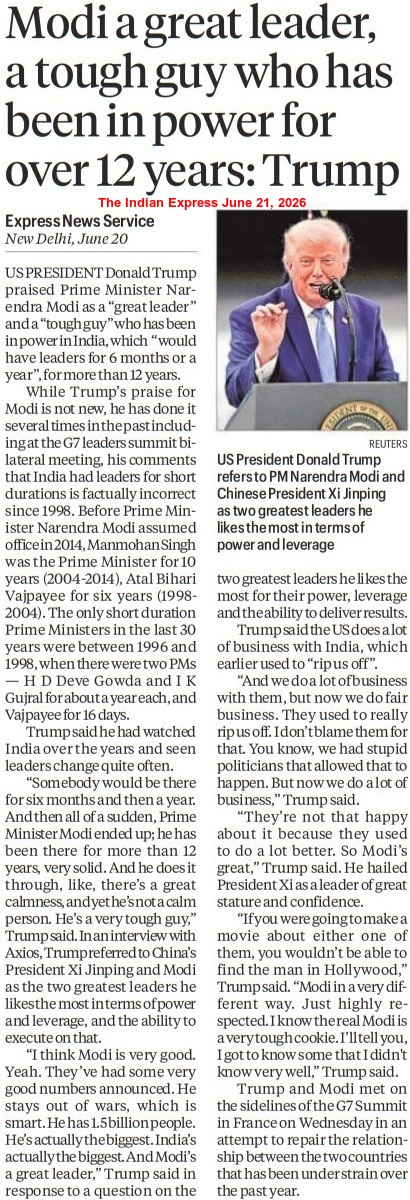
His predecessor, Atal Bihari Vajpayee (December 25, 1924 – August 16, 2018), was also an extraordinary orator. His speeches were masterpieces of oratory, celebrated for their poetic cadence, profound metaphors and ability to bridge deep political divides. Vajpayee, the 10th Prime Minister of India, seamlessly integrated the soul of a poet into the pragmatism of a statesman. He used to address the root of complex problems and try to find a common ground. On the other hand, Modi’s speeches connect his actions directly with the public mainly because of his conversational delivery, emotive storytelling and use of local idioms. By blending personal anecdotes with interactive elements, such as engaging the crowd directly, he creates a highly intimate and impactful communication style.
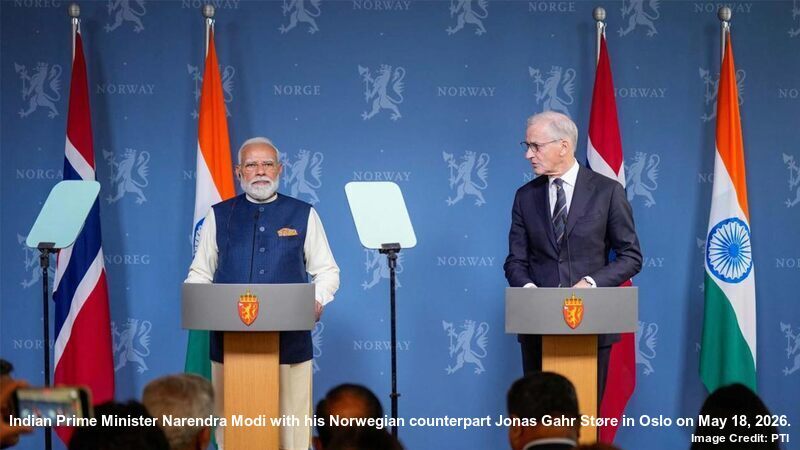
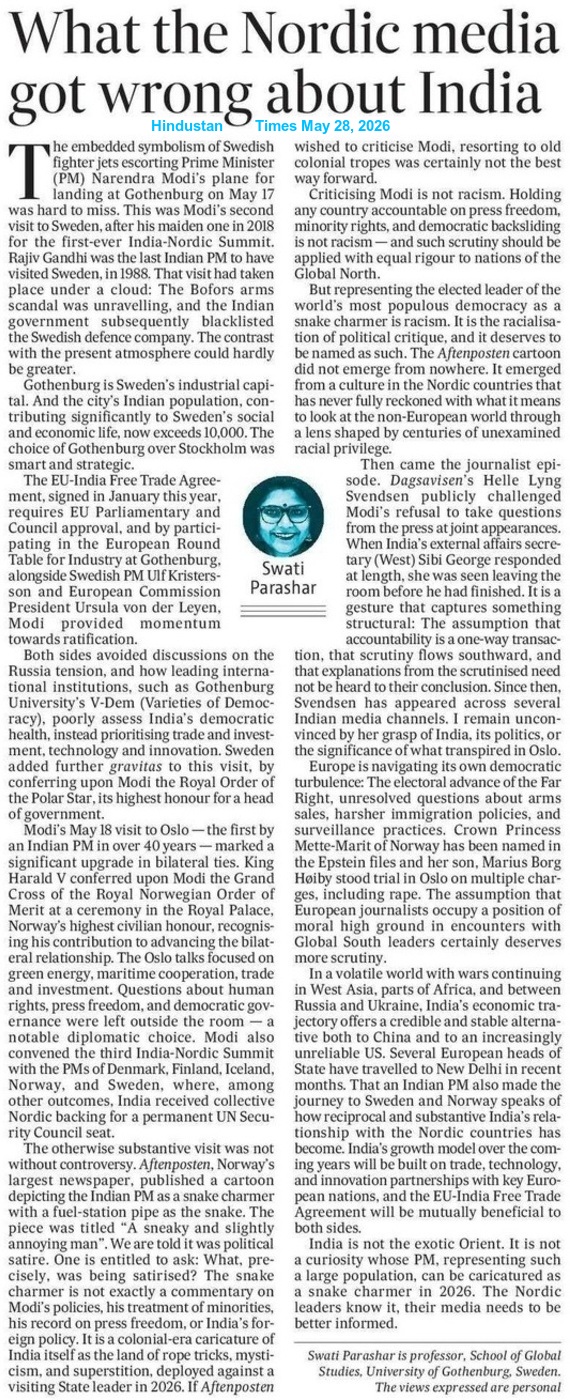
Interestingly, Modi is not interested in exchanging views with the media. He is comfortable answering only those questions that will not shake his image or cause him discomfort. Indian journalists are well aware that their Prime Minister does not hold press conferences. The matter recently came under international scrutiny thanks to Helle Lyng Svendsen, a journalist from the Norwegian newspaper Dagsavisen. Svendsen made global headlines during Prime Minister Modi’s state visit to Oslo on May 18-19, 2026. As the Indian and Norwegian leaders wrapped up a joint press conference, the journalist shouted: “Why don’t you take some questions from the freest press in the world?” Modi’s silence in Oslo prompted the Indian Ministry of External Affairs to present a detailed account of the South Asian country’s constitutional values, pluralism, Human Rights record and democracy.
In his 2005 Nobel Lecture titled Art, Truth & Politics, Harold Pinter, an English playwright, screenwriter, director and actor, read an excerpt from an essay he had penned in 1958, stating: “There are no hard distinctions between what is real and what is unreal, nor between what is true and what is false. A thing is not necessarily either true or false; it can be both true and false.” He explained that truth in drama is inherently ambiguous and perpetually elusive, making the search for it more important than nailing down a single, objective fact. Conversely, Pinter argued that this artistic ambiguity could not apply to the real world. As a citizen, he declared it a mandatory obligation to ask objective questions: What is true? What is false? Pinter’s lecture famously pivoted into a searing, uncompromising critique of political rhetoric, specifically targeting the justifications used by the US and the UK for the invasion of Iraq. He argued that politicians manipulate truth to maintain power.
While authors and artists often express internal truths or entertain people through their works (fictions or imaginations), the core duty of journalists is to uncover and report objective reality. Journalists hold a fundamental right and democratic responsibility to question those in power. Acting as the vital watchdog for the public, a free press enables accountability and provides a platform to expose systemic failures, apart from amplifying the needs and aspirations of citizens.
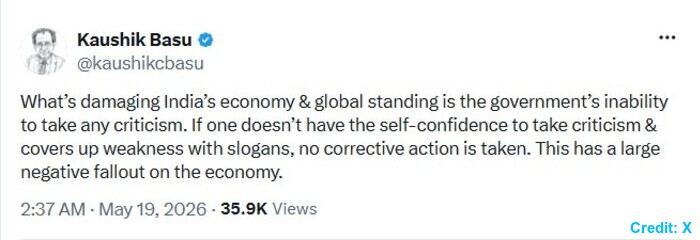
After the Oslo incident, Economist Kaushik Basu said: “What’s damaging India’s economy and global standing is the government’s inability to take any criticism. If one does not have the self-confidence to take criticism and covers up weakness with slogans, no corrective action is taken. This has a large negative fallout on the economy.“
Prime Minister Modi has declared that his government’s vision of reaching the last person relies on the principle of Antyodaya (lifting the weakest and poorest) through a saturation approach, aiming for 100% coverage of eligible beneficiaries without discrimination or leakages. At the same time, it is worth keeping in mind that the person in the back is not merely a recipient; s/he, too, has the right to have her/his questions answered.
Meanwhile,
Boundless Ocean of Politics on Facebook
Boundless Ocean of Politics on Twitter
Boundless Ocean of Politics on Linkedin
Contact us: kousdas@gmail.com

 ISMC
ISMC
