

Beyond Black ‘N’ White
Maintaining a diplomatic balance is widely considered a difficult, often precarious, task. However, it has become quite crucial for India to somehow maintain cordial relations with both Iran and the US while navigating an assertive China. This strategy, often described as strategic autonomy or multi-alignment, would allow the South Asian nation to pursue its national interests, such as securing discounted energy and defence supplies, without becoming a junior partner to any single superpower.
The way a section of Iranian society, especially women, have risen their voice against the conservative fundamentalist regime of Ayatollah Ali Hosseini Khamenei is unprecedented in recent times. The uprising is widely regarded as one of the most significant challenges to the Islamic Republic, as well. Since the fundamentalist force brought an end to the rule of Mohammad Reza Shah Pahlavi through the 1979 Islamic Revolution, the Nezam (the National Government of Iran) has created a suffocating atmosphere in the West Asian nation by curbing democratic rights and freedom of women.
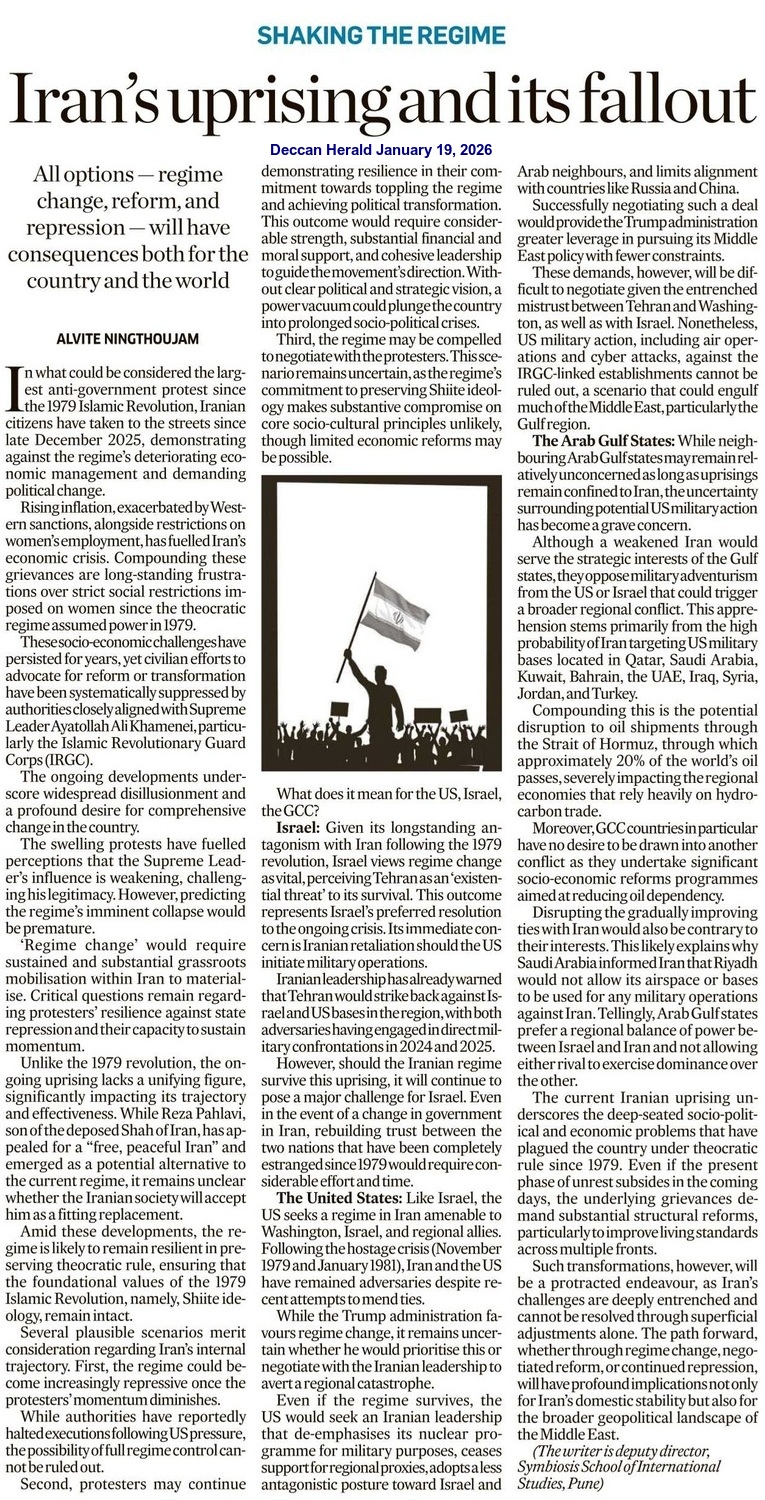
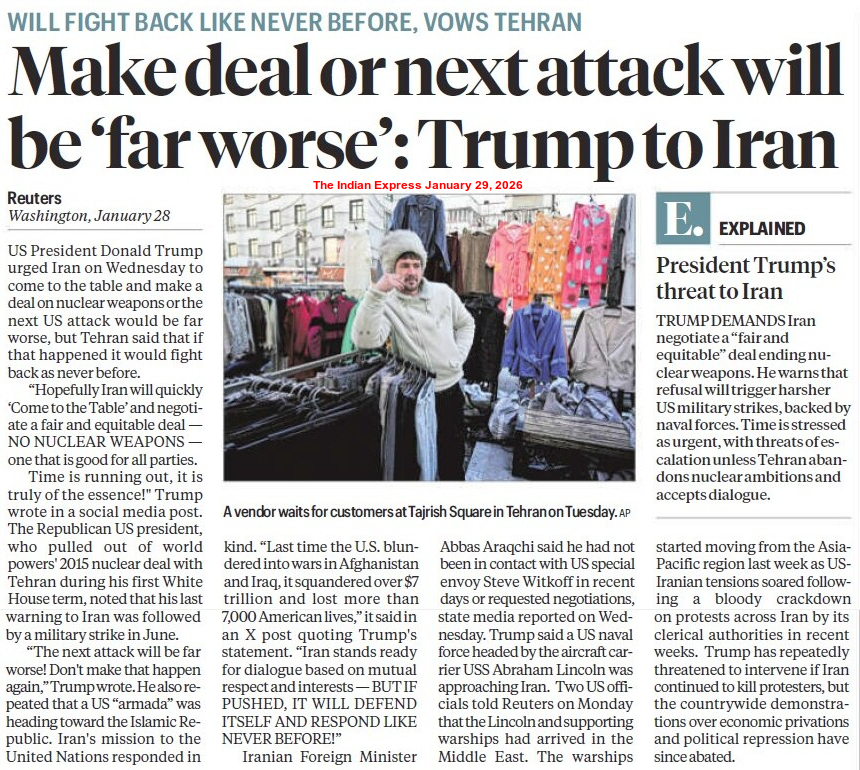
Naturally, the question arises here: Whether a country, like India that is constitutionally defined as a Secular and Democratic Republic, has any moral responsibilities to criticise the Islamic Republic during this historic period of social upheaval? Indeed, it is a subject of intense debate, involving a conflict between normative international ethics (values-based) and realpolitik (interest-based foreign policy). The US and its Western allies strongly back the Iranian protesters, with President Donald John Trump assuring that he will send aid to Tehran. In such a scenario, siding with the Iranian State would be a risky move for India. The current political, as well as security, landscape in South Asia has prompted India to maintain cordial diplomatic ties with the US, although President Trump’s tariff policies have put New Delhi at disadvantage to peers.
On the other hand, the India-Iran equation holds a great importance for both countries. It may be noted that this relationship is a cornerstone of New Delhi’s Act West policy that is deeply rooted in shared civilisational history, cultural ties, and crucial strategic, economic and security interests. Despite external pressures (such as US sanctions) and shifting regional dynamics, both India and Iran maintain a “pragmatic and multifaceted engagement” to leverage their mutual, and at times indispensable, partnership.
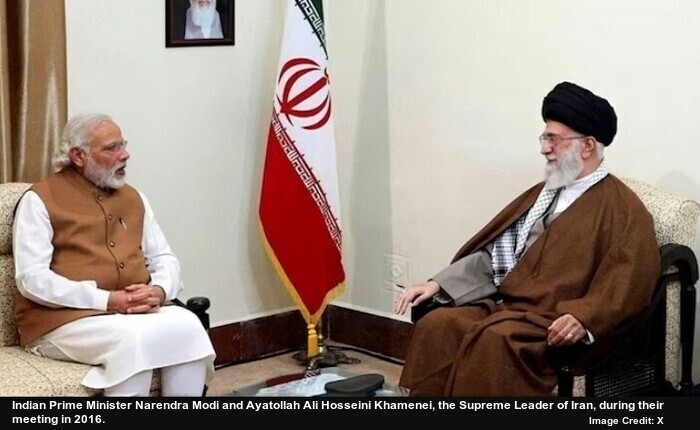
Interestingly, the foundation of India-Iran relations has not been based on ideology since the Islamic Revolution. Had bilateral relations been framed on the basis of the principles of democracy or secularism, they could have come under immense pressure in the last few decades. Instead, India has maintained friendly ties with Iran while navigating the shift from the Shah’s monarchy to the Theocratic Republic since the 1979 Islamic Revolution. Both countries have been able to strengthen ties and create a model of mutual cooperation by prioritising their respective geopolitical objectives.
Right now, the friendship with Iran has a great importance for India which has become diplomatically isolated in the entire South Asian region. As almost all the neighbouring countries have become hostile towards India, China is strengthening ties with the unfriendly neighbours (of India). The growing Chinese influence on Pakistan can help one to realise the immense importance of relations between New Delhi and Tehran. Most importantly, Iran is quite active in reducing the influence of Pakistan in Central Asia.

The Belt and Road Initiative (BRI) of China has created significant challenges for India, potentially limiting New Delhi’s trade and strategic influence in Central and West Asia by diverting trade routes. China has also increased its influence in India’s neighbourhood by implementing various infrastructure projects (like CPEC through Kashmir) and creating dependency (on Beijing). In this context, the importance of the Chabahar Port, being built under the Iran-India friendship agreement, is immense. In such a situation, it is difficult for India to take an ideological stance on the ongoing unrest in Iran. New Delhi is not in a position to take the risk of creating diplomatic distance or hostility with the ruling establishment in Tehran.
Sriparna Pathak, a Professor of China Studies and International Relations at O P Jindal Global University’s Jindal School of International Affairs, has stressed that India is closely monitoring the ongoing unrest in Iran with “quiet unease” because of the deep historical and strategic ties between New Delhi and Tehran. She added: “A regime change in Iran could shrink India’s strategic manoeuvring space in the region, especially amid challenges from Pakistan and China.”
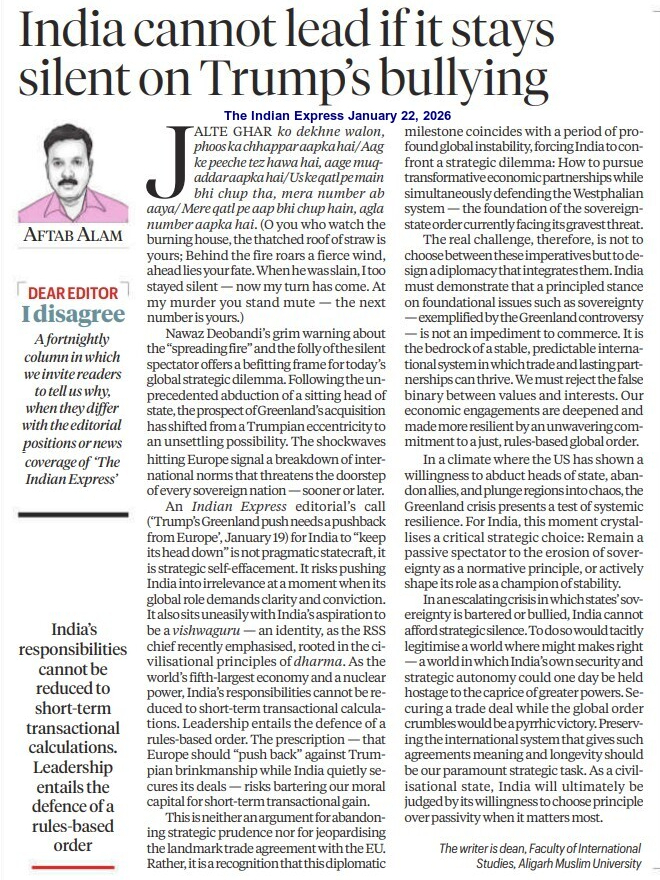
The canvas of diplomacy is not painted in black and white. Instead, it contains different colour shades. India would have to carefully craft diplomacy on that complex canvas. In other words, it has become important for New Delhi to respect democratic rights and aspirations of the people of Iran, without getting directly involved in the complex vortex of internal affairs of the Islamic Republic. Iran is not Bangladesh. Hence, India should frame its role in internal issues of Iran in a somewhat detached tone.
Previously, India navigated complex diplomatic challenges with Ukraine and Palestine, balancing its traditional support for Palestinian Statehood with growing ties to Israel and maintaining a neutral stance on Ukraine because of its deep historical ties with Russia. One can hope that New Delhi would act cautiously with Iran due to its complex interests, balancing energy security, regional stability (especially with Gulf nations) and managing relations with the US (and its Western allies).
Meanwhile,
Boundless Ocean of Politics on Facebook
Boundless Ocean of Politics on Twitter
Boundless Ocean of Politics on Linkedin
Contact us: kousdas@gmail.com

 ISMC
ISMC Boundless Ocean Of Politics