

Pak, Saudi, Turkey Team Up For ‘Islamic NATO’
Mian Muhammad Shehbaz Sharif, the Prime Minister of Pakistan, signed a Strategic Mutual Defence Agreement with Saudi Arabia on September 17, 2025 in Riyadh, formalising a pact that states any aggression against one nation would be considered aggression against both. The accord significantly deepened bilateral security and military cooperation, amidst regional security concerns. Following the agreement, Defence Minister of Pakistan Khawaja Muhammad Asif assured Saudi Arabia that Islamabad would provide Riyadh with nuclear security.
Reuters reported that Pakistan was in talks with Saudi Arabia to convert about USD 2 billion of Saudi loans into a military deal, involving the JF-17 Thunder fighter jet, jointly developed with China. The discussions have marked a significant shift from traditional cash repayments to defence-based debt settlement, underscoring the financial stress Islamabad is facing. Meanwhile, Turkey has stepped forward to strengthen ties with Pakistan and Saudi Arabia, giving further impetus to the idea of an Islamic NATO.
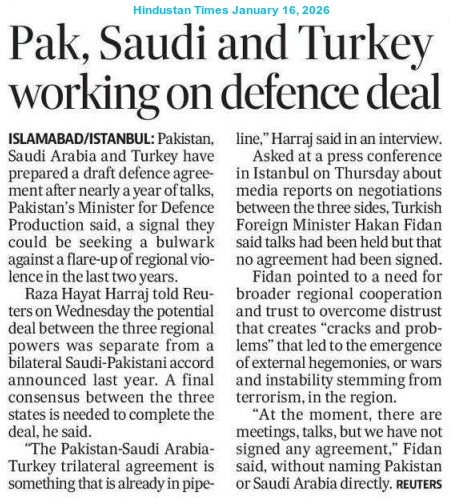
Bloomberg has reported that Turkey is eager to join the defence alliance, similar to NATO’s collective defence framework, between Saudi Arabia and nuclear-armed Pakistan. The proposed agreement is based on Article 5 of NATO, which is the core principle of the security alliance as it states that an armed attack against one member will be treated as an attack against all, obligating allies to take necessary action, potentially including force, to restore security.
Nihat Ali Özcan, a strategist with Ankara-based think tank TEPAV, has claimed that if Islamabad, Riyadh and Ankara manage to reach an agreement, then Saudi Arabia would “bring financial clout, Pakistan has nuclear capability, ballistic missiles and manpower, while Turkey has the military experience and has developed a defence industry“. Bloomberg quoted him as saying: “As the US prioritises its own interests and that of Israel in the region, changing dynamics and fallout from regional conflicts are prompting countries to develop new mechanisms to identify friends and foes.”
Defence analysts are of the opinion that Turkey’s strategic interests across South Asia, West Asia and parts of Africa drive it towards a closer alignment with Pakistan and Saudi Arabia. They also believe that the security agreements with Islamabad and Riyadh are a logical step for Ankara as “Turkey sees the pact as a way of strengthening security and deterrents when there are questions over the reliability of the US, which has strong military ties with all three countries, and President Donald John Trump’s commitment to NATO“.
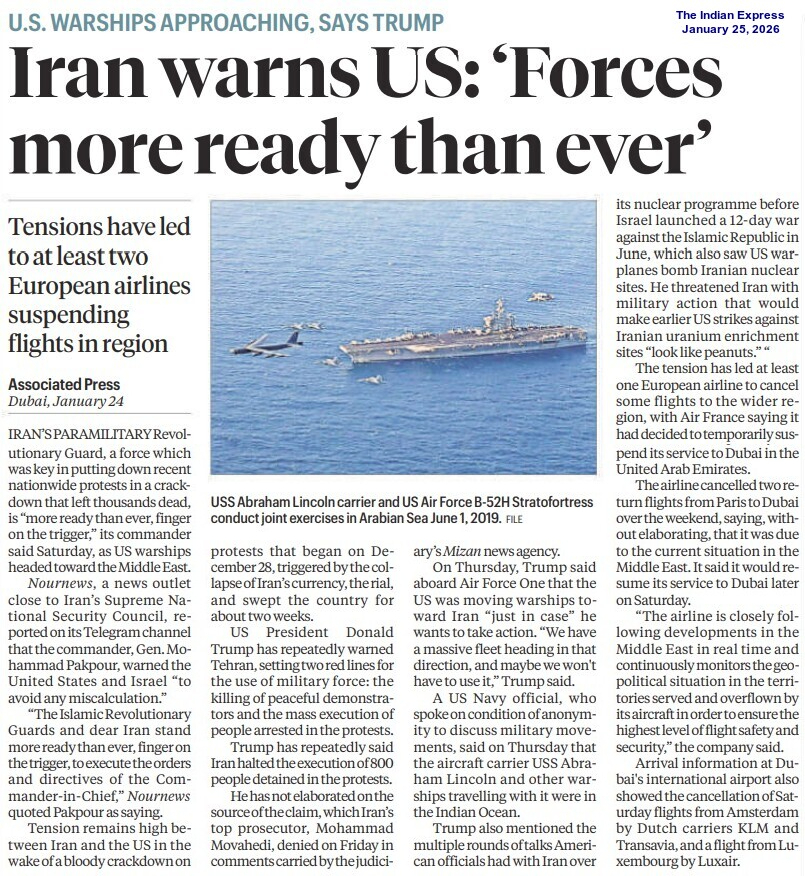
Turkey’s membership of the proposed Islamic NATO shall have a significant importance as the Eurasian nation is not a regional player, but an important NATO member. Furthermore, neither Turkey nor Saudi Arabia maintains cordial ties with Shia-majority Iran. Although both countries have repeatedly expressed concern about the (nuclear) activities of the Islamic Republic, they are in favour of peaceful negotiation (instead of armed conflict) with Tehran to resolve all outstanding issues. Also, Ankara and Riyadh support a stable, Sunni-led Syria, as well as the establishment of a sovereign Palestinian State.
Meanwhile, Pakistan is trying hard to transform the Organisation of Islamic Cooperation (OIC, the world’s second-largest intergovernmental body after the UN, uniting 57 Muslim-majority states to promote Islamic solidarity, safeguard Muslim interests and uphold peace, with headquarters in Jeddah) into a full-fledged Islamic NATO. However, a section of political analysts has opined that it would be quite difficult for Pakistan, which enjoys close defence ties with Turkey, to create an Islamic NATO, together with Riyadh and Ankara. It is mainly because several of the OIC countries are experiencing severe famine. Most importantly, Pakistan, despite being a nuclear power, is facing difficulties in tackling poverty.
Terrorism is another major issue for the Islamic countries. Pakistan, Iran, Syria, Afghanistan, Iraq, Turkey and also some Islamic nations in Africa have become a heaven for terrorist outfits. While terrorism remains highly concentrated in conflict-ridden nations in the Middle East and South Asia, including Pakistan, Syria, Afghanistan and Iraq, the fastest growth and highest fatality rates have shifted to African nations. As per the Global Terrorism Index (GTI) 2025, the landscape of global terrorism has seen a significant shift, with the Central Sahel region of Africa becoming the world’s primary epicentre of violence. Civil war is going on in most of these places, which have also been rocked by religious extremism and fundamentalism.
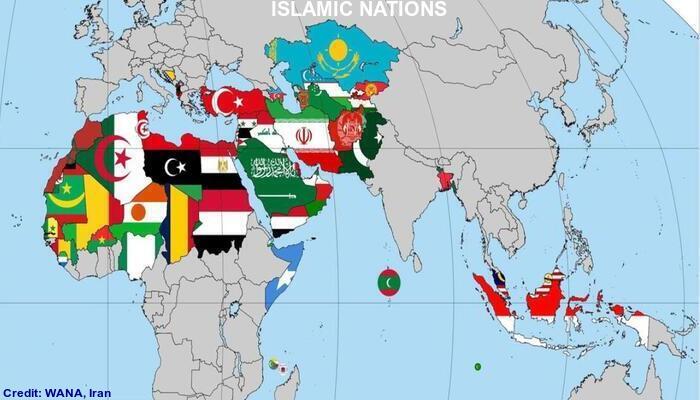
According to former military officers, modern warfare is largely dependent on Artificial Intelligence (AI) and satellites. These are practically not in the hands of Islamic countries. Based on analysis of technology, economic and scientific indicators within the OIC countries, several critical areas are frequently identified as being under-developed or heavily reliant on external, non-Islamic powers. Also, they are dependent on the US and Western countries for state-of-the-art weapons.
In such a situation, it would be quite difficult for Pakistan, Saudi Arabia and Turkey to form a NATO-like alliance.
Meanwhile,

Boundless Ocean of Politics on Facebook
Boundless Ocean of Politics on Twitter
Boundless Ocean of Politics on Linkedin
Contact us: kousdas@gmail.com

 ISMC
ISMC Boundless Ocean Of Politics