

A Bengali Émigré Who Disappeared In USSR
“দুয়ার এঁটে ঘুমিয়ে আছে পাড়া
কেবল শুনি রাতের কড়ানাড়া
‘অবনী বাড়ি আছো?’” – শক্তি চট্টোপাধ্যায়
In an October night, 1937, the Soviet Secret Police knocked on the door of a residence in Moscow. When the houseowner opened the door, the Police dragged him into a black prison van. No trace of that person has ever been found since then!
Abaninath Mukherji (often spelt Abani Mukherjee; June 3, 1891 – October 28, 1937), an Indian communist and émigré based in the erstwhile Soviet Union who co-founded the Communist Party of India (Tashkent Group), was born in the central Indian city of Jabalpur, 134 years ago. Although his father, Trailokyanath Mukherji, was a government official, the son joined the anti-British movement after coming in contact with Sakharam Ganesh Deuskar (1869-1912), an Indian nationalist and revolutionary. Trailokyanath sent Abani to Ahmedabad to study textile technology in order to keep his son away from politics. After completing his studies, Abani got a job in Kolkata (then Calcutta).
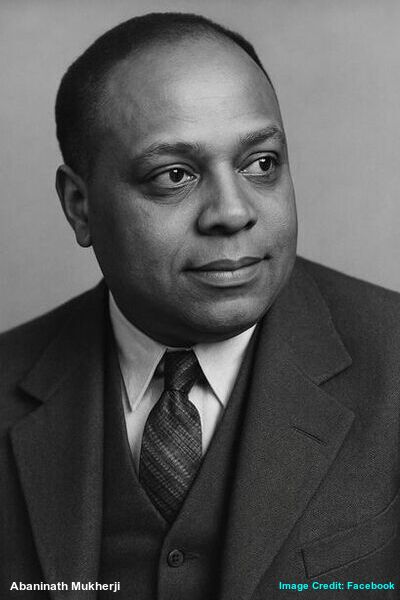
In Kolkata, Abani met Jatindranath Mukherjee (popularly known as Bagha Jatin; December 7, 1879 – September 10, 1915), the noted Indian independence activist, in 1914. On Mukherjee’s advice, he took a job in Tokyo and contacted the armed revolutionaries in Japan and other Asian countries. In the Japanese capital, he got an opportunity to meet Chinese revolutionary Sun Yat-sen (November 12, 1866 – March 12, 1925) and Indian revolutionary leader Rashbehari Bose (May 25, 1886 – January 25, 1945). Later, Bose, Bhagwan Singh and Abani formed an Independent Council which sketched out a seaborne arms importation plan that they presented to the German representatives in China (though they declined an invitation to a reception at the German Consulate in Beijing “owing to the fear of arrest”). On his way back after meeting the German ambassador, Abani was detained by the Singapore Police in 1917. The Police also seized his notebook, containing the names and addresses of other Indian revolutionaries, and incarcerated him at the Fort Canning Prison. Abani remained in the prison until he escaped in the autumn of 1917 and then arrived in Sumatra where he joined a rubber plantation project. During his stay in Sumatra, he secretly contacted the Indonesian Communist Party. There, he learned about the Russian Revolution and developed interest in Communism.
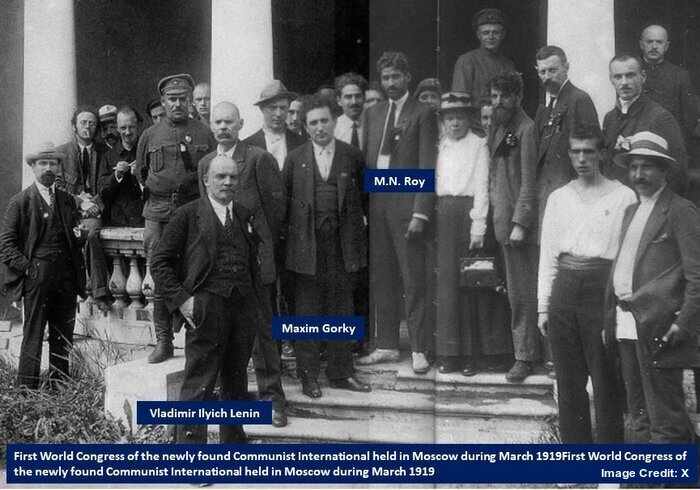
Using a fake certificate, Abani went to The Netherlands and Germany under the pseudonym Shahir and met noted Indian revolutionaries Bhupendranath Datta (September 4, 1880 – December 25, 1961), Virendranath Chattopadhyaya (October 31, 1880 – September 2, 1937) and Manabendra Nath Roy (born Narendra Nath Bhattacharya, better known as M N Roy; March 21, 1887 – January 25, 1954). They decided to create a revolutionary organisation with all the Indian revolutionaries living in the diaspora in Europe, including nationalist and Communist revolutionaries, and to carry out revolutionary efforts from outside the country in the light of Communist ideology.

Abani arrived in Russia to attend the Second Congress of the Communist International in 1920. On the sidelines of this event in Petrograd, he met Vladimir Ilyich (Ulyanov) Lenin. With the help of M N Roy and his wife Evelyn Trent, he presented the Charter of the Communist Party of India in Petrograd. Then, Abani attended the Peoples of the East Conference in Baku as a representative from India.
Abaninath Mukherji, jointly with M N Roy, founded the Communist Party of India in Tashkent on October 17, 1920 and also arranged military training for expatriate Indians at the Russian Military Academy in Baku. He was then nominated as a member of the Russian Communist Party and participated in the Third Congress of the Communist International in Moscow in 1921 as a delegate of the Bolshevik Party. After holding talks with the visiting revolutionaries from India at the end of that event, Abani decided to return home.
Ignoring an arrest warrant issued against him by the Colonial British Government, Abani returned to India in 1922. He used various pseudonyms, like Gangaprasad, Charlu, Melen, etc., upon his arrival in the southern Indian city of Chennai (then Madras). There, he met labour leader Malayapuram Singaravelu Chettiar, Santosh Kumar Mitra, Abdur Rezzak Khan and some other Indian revolutionaries. However, his activities angered different revolutionary organisations in India. Abani reportedly got involved in a personal strife with revolutionary Nolini Kanta Gupta (January 13, 1889 – February 7, 1984). He also made an attempt to receive firearms from foreign countries with the help of some German revolutionaries, but failed. These events prompted him to leave India, yet again.
In Moscow, Abani tied the nuptial knot with Rosa Fitingov, who was then an assistant to one of Lenin’s private secretaries, Lydia Fotieva. They had two children; a son, Gora, and a daughter, Maya. It may be noted that Gora Mukerdzhi died while fighting the invading Wehrmacht in the Battle of Stalingrad in 1942. Abaninath Mukherji worked as a Professor at the Department of Oriental Studies in Moscow University (as an Indologist) and also received a Doctoral Degree for his research works on the possibilities of Communism in India. He penned a booklet about the 1921 Moplah Rebellion in India which secured its place in Lenin’s personal library.

After the demise of Lenin, Joseph Vissarionovich Stalin targeted Abani most probably because of his closeness to Nikolai Ivanovich Bukharin. Around 1.2 million people disappeared in the erstwhile Soviet Union during the Great Purge (1936-38) and Abani was one of them. The probable date of his death is October 28, 1937. In fact, the Soviet authorities acknowledged his demise after 1955. The Indian revolutionary was arrested on June 2, 1937 and assigned for the first category of repression (execution by shooting) in the list Moscow-Centre.
The Great Purge or Great Terror was a political purge in the Soviet Union orchestrated by Stalin in 1936-38. After the assassination of Sergei Kirov by Leonid Nikolaev in 1934, Stalin launched a series of show trials, known as the Moscow trials, in order to remove suspected dissenters from the Communist Party of the Soviet Union (especially those aligned with the Bolshevik Party). Historian Robert Conquest popularised the term Great Purge in his 1968 publication The Great Terror, whose title alluded to the French Revolution‘s Reign of Terror.

Interestingly, the Indian Communists were initially a part of the Indian National Congress movement in British India. Speaking at an event in Kolkata on November 2, 2025, Jawhar Sircar, a senior official (retired) of the Government of India, recalled that the Communists were the first to demand complete independence (Purna Swaraj), at a time when the mainstream Gandhi group was undecided. At the Congress’ Ahmedabad Session in 1921, two Communists – Maulana Hasrat Mohani and Swami Kumaranand – moved the first resolution for Independence from British rule. However, the Congress Party rejected the proposal.
Subsequently, the Communists again sought for complete independence at the Gaya Session of the Congress in 1922. However, they were unsuccessful as the majority in the Congress felt that India should seek to be a Dominion within the British Empire. In 1928, the Communists decided to make a show of strength at the Calcutta Session of the Indian National Congress, and led a huge procession of 50,000 people of its Workers’ and Peasants’ Party. It comprised of factory workers and subalterns, and the demand was for immediate adoption of complete independence resolution. Unfortunately, the Congress took one more year. It was Party President Pandit Jawaharlal Nehru who adopted the Purna Swaraj (complete independence) resolution at the Lahore Session of Congress in December 1929-January 1930.
According to Sircar, the Communists were also the first to demand a Constituent Assembly to draft India’s Constitution, and advocated for including key principles, like social justice, equality, secularism and land reforms. These were included as of provisions in the final Constitution, especially the Directive Principles of State Policy. The Communists further called for a total rejection of the British-imposed colonial framework through the Government of India Acts and demanded the “sovereignty of the people“. They pressured the Congress to adopt the idea of the “people as supreme“, which later became central to the Indian Constitution. It is reflected in the opening words of the Preamble of the Indian Constitution: “We the People of India.”

Sircar stressed that the Communists cooperated in drafting the Constitution and also in upholding its ideology. There are several instances where they confronted the constitutional government with agitations, demands and violence. After all, pursuing their ideology of socio-economic equity and justice for workers and peasants were higher priorities.

Today, during India’s darkest period of undeclared Emergency, Right-Wing Extremism and One-Man Authoritarianism, there are only diehard secular Left Liberals, agitating farmers and workers, and Communists who are jointly fighting this unacceptable, communal, pro-rich regime, he added.
Boundless Ocean of Politics on Facebook
Boundless Ocean of Politics on Twitter
Boundless Ocean of Politics on Linkedin
Contact us: kousdas@gmail.com

 ISMC
ISMC Boundless Ocean Of Politics