

India-Taliban Alliance: The Complex Geopolitical Calculations
Consuming poison, even when done knowingly, is virtually guaranteed to cause a range of immediate or long-term side effects. The same applies to foreign policy, also.
Twenty-six years ago, India had held failed talks with the Afghan Taliban after Indian Airlines Flight 814 (commonly known as IC 814) was hijacked by five Pakistan-based Harkat-ul-Mujahideen terrorists on December 24, 1999. The Airbus A300 aircraft, en route from Kathmandu to New Delhi, was taken over shortly after it entered Indian airspace at about 4:53pm (Indian time) and flown to Dubai via Amritsar and Lahore. On December 25, the hijackers forced the aircraft, with 179 passengers and 11 crew members onboard, to land in Kandahar, Afghanistan. As the negotiation between India and the Afghan Taliban failed, New Delhi had to release Maulana Muhammad Masood Azhar Alvi, a Jaish-e-Mohammed militant and the main mastermind of the 26/11 terror attacks in western Indian city of Mumbai, to save the lives of 190 innocent Indians.
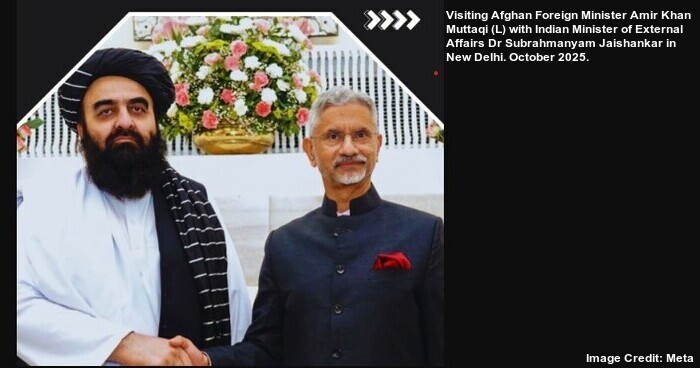
More than two decades later, Amir Khan Muttaqi, the Afghan Taliban Foreign Minister, received a warm welcome upon his arrival in the Indian capital on October 9, 2025 for a week-long trip! The seasoned Indian diplomats are well aware of the fact that welcoming a Taliban minister is like consuming poison, knowingly. However, they have taken such a calculated risk partly because of strategic reasons, and partly to gain diplomatic advantage in South Asia.
Historically, India has been critical of what it perceived as the US’ nuanced and ambiguous approach to different Taliban factions in Afghanistan, saying that the Good Taliban, Bad Taliban distinction is a counterproductive concept. New Delhi also suspected that Washington DC tacitly tolerated or turned a blind eye to this Pakistani tactic. In fact, India described the Taliban as terrorists and misogynists who provide children with Kalashnikovs, instead of books. However, a complex and evolving regional geopolitical dynamic has prompted the top Indian political leadership to shift its stand on Taliban considerably in recent times.
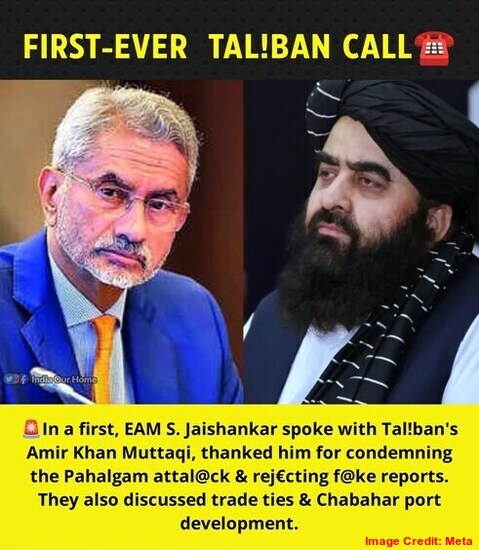
Needless to say, India has decided to strengthen ties with the Afghan Taliban after reviewing all the possible risks, as well as benefits. New Delhi is playing the Taliban card mainly to gain a strategic advantage in the region, with Pakistan and China creating troubles for India in a virtually unfriendly neighbourhood. The Narendra Modi Administration has argued that the Afghan Taliban has maintained cordial ties with India since its return to power on August 15, 2021 and strongly condemned the April 22, 2025 Pahalgam terror attack by at least three Pakistani terrorists. Secondly, Russia has already officially recognised the Afghan Taliban and some Western powers are all set to do the same. As China is also planning to bolster ties with the Taliban, it has become important for India to reach out to Kabul without wasting time. Thirdly, the move (strengthening ties with Taliban) would certainly help India to create a diplomatic balance in the region.
Finally, the Taliban of 2021 is a more evolved, politically and tactically sophisticated organisation than the group that had seized power in 1996, although their core ideology has remained largely unchanged. The most significant differences lie in their strategic approach, administrative capacity and a recognition of the need for international engagement, even while maintaining a hardline stance on issues, like Women’s Rights. Hence, the Taliban 2.0 is desperate to gain global recognition and diplomatic legitimacy.
Significantly, the joint statement issued after talks between Dr Subrahmanyam Jaishankar, the Indian Minister of External Affairs, and Muttaqi referred to the site of the Pahalgam terror attack as being located in northern Indian territory of Jammu and Kashmir. Also, the Taliban Foreign Minister’s visit to India coincided with an outbreak of deadly cross-border clashes between the Afghan and Pakistani Armed Forces.
Addressing a press conference at the Afghan Embassy in New Delhi, Muttaqi warned Islamabad not to get involved in a war with Kabul. In fact, India created such a platform for the visiting Taliban minister in New Delhi for its own interests. Most importantly, Muttaqi spoke in Urdu during the press conference to ensure his message reached a wider audience across the Indian Subcontinent. His choice of language was particularly notable because he is known to prefer speaking Pashto during his visits to Pakistan.
India also announced new development projects, upgraded its diplomatic mission and discussed increased trade, as well as connectivity, during the visit of Muttaqi. This diplomatic shift reflects a cautious but pragmatic approach by New Delhi to engage the Taliban, who are actively seeking international investment and aid to overcome the severe economic crisis. The scenario offers India a chance to counter Pakistan’s diminishing influence in Afghanistan, where Islamabad once hoped to gain “strategic depth“.
Read: The complicated history of US-Pakistan relations
Although India maintains cordial ties with Britain, Canada, France, Germany, Russia and the US (in spite of the Tariff War triggered by President Donald John Trump), the Western countries have always prioritised their own (vested) interests over Pakistan-sponsored terrorism in India. After considering all these, New Delhi has decided to corner Islamabad in South Asia with the help of the Afghan Taliban. In other words, India plans to fight fire with fire.
Meanwhile,

Boundless Ocean of Politics on Facebook
Boundless Ocean of Politics on Twitter
Boundless Ocean of Politics on Linkedin
Contact us: kousdas@gmail.com

 ISMC
ISMC Boundless Ocean Of Politics