

Surviving Asymmetrical Warfare In Neoliberal Era
The global community observed a strange phenomenon after the end of the recent Iran-Israel War. While Israel claimed that it destroyed Iran’s ability to build nuclear weapons, the US said that it stopped the war by heavily bombing the Islamic Republic and Iran declared that it successfully repelled joint Israeli-US aggression to remain undefeated. In this case, the success or failure (in war) is not determined by the number of casualties, but by the achievement of goal. Hence, no one can dismiss Tehran’s claims, although the West Asian nation suffered significant losses.
Basically, it was an asymmetrical warfare. One can survive such a war, if the goals of the two warring parties are different. Asymmetrical wars were fought in the 20th Century. For example, one can mention the Vietnam War. However, this sort of war has taken a specific form in the 21st Century. It is difficult to understand the real character of an asymmetrical war as some confusing information cover the battlefield. On January 3, 2020, Qasem Soleimani, an Iranian Major General, was eliminated by a US drone strike ordered by President Donald John Trump near the Baghdad International Airport in Iraq. He was scheduled to meet Iraqi Prime Minister Adil Abdul-Mahdi. However, the assassination of Major General Soleimani did not trigger a war between Iran and the US as Tehran showed restraint. The scenario was completely different on June 22, 2025 when the US carried out airstrikes on three Iranian nuclear sites, called Operation Midnight Hammer. According to a section of political analysts, the US bombed Iran this time to prompt Tehran to return to the table for negotiations.

Returning to the table for negotiations means forcing Iran to unilaterally abandon its nuclear programme, to bow to Israeli aggression and to declare that it would abandon the path of terrorism. The Trump Administration wants Tehran not to raise its voice against the Israeli atrocities in Gaza. President Trump believes that it would be a failure for Washington DC, as well as Tel Aviv, if Iran refuses to hold talks with the US. However, the US has failed to suppress Iran even after damaging its nuclear sites. In other words, Iran remained undefeated despite being a relatively weaker power in this war. With this, the anti-Zionist forces persist and rebel activities continue in the Red Sea. Although the war was an asymmetrical one, its outcome was not determined solely by military strength.
Sometimes an armed conflict increases the possibility of an all-out war. Iran is a fine example of how a comparatively weaker power maintains its Right to Self-defence during such an asymmetrical war. Unfortunately, biased media coverage often covers up the truth. Israel made an attempt to win the war in a few days by launching a surprise attack and killing top Iranian scientists. However, Iran refused to surrender. The approximate distance between Tehran and Tel Aviv is around 1,600km. The Israeli fighter jets crossed more than 1,500km to launch attacks on Iran, and the Islamic Republic defended itself by launching drone and missile-attacks on Israel in retaliation.

It may be noted that while Iran has virtually no sophisticated fighter jets, Israel has several state-of-the-art aircraft. However, the Israeli air defence system failed to completely prevent the combined use of drones and missiles by Iran. Hence, Tel Aviv accepted the ceasefire proposal. The Wall Street Journal reported that Israel’s war with Iran was costing the Jewish Nation an estimated USD 200 million per day, a staggering figure that quickly became a major constraint on the duration of the conflict. Meanwhile, The Washington Post mentioned in a report that Tel Aviv’s missile defence costs reached approximately USD 285 million per night during the Iran-Israel War! This high daily expenditure was due to the extensive use of missile defence systems, such as the Arrow and Iron Dome, against Iranian attacks. In fact, there are a number of misconceptions even within the concept of asymmetrical war.
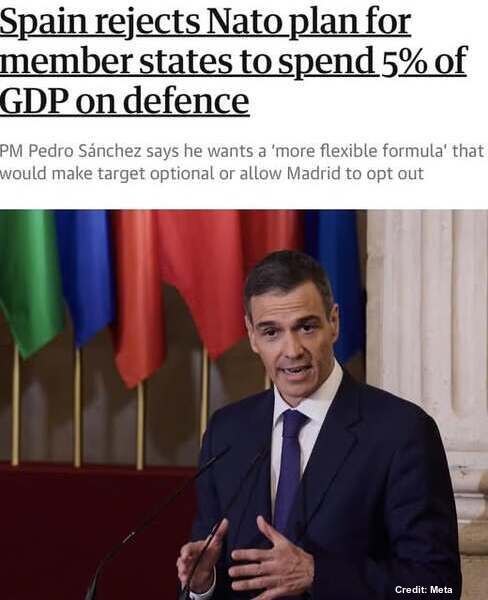
Israel is currently under immense pressure as it has started losing its support base in the West. Spain recently rejected the NATO plan for member states to spend 5% of their GDP on defence. Pedro Sánchez, the Prime Minister of Spain, stressed that the idea would “not only be unreasonable, but also counterproductive”. He further said that there should be a “more flexible formula” which would either make the target optional or allow Spain to opt out. The German Cabinet has passed a draft bill that would introduce voluntary military service. Berlin has made the move in an attempt to boost national defence, following Russia’s full-scale invasion of Ukraine. The European countries, mainly Germany and Italy, plan to do all this not to protect Europe from its enemies, but to bring back their soldiers from NATO missions (in order to save them from President Trump).
In such a situation, Europe has stressed on diplomacy to prevent a repeat of the Iran-Israel conflict. This is what they can do in an attempt to win the confidence of Iran. On the other hand, Reza Pahlavi, the surviving son of the last Shah of Iran, has not returned to Tehran from the US to reinstate the Shah Regime. Instead, he lives in exile in the US and supports the establishment of a liberal democracy in Iran, although he is a member of the deposed Pahlavi Dynasty.
Political analysts are of the opinion that the US, Israel and the European Union (EU) actually want an end to the independence and nationalism of Developing Nations. Instead, they want to destroy the resistance structures, such as in Gaza, and have a total reconstruction there as per the needs of the capitalist economy. They also want a mass evacuation of Palestinians in large swaths of the Gaza Strip and the division of Iran as was done to Iraq. This is the real purpose of one warring party in case of an asymmetrical war. The neoliberalists are waging such a war in different forms, like tariff war, armed conflict, diplomatic war and war on immigrants. Needless to say, resistance to this sort of war shall also be asymmetrical. Both the Gazans and the Iranians have shown how the less powerful can survive an asymmetrical war.
It requires political goals that would help the less powerful to survive a war in the Neoliberal Era, in spite of numerous obstacles and weaknesses. In a sense, intervention in a war situation with a fixed goal (or purpose) is called Politics.
Boundless Ocean of Politics on Facebook
Boundless Ocean of Politics on Twitter
Boundless Ocean of Politics on Linkedin
Contact us: kousdas@gmail.com

 ISMC
ISMC Boundless Ocean Of Politics