

Muslim Brotherhood: Turkey Sending Arms To Pakistan
Turkey has started sending military aid to panicked Pakistan as the latter’s conflict with neighbouring India intensifies. Reports suggest that a Turkish C-130E Hercules cargo plane landed at the Karachi Air Force Base in southern Pakistan on April 28, 2025 with a large amount of weapons, ammunition, missiles and defence equipment. Although Islamabad is yet to confirm the news, the Pakistani media have reported that six C-130E Hercules aircraft of the Turkish Air Force reached Karachi after flying over the Arabian Sea. Interestingly, the Turkish Defence Ministry has issued a statement, mentioning that no weapons or ammunition have been sent to Pakistan. However, the Recep Tayyip Erdoğan Administration has acknowledged that a Turkish cargo plane landed in Karachi on April 28 (2025) for refuelling.
As Islamabad and Ankara have always shared cordial ties, Pakistan would receive help from Turkey during its ongoing armed conflict with India. Sushant Sareen, a Senior Fellow at Observer Research Foundation, has strongly criticised the Narendra Modi Government in New Delhi for maintaining friendly ties with Turkey. In a recently-published article, he wrote: “India is not a serious country. We feed snakes and then wonder why they bite us. We reward our enemies and treat our friends shabbily. We delude ourselves that countries, like Turkey, will give up their hostility. They benefit from us and then stab us openly.“

Rajeev Mantri, the Founder and Managing Director of Navam Capital, has also criticised India’s approach to national security versus economic diplomacy, stating that New Delhi was interested in acquiring offensive drones from Ankara three-four years ago. However, Turkey made it clear that it would export the Baykar drones to Pakistan, and not India. “The same drones have also been sold to Bangladesh. What did India do? Permitted/encouraged its airlines to collaborate with Turkish Airlines, also launched ‘Operation Dost’ to help Turkey after it was devastated by an earthquake (in 2023). At the same time, Indian defence drone developers do not clear orders from our own armed forces. When they clear orders, payment is not released for months on end. Yes, India is not a serious country,” added Mantri, backing Sareen’s stance. Furthermore, Turkish President Erdoğan assured Pakistan of support on the Kashmir issue on the international stage during his visit to Islamabad in February 2025.

Defence analysts have advised the Modi Administration not to allow the US or Europe-bound Indian civilian flights to make a stopover at Istanbul airport, saying that there is no need to provide additional financial benefits to the Turkish aviation sector. Analysts have recalled that Turkey is working with Pakistan to develop a fifth-generation stealth fighter jet, called the Kaan (formerly known as TF-X or MMU). Ankara and Islamabad also signed an agreement in this regard in 2024 on the basis of which the Pakistani Air Force would receive those fighter jets in the near future.
However, it is not the case that Pakistan has received support from all the Islamic nations since the April 22 (2025) Pahalgam terror attack carried out by the Pakistan-backed terrorists that claimed the lives of 26 innocent Indian tourists. The entire Arab World has given importance to better geopolitical, economic and trade ties with India, instead of sending a message of religious solidarity to Pakistan. Saudi Arabia, Qatar and the United Arab Emirates (UAE) have made it clear that Kashmir is a bilateral issue (between India and Pakistan) and they would not interfere in it. Meanwhile, Iran has offered to mediate between India and Pakistan in order to resolve the current crisis.
Apart from Turkey, Pakistan has received support from Azerbaijan. It may be noted that a war has been going on between Azerbaijan and Armenia for the past few years and Armenia has purchased several deadly weapons from India. Hence, Azerbaijan is openly backing Pakistan.
A section of defence analysts believe that Islamabad is trying to build a tri-nation alliance with Ankara and Baku. They have urged the Modi Government to remain alert and to monitor the Turkish activities in Pakistan, stressing that India would have to tackle the Turkish threat through diplomacy.

The 21st Century world has already witnessed two historic conflicts: the Russia-Ukraine War and the Israel-Hamas War. However, a full-scale war between India and Pakistan would undoubtedly be a more dangerous one in terms of the potential horror and impact. The military capabilities, as well as diplomatic skills, of these two belligerent nuclear powers are particularly noteworthy.

Although India cannot be compared to Pakistan as far as socio-economic development is concerned, the situation is completely different from a military and diplomatic perspective. Keeping this in mind, New Delhi is on high alert and it is evident in India’s military pushback and self-restraint in the past few days. The seriousness of the situation is also reflected in the message sent by the Indian Army to Pakistan.
The possession of nuclear weapons is not the only indicator of the defence strength of a country. The nuclear policies of the country, too, are quite important. It may be noted that China and India are currently the only two nuclear powers to formally maintain a No First Use policy, adopting pledges in 1964 and 1998, respectively. Interestingly, Pakistan is consciously avoiding this policy. In other words, Islamabad can use nuclear weapons, if it feels that its sovereignty is threatened. This is a serious issue and Defence Minister of Pakistan Khawaja Muhammad Asif, soon after the April 22 (2025) Pahalgam terror attack, mentioned in a statement that his country would never follow this policy. Hence, India is taking calculated steps to counter Pakistan-sponsored terrorism.

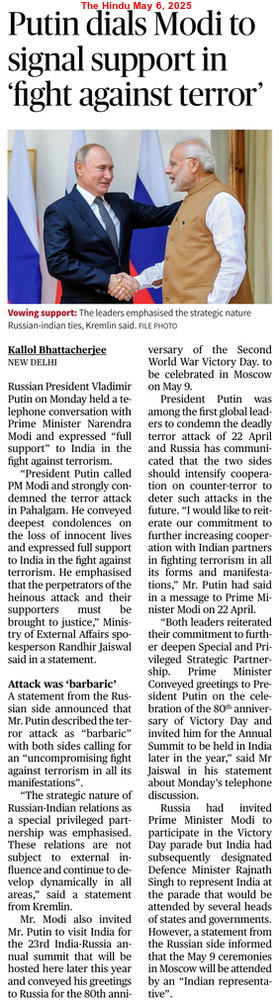
In fact, India is well aware of the fact that the situation could take a different turn at any moment. New Delhi is also aware of Pakistan’s strategic ties with China, Turkey and some Arab nations. India, renowned for its ground force and drone proficiency, receives support from the US, Russia, Israel and some Western European countries. As there is a close connection between defence strength and geographical location of a country, India has to handle Pakistani aggression carefully along the Line of Control (LoC) in Kashmir. The China-Pakistan Economic Corridor (CPEC) and the Organisation of Islamic Cooperation (OIC), too, keep New Delhi on high alert at the moment.

While the UN and the US have requested both India and Pakistan to find a peaceful solution, Britain has stressed that it is ready to help both the countries to resolve the crisis. Considering the overall scenario, it might seem prudent to limit the military conflict and to move towards a diplomatic solution. One can recall the key piece of advice from Sun Tzu‘s ‘The Art of War‘ that “the highest strategy is to subdue the enemy without fighting“.
Boundless Ocean of Politics on Facebook
Boundless Ocean of Politics on Twitter
Boundless Ocean of Politics on Linkedin
Contact us: kousdas@gmail.com

 ISMC
ISMC Boundless Ocean Of Politics