

Nuclear Deterrence Unthinkable In Subcontinent
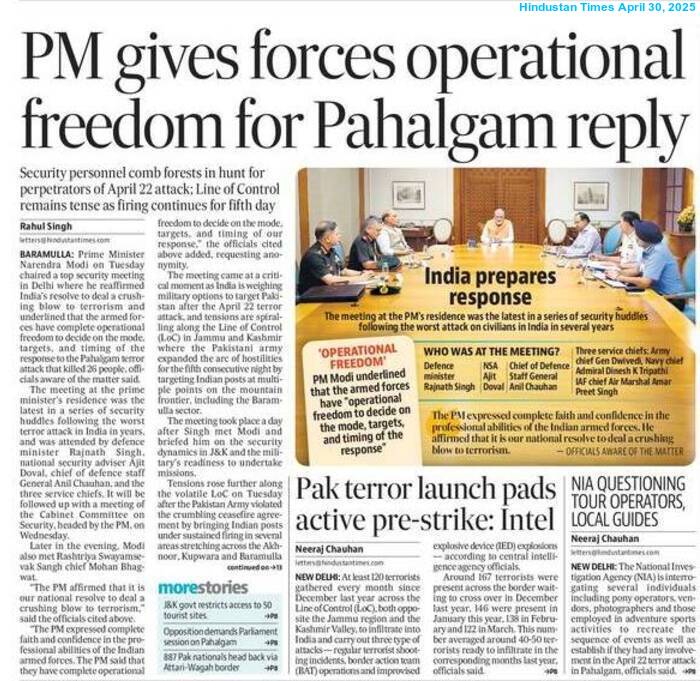
Relations between India and Pakistan hit a new low after The Resistance Front (TRF) terrorists killed 25 tourists near the picturesque northern Indian hill town of Pahalgam on April 22, 2025, bringing the two South Asian neighbours to the brink of war. Although it is still uncertain whether the two nuclear-armed states would risk a full-scale war, the possibility of a devastating conflict has increased in the last few days.
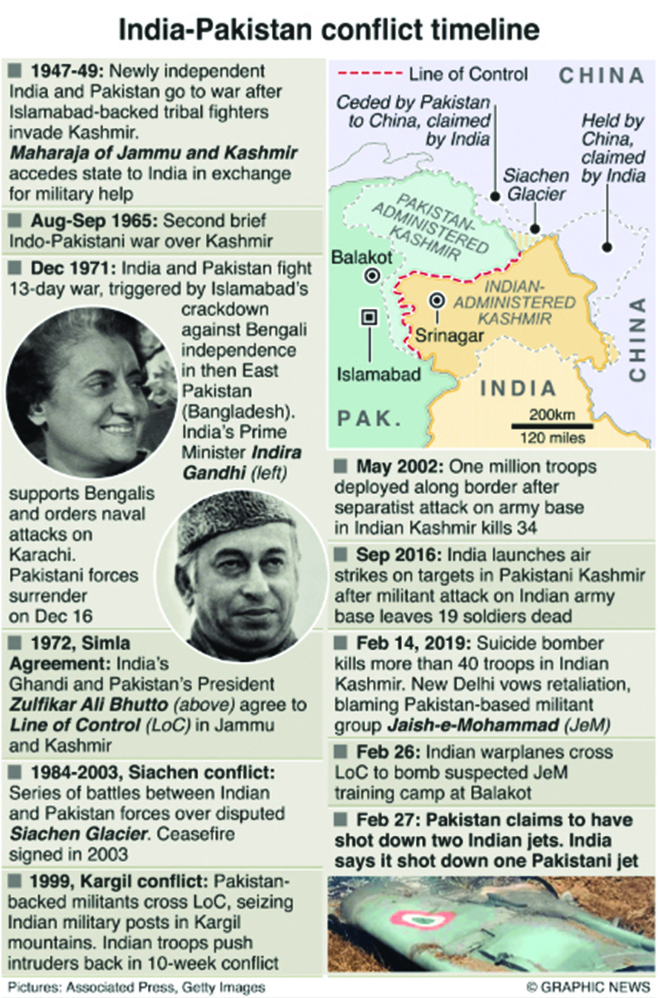
From this, a couple of clear facts are apparent: Firstly, nuclear weapons have failed to prevent a risky or limited war in the Indian Subcontinent. India and Pakistan fought the Kargil War in May-July 1999 after becoming nuclear-armed states. However, it was a conventional military conflict, and not directly related to their nuclear capabilities. Pakistan often triggers a war-like situation by helping terrorists to attack Indian civilians and institutions. Hence, instability prevails in South Asia. A theory in Political Science states that nuclear weapons have encouraged Pakistan to take risky steps in order to test the limits of India’s retaliation. However, Islamabad failed to stop the Indian Army from carrying out a Surgical Strike inside its (occupied) territory in 2016. On September 29, 2016, the Indian Army commandos crossed the Line of Control (LoC) into Pakistan-occupied-Kashmir (PoK) to destroy terrorist camps. The raid took place 10 days after four Pakistani terrorists attacked an Indian Army outpost at Uri in Kashmir and killed 19 soldiers. Therefore, nuclear weapons have not brought stability in the Subcontinent. Instead, they have pushed the region towards further uncertainty.
Secondly, Pakistan does not want to learn from past mistakes. The Pakistani Army is still trying hard to establish a firmer grip on State Power at a time when the country is facing an unprecedented economic crisis and diplomatic isolation. Pakistan has also been recognised as one of the most dangerous places in the world. Due to its strategic geopolitical importance, countries, like China, Saudi Arabia, Turkey and the US, still help Islamabad by sending relief. However, their patience is constantly waning. The Belt and Road Initiative (BRI) of China is a total failure. Now, one hardly considers China an all-weather friend of Pakistan because of the changing regional geopolitical landscape. US President Donald John Trump has already made it clear that his administration is not interested in rescuing Islamabad from the current economic crisis. Also, there is no evidence yet that religious beliefs play a major role in World Politics. Else, the Palestinian people would have enjoyed the full support of the Arab World.

It seems that there are three possible reasons for Pakistan’s belligerent attitude towards India. According to the Spiral Model of escalating conflict, when one party tries to change the behaviour of the second one by punishing the latter, then the conflict deepens. The second party does not surrender after getting punished, rather feels humiliated or threatened and becomes more aggressive. Then, the first party thinks that the punishment might not have been harsh enough and escalates (its) reaction. With this, a small disagreement can gradually escalate into a fierce conflict or even lead to war. As per the Spiral Model, the best way to maintain peace is through understanding and compromise. Precisely, a hint of reconciliation is more effective than punishment.

On the contrary, the Deterrence Model states that appeasement could boomerang in various ways as people do not commit crimes because they are afraid of getting caught, but due to some deep moral senses. In other words, when one party pardons the other despite the offense, the other party may consider the gesture as a sign of weakness and become more aggressive. It increases the risk of misunderstanding, as well as war. From the perspective of the Deterrence Model, aggression should be responded with force, as only strength and determination can restore peace. This particular model stresses on power, and not on cooperation.
Dr Sumit Gangopadhyay, an American Political Scientist, has rightly pointed out that Pakistan is undoubtedly a fine example of preventive response. He has argued that Islamabad has consistently pursued a risky policy, assuming that New Delhi would maintain restraint in its response and would not resort to harsh punishment. It would be a mistake to explain the strategic behaviour of Pakistan from the perspective of security dilemma. The goal of Islamabad is not to strengthen its defence sector. Rather, Pakistan should be considered as a greedy state that takes all sorts of risks to claim the entire Kashmir as its legitimate territory.
The third explanation is based on identity and political structures. Pakistan has failed to get rid of its decades-old mentality to deny the very existence of India. At the same time, Islamabad has militarised its security and securitised the military. It has always made a serious effort to maintain close ties with China and the US in an attempt to balance its (diplomatic) position against India. Since civilian political forces have failed to establish dominance in Pakistani politics, the country has inevitably become a failed Military State. Unfortunately, the anti-India sentiment is the only element that still holds the divided political society of Pakistan together.
No matter how serious the crisis, Pakistan would always follow a divisive ideology and carry a political culture that uses crises as a template for testing nationalist strength. It is quite difficult for a state to change its core identity. And if the very foundation of a country is based on anti-India sentiment, then it is impossible for that country to build a benevolent collective society. A series of horrific terrorist attacks have fuelled anger, as well as resentment, among the common Indian people. The Indian State is well aware of the fact that if it declares a war against Pakistan (especially after the Pahalgam terror attack), the general public would back the decision. Prime Minister Modi’s people-driven (or populist) politics is based on the idea of mass sacrifice for a noble cause. Therefore, if the international community fails to bring New Delhi and Islamabad to the negotiating table, then the situation would quickly go out of control. Sadly, President Trump’s extremist foreign policies have confused the global community in recent times. As a result, the active intervention (of the US) seen at the international level in the recent past is now absent.

When public anger turns into intense emotion, it becomes difficult to explain the behaviour of a state through logic and rationality. Pakistan has repeatedly proven that it is unable to change its anti-India mentality. On the other hand, Russia and Israel have shown how far powerful states can go. There is no place for justice and values in contemporary global geopolitics. Therefore, the India-Pakistan conflict could not be resolved through peaceful negotiations based on morality.
It seems that Nuclear Deterrence could be the only regulator as far as India-Pakistan relations are concerned. As discussed earlier, nuclear deterrence could not ensure permanent peace and stability in the Indian Subcontinent. War is also not desirable at all. That’s why strong international intervention has become necessary in this particular case. Otherwise, it may become increasingly difficult to restore normalcy in South Asia.
Boundless Ocean of Politics on Facebook
Boundless Ocean of Politics on Twitter
Boundless Ocean of Politics on Linkedin
Contact us: kousdas@gmail.com

 ISMC
ISMC Boundless Ocean Of Politics