

Trump’s Peace Offensive & Desperate Response From Europe
In the extensive media coverage of the showdown between US President Donald John Trump and Ukrainian President Volodymyr Oleksandrovych Zelenskyy at the White House on February 28, 2025, there is a notable omission, by which the intent of the US leader’s message is obscured. “You’re gambling with World War III”, Trump exclaimed more than once. As for the Ukrainian President, his intent in coming to the White House was to insist that the US provide more funds and weaponry to enable Ukraine to continue the war against Russia.
Had he succeeded, it would not only have disrupted the process of normalisation of US-Russian relations initiated by a Trump-Putin phone call on February 12 (2025), followed by a meeting of representatives of the two Presidents in Riyadh six days later, but could also have led to an escalation of tensions with Russia. Such an outcome is precisely what President Trump is determined to prevent, by demanding that negotiations begin immediately and the war be ended.

In contrast, throughout the discussion being broadcast, President Zelenskyy limited his remarks to attacks on Russia, with no perspective of a settlement. President Trump forcefully rejected those provocations and let him know where things stand. “You have been defeated on the battlefield,” the US President told his guest. “You have no military capability to change that. You do not have the cards,” President Trump concluded, just before he ended the meeting and his aides escorted the Ukrainian entourage from the White House.
The pathetic attempt by British Prime Minister Sir Keir Starmer and French President Emmanuel Macron to rally Europe behind the beleaguered Zelenskyy then fell flat on Sunday (March 2, 2025). London’s effort to mobilise a “coalition of the willing” against Russian President Vladimir Vladimirovich Putin would mean European leaders must either change President Trump’s mind or formalise a break with the US, the prospect of which has not produced an alternate plan, but has led to incoherent babbling among them.
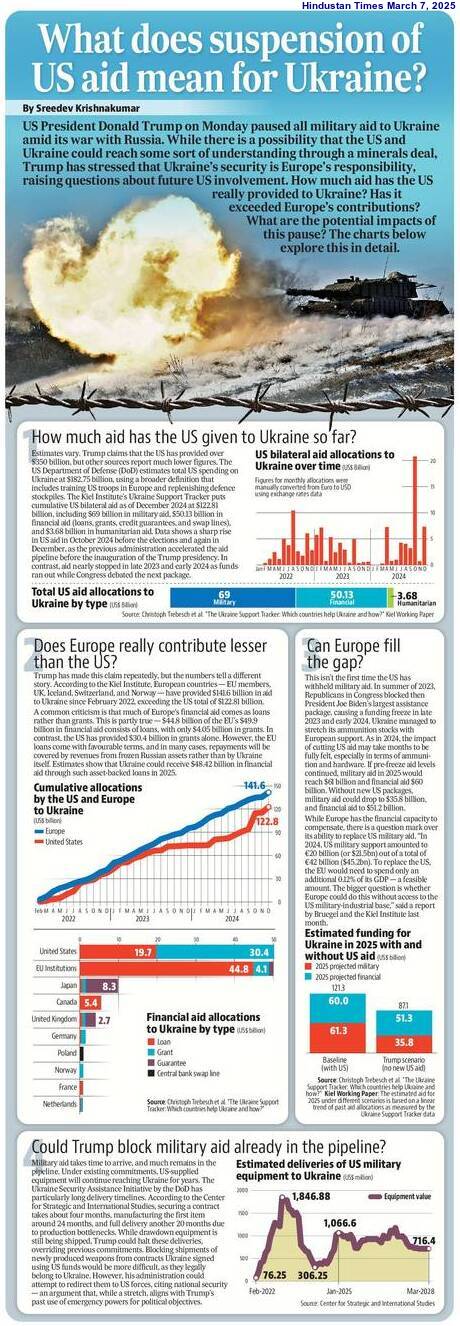
After the meeting, a visibly delusional Ukrainian President declared that Kiev could still count on US support to carry out the war, saying that “peace is very, very far away”. It led President Trump to suspend delivery of all US military aid to Ukraine.
The US President’s commitment to negotiations was reiterated by his Director of National Intelligence Tulsi Gabbard in an interview on March 2, 2025. She said that President Trump “recognises the urgent need to end this war after three long, bloody years”, while Zelenskyy would only accept an end in which Ukraine is victorious, even if that means risking “an incredibly high cost of potentially World War Three or even a Nuclear War”.

While the intention to end the war is laudable, President Trump’s very weak flank remains the economic, as well as financial, crisis in the US itself, and the need in that respect to foster win-win relations with the rest of the world. This is why the Schiller Institute has emphasised that his efforts to change the security architecture through collaboration with Russia must be accompanied by an opening to cooperation with the BRICS, to advance a new economic development architecture. Securing a lasting peace can only be fully achieved through economic cooperation for mutual benefit, applying the lesson of the 1648 Peace of Westphalia.
This article was first published in Executive Intelligence Review (EIR) Strategic Alert weekly newsletter (Volume 39, No. 10) on March 6, 2025.
Boundless Ocean of Politics on Facebook
Boundless Ocean of Politics on Twitter
Boundless Ocean of Politics on Linkedin
Contact us: kousdas@gmail.com

 ISMC
ISMC Boundless Ocean Of Politics