

Events In Syria Underscore Need To Bury Geopolitics
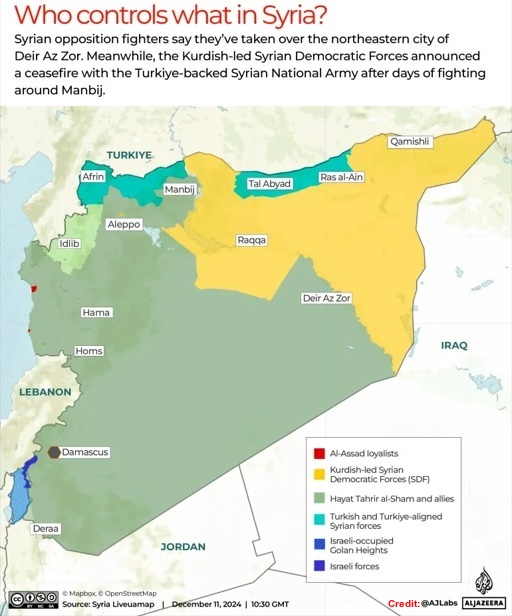
The dramatic turn of events in recent days in Syria is not an expression of dynamics internal to that besieged nation, but the result of external pressures, interventions and manipulations. These reflect a world in turmoil as a dying world order struggles to recover a hegemony that is gone forever. West Asia has been thrown into yet more uncertainty, as the US reinforces its positions there and Israel, with the benediction of Washington DC, pounds Syria with bombs.
Whoever is now controlling the Joe Biden Administration has just decided to pour nearly USD 1 billion worth of weapons into Ukraine, while Rear Admiral Thomas Buchanan, the spokesperson for the Pentagon’s Strategic Command, calmly stated (on November 20, 2024) that the use of nuclear weapons against Russia was no longer unthinkable, provided the US maintains enough of a “reserve capacity” to deter future enemies. Some in the Strategic Command have clearly lost all sense of reason.
In Europe, the European Union (EU) is pursuing the same blind flight forward. As for the much-touted democracy, when election results are not to their fancy, as can be seen in Romania, they are simply cancelled.
The December 7-8, 2024 international (online) conference of the Schiller Institute provided the assessments and the concepts needed to build an international resistance movement to this unipolar world. Therefore, our issue is largely devoted to highlights of Panel I, following three news items. The videos of the full conference are available here.

The Fall of al-Assad: An Expert’s View
The View of an Expert on the fall of al-Assad among the countless comments on what is happening in Syria with the rapid fall of the al-Assad Government, and its repercussions, one assessment worth reflecting upon was given by former US State Department official Chas Freeman in an interview on December 8, 2024 with Pascal Lottaz, for his Japan-based blog Neutrality Studies. Freeman, a respected diplomat whose career included service as Ambassador to Saudi Arabia, emphasised at several points that it was too early to draw conclusions as to what led to the collapse of the government, and to know what the future Syria would look like, but there were profound geopolitical implications which were knowable.
To begin with, Freeman stated that the big winner is Israel and Prime Minister Benjamin ‘Bibi’ Netanyahu. Israel has successfully dealt with the forces identified as Iran’s military proxies in the region, pounding Hamas in Gaza, decapitating Hezbollah and decimating its ranks, and now, removing the bridge, in Syria, that Iran used for logistical support for Hezbollah. The Israeli objective now is to “fragment Syria…through divide-and-rule”. This would mean that Iran now faces Israel directly, as there is no longer a “forward-deployed deterrent” force protecting the Islamic Republic. Freeman suggested that this may start up the discussion in Tehran about reviving the country’s nuclear weapons programme, although he has seen no evidence of this yet.
As to the correlation of forces which led to President al-Assad’s fall, Freeman said that there were “many foreign hands in this”, but the full picture was still “a little bit murky”. Hayat Tahrir al-Sham (HTS) was not a band of guerrilla rebels, but a “well-trained, well-led army… with a full panoply of new weapons”, including tanks. He implied that it was due to backing from Turkey and to some extent Ukraine, though he also mentioned the CIA, which he said had been involved in regime change efforts in Syria since 1947 and possibly the French.
In an earlier interview, he had identified the role of the Caesar Sanctions, issued by the US, which crippled the economy overall and harmed morale of the Army, as well as the US takeover of Syrian oil fields. The daily blackouts have taken their toll, diminishing popular support for al-Assad.
As for the role of Turkey and President Recep Tayyip Erdoğan, he specified that the Turkish interest is to eliminate the Syrian Kurd factions allied with the PKK, and to return the five million Syrian refugees in Turkey. Both Turkey and Russia had put pressure on Bashar al-Assad to make peace with HTS, but he refused. As a result, Freeman speculated that it was “not improbable” that Turkey and Russia had “written him off”, leading to Ankara providing military training for HTS. Russia is reportedly in negotiations with the HTS to maintain its main base in Syria.
Freeman noted that Abu Mohammad al-Julani, the leader of HTS, who has a USD 10 million bounty on his head issued by the US, has distanced himself from his more radical jihadist days when his militia was an al-Qaeda affiliate, known as al-Nusra. Has he changed? Freeman joked that the Western media propagandists are calling him a “democratic liberal jihadist”, but time will tell.
Israeli Prime Minister Netanyahu wasted no time proclaiming this a great victory, and beginning to carve up Syria. The Times of Israel reported that IDF forces captured Syrian territories on the Golan Heights, which Netanyahu, who visited the area December 9, 2024, described as necessary “to protect our border”. Netanyahu is obviously hoping that Israel’s military victories will be a factor in protecting him, as he heads to court to face numerous charges of corruption.
This article was first published in Executive Intelligence Review (EIR) Strategic Alert weekly newsletter (Volume 38, No. 50) on December 12, 2024.
Boundless Ocean of Politics on Facebook
Boundless Ocean of Politics on Twitter
Boundless Ocean of Politics on Linkedin
Contact: kousdas@gmail.com

 ISMC
ISMC Boundless Ocean Of Politics