

France Accused Of Double Standards
As Israel is upset with France, the Israeli Defence Forces (IDF) recently blew up a gas station of the French company, Total Energies, in Lebanon! A section of defence experts believes that the ties between the two friendly nations have touched a low due to the Israeli airstrikes in Lebanon.
The IDF have been carrying out carpet bombing in Gaza and other parts of Palestine for the last one year in an attempt to wipe out the Iran-backed Palestinian Hamas Movement. The Israeli forces have not even spared schools and hospitals in Palestine, causing a storm of condemnation across the globe. However, the Zionist Regime is conducting ground operations in Gaza without paying much attention to it. The IDF have reportedly captured about 75% of the Palestinian territory!
Hezbollah, the Iran-backed Lebanese Shia Islamist militant group and political outfit, has been supporting Hamas since the beginning of the Gaza War on October 7, 2023. The outfit has numerous secret bases in Lebanon from where the Hezbollah fighters have launched missile attacks on Israel in recent times. The Jewish nation has, so far, managed to neutralise the effects of most of the missiles fired by Hezbollah in the air with the help of its Air Defence System. The Iron Dome, David’s Sling and Arrow (or Hetz) have done a great job in this regard. After turning the Palestinian territory into ruins, Israel is currently targeting Lebanon to wipe out Hezbollah.
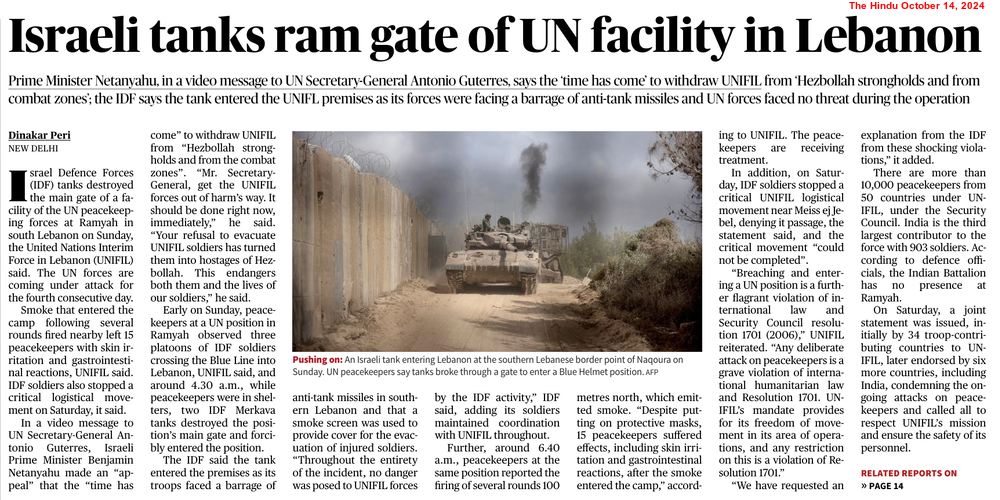
From the middle of September 2024, the IDF began to increase the number of airstrikes in southern Lebanon. One part of the Lebanese capital of Beirut has already been destroyed by the IDF with missiles. The Israelis have started ground operations there, as well! Although the US has been vocal about the Human Rights violations by Israel in Gaza, France has not criticised the Zionist Regime. However, Paris has strongly condemned the Israeli atrocities in Lebanon!
According to political analysts, France has adopted different policies for Gaza and Lebanon because of its economic, as well as political, interests! French President Emmanuel Jean-Michel Frédéric Macron is not ready to compromise with the national interests of his country. In fact, there was no such country as Lebanon in the early 20th Century and the territory was a part of Syria. The small mountainous nation on the Eastern Mediterranean was created at the end of the First World War and came out of the breakup of the Ottoman Empire. After the end of the First World War in 1918, the vast territory of West Asia, including Syria, came under the possession of France. Later, France created a separate country in the western part of Syria that was basically a Christian-dominated area. As Lebanon is situated on the shores of the Mediterranean Sea, it became one of the centres of French maritime trade.
When Lebanon was created in 1918, 50% of its inhabitants were Christians and the remaining 50% were Shia and Sunni sects of Islam. Incidentally, the demography changed in the second half of the 20th Century. Following the Second World War and the Holocaust, international pressure mounted for the establishment of a Jewish State in Palestine, leading to the creation of Israel in 1948. As Israel is bordered by Lebanon (and Syria) to the north, the two countries in the Southern Levant region of West Asia often got involved in armed conflict. In the mid-1960s, the Muslim residents of Israel started arriving in Lebanon. This influx of Palestinian refugees caused a major shift in demographics of Lebanon. While Christians became a minority in the Mediterranean country, the number of Shias and Sunnis increased several times! However, the French influence on Lebanon has remained the same.
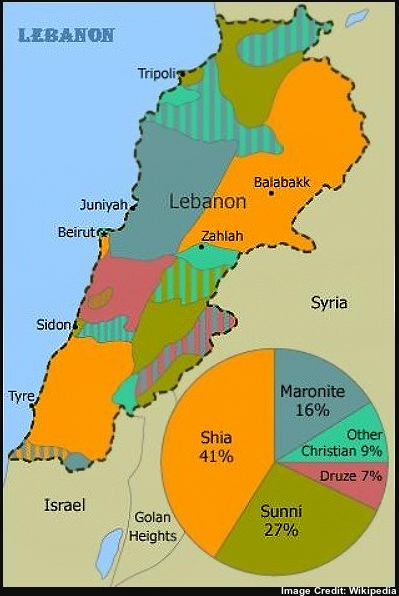
French is the second major language in Lebanon and it is taught in 70% of schools! The West Asian nation also attracts a large number of French tourists every year, prompting Paris to open a number of embassies across Lebanon. Most importantly, France has invested heavily in Lebanon. Paris reportedly committed EUR 845 million (EUR 208 million in donations and EUR 637 million in loans) for the 2020-22 period in Lebanon and Syria. Quite a number of French corporations have indulged into extraction of mineral oil and gas, there!
Total Energies, the French multinational integrated energy and petroleum company founded in 1924 and one of the seven supermajor oil companies, entered Lebanon in 1951 and started extracting oil from the Mediterranean Sea. However, there is a dispute between Beirut and Tel Aviv over that particular area of the Mediterranean Sea. Total Energies reached an agreement with Israel a couple of years ago on the basis of which Tel Aviv allowed the French company to extract oil from the Mediterranean. However, the IDF blew up a gas station of Total Energies in the first week of October 2024!
Defence experts are of the opinion that there are multiple reasons behind Israel’s anger towards France. On September 26 (2024), President Macron unveiled a proposal for a 21-day ceasefire in Lebanon in a UN diplomatic push (together with the US) as the death toll mounted from strikes by Israel against Hezbollah. However, Israeli Prime Minister Benjamin ‘Bibi’ Netanyahu rejected the proposal, stressing that Paris’ proposal would ultimately boost Hezbollah. Instead, Tel Aviv sent 10,000 soldiers to Lebanon! According to sources, France wanted the ceasefire to withdraw the majority of investments from the West Asian nation. After Israel rejected his proposal, President Macron announced that his country would stop supplying arms to the Jewish State, stating: “I think that today, the priority is that we return to a political solution, that we stop delivering weapons to fight in Gaza.”
On his X handle, Prime Minister Netanyahu strongly criticised France’s move on October 5, stressing: “As Israel fights the forces of barbarism led by Iran, all civilised countries should be standing firmly by Israel’s side. Yet, President Macron and other Western leaders are now calling for arms embargoes against Israel. Shame on them.” Jean-Noël Barrot, the French Minister for Europe and Foreign Affairs, held a meeting with his Israeli counterpart Israel Katz in Tel Aviv on October 7 (2024) in an attempt to normalise bilateral ties. The visiting minister of France also described Israel as a close friend.
Now, the global community will have to wait and watch whether Paris lifts the arms embargo on the Zionist Regime.
Boundless Ocean of Politics on Facebook
Boundless Ocean of Politics on Twitter
Boundless Ocean of Politics on Linkedin
Contact: kousdas@gmail.com

 ISMC
ISMC Boundless Ocean Of Politics