

The Death Of Two-State Solution
Immediately after the Palestinian Hamas Movement launched deadly terror attacks on Israel on October 7, 2023, the Jewish nation began a fierce counter-offensive. Commenting on rocket attacks carried out by Hamas, US Secretary of State Antony Blinken reportedly said: “If you look at this in proportion to the size of Israel’s population, this is the equivalent of ten 9/11s. That is how big and how devastating this attack has been.” It is not known what was going on in Blinken’s mind when he met the press, but the situation is dire in West Asia.
Now, Gaza is filled with dead, wounded, dying, homeless and hungry people. Israel is trying hard to uproot all the Gazans from their own territory. Hamas, too, has not yet released the Israeli hostages, and there is no such possibility in the near future. The situation is constantly deteriorating in Jerusalem, Gaza and the West Bank. Obviously, 9/11 was an tragic event. However, the character of the ongoing Israel-Palestine conflict is completely different. People across the globe have expressed serious concern over the two wars (the Ukraine-Russia War and the Israel-Hamas War), taking place in the 21st Century.

Some are of the opinion that what is going on in West Asia is not a war, but a one-sided attack! They have argued that as the State of Israel is using force on the Palestinian people in Gaza, it cannot be called a war between the two parties. It is also a fact that Hamas triggered the crisis, this time. Hence, it is better to say that Israel is about to destroy an entire population in Gaza because of some radical Palestinians.

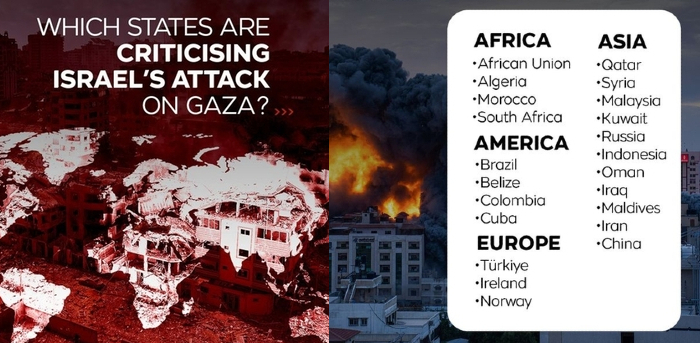
Amidst these arguments and counter-arguments, one thing is clear: Although the Palestinian people cannot fight back, they have no shortage of supporters. Countries, like Iran, Lebanon and Jordan, have declared that they are with Palestine. Other Arab nations, too, back Palestine. Even if they have issued no immediate statement on the Israel-Hamas conflict, governments of those states are under tremendous pressure due to public opinion in favour of Palestine. So, one can say that a war has begun in West Asia, although the Gazans have failed to create much trouble for Israel so far.

No war is confined to any continent or border in the 21st Century. It has become a reality since the Second World War (1939-45), and the reality is even more evident in a globalised world. Attempts to cover up the anti-Israel Movement (in the Muslim World) have already begun in various European countries and in the US, as the Jewish nation shares cordial ties with the Western world. Germany and Austria have started monitoring the movements of the supporters of Islamic extremism. These incidents are worrying in the larger context of Islamophobia. As a result, the situation is likely to become more difficult for Syrian refugees seeking asylum in various countries. Meanwhile, the role of China and Russia, the two rivals of the Western world, is not yet clear. It is difficult to predict whether Beijing and Moscow would try to restore peace in the Gaza Strip.

Experts are of the opinion that the Israel-Hamas conflict may have an impact on the global economy. Crude oil prices are already on the rise. Now, there is little risk of oil supply disruptions. However, such a possibility cannot be ruled out if the conflict continues, and the geopolitical landscape changes suddenly in West Asia. In case Iran plans to block the Strait of Hormuz, a major international trade route will be cut off. A rise in oil prices or disruptions in trade will certainly trigger inflation worldwide.
A second conflict would naturally complicate the situation, as the Russia-Ukraine War has been going on since February 24, 2022. Furthermore, the tight monetary policy that has been adopted everywhere in the world is likely to be prolonged. It will also have an impact on investment. Investors have claimed that the impact of tight monetary policy is being seen in capital markets. If the Israel-Hamas conflict drags on for too long, then the financial meltdown will become inevitable.
Boundless Ocean of Politics on Facebook
Boundless Ocean of Politics on Twitter
Boundless Ocean of Politics on Linkedin
Contact: kousdas@gmail.com

 ISMC
ISMC Boundless Ocean Of Politics