

On ‘Enemy’s Enemy’
Enemy’s enemy is a true friend. Iran has started following this policy as the Islamic Republic is strengthening ties with the declared anti-US countries. Iranian President Ebrahim Raisi arrived in Cuba on June 15, 2023 on an official state visit mainly to bolster ties with the island nation.
Although both Cuba and Iran are popularly known as the enemies of the US, Havana and Tehran never publicly criticised the US policies jointly in the past. After receiving his Iranian counterpart Raisi at his official residence, Cuban President Miguel Mario Díaz-Canel y Bermúdez said that both the countries “have had to face heroically, with tenacious resistance, the sanctions, the pressures, the threats, the blockades and the indifference of US imperialism and its allies“. It may be noted that apart from imposing economic sanctions, Washington DC has also included Cuba and Iran in its list of State Sponsors of Terrorism. The local media reported that the two leaders presided over the signing of Memoranda on Cooperation in different areas, such as customs, telecommunications and justice. Before his meeting with President Diaz-Canel, the visiting Iranian President had told a business forum that his country was ready to work with Cuba in science and technology, on hydroelectric and thermoelectric plants, and mining.
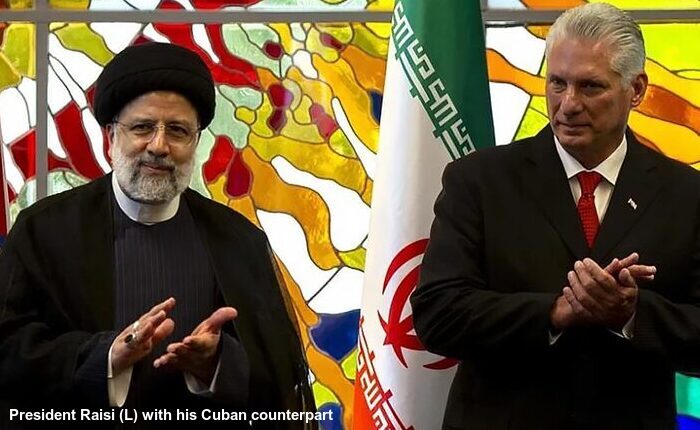
Ahead of his arrival in Havana, President Raisi visited Nicaragua and Venezuela as a part of his three-nation tour. The US has imposed economic sanctions on these two Latin American countries, too! Speaking at official events in Managua and Caracas, he described the US as a common enemy. Iran also signed a number of agreements with Nicaragua and Venezuela during the trip of President Raisi. Incidentally, all these countries are allies of Russia, and they are backing the Russian Invasion of Ukraine. Experts are of the opinion that Russian provocations or China’s activism might have prompted these countries to jointly criticise the US. They have opined that some South and West Asian nations, too, have started showing anger against Washington DC in recent times, and Beijing is instigating them to issue anti-US statements.
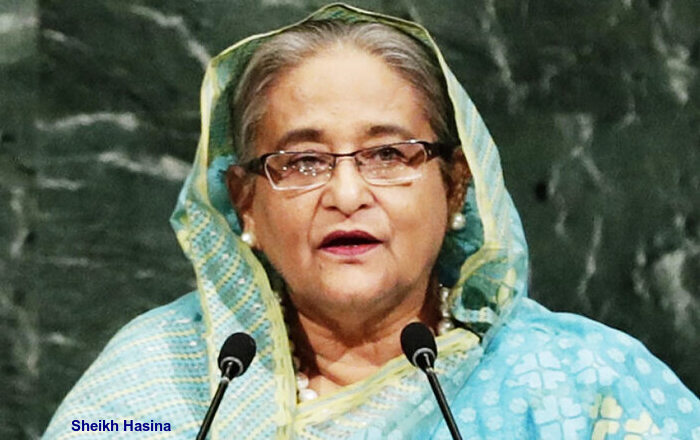
Sheikh Hasina Wazed, the Prime Minister of Bangladesh, strongly criticised the US in May 2023 for interfering in internal affairs of her country. She also accused the Joe Biden Administration of ruining the Democracy in Bangladesh. A section of political analysts is of the opinion that Prime Minister Hasina did not like the US’ move to communicate with the opposition Bangladesh Nationalist Party (BNP). They also believe that the statement of Hasina is not her alone, as she mentioned the current political situation in Nepal and Sri Lanka. Long before Prime Minister Hasina publicly criticised the US, the hardliners in Bangladesh had pointed the finger at Washington DC. They still consider the return of the Taliban in Afghanistan as a victory for Islam.
Sri Lanka has not considered the US as a friendly nation since 1970. The US’ passive role in the Sri Lankan Civil War, and stand on UN policies on refugees and also on Human Rights have angered the Sri Lankan nationals. In the past, the Sri Lankans refused to use products imported from the US. Dissatisfaction with the US has been there in Nepal since the 1950s. Majority of the people in the Himalayan country were against the US’ move to trigger unrest in Tibet, as well as to monitor China, from their soil. According to political analysts, Beijing has started taking advantage of this situation in order to increase its influence in South Asia and West Asia.

The timing is also an important factor here. At a time when some South Asian countries are openly criticising the US policies, Iran has joined hands with some Central and Latin American nations to openly blast foreign policies of the Joe Biden Administration.
Boundless Ocean of Politics on Facebook
Boundless Ocean of Politics on Twitter
Boundless Ocean of Politics on Linkedin
Contact: kousdas@gmail.com

 ISMC
ISMC Boundless Ocean Of Politics