

On Multi-Layered Diplomatic Policy
Turkish President Recep Tayyip Erdoğan raised the Kashmir issue during his address to the 81st UN General Assembly on September 22, 2026, in keeping with established practice. He stated that “all disputes (between India and Pakistan), including the Kashmir issue, be addressed through dialogue within the framework of the United Nations Charter and of relevant resolutions“. Thus, President Erdoğan employed his familiar diplomatic tactic of siding with Pakistan yet again, ignoring India’s strong objections.
However, Ankara’s decision to extradite wanted narco-trafficking kingpin Navpreet Singh from Turkey to India in early October 2026 has defied the established diplomatic patterns and garnered significant global attention. In fact, the emergence of such strategic cooperation (shortly after the expression of differences at the UN) makes it clear that the diplomatic relationship between New Delhi and Ankara is underpinned by pragmatic geopolitics, in spite of verbal opposition.
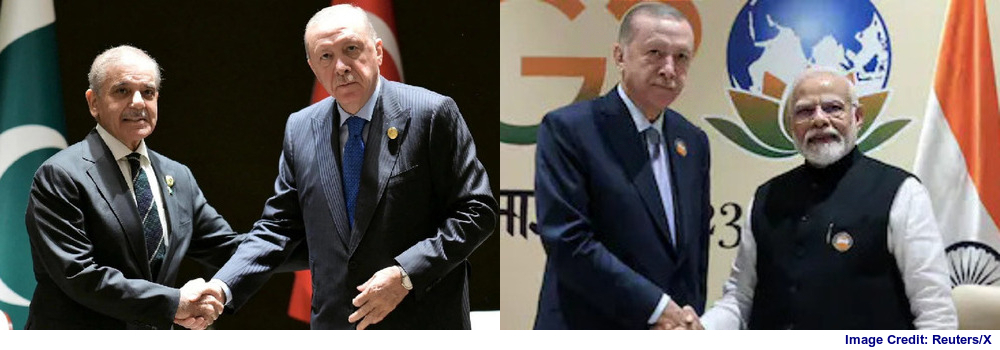
The shadow of Pakistan has long shaped India-Turkey relations, acting as the primary barrier to a deeper strategic partnership. Whether it is the Kashmir dispute or the 2025 military conflict between India and Pakistan, Turkey has always aligned with Pakistan, driven by strategic defence ties and shared geopolitical interests. Ankara has repeatedly undermined New Delhi’s interests by acting as a key diplomatic shield for Islamabad during Pakistan’s tenure on the FATF Grey List (2018-2022) and also by opposing India’s membership in the 48-nation Nuclear Suppliers Group (NSG). It can be assumed that Ankara’s geopolitical ambition to become the preeminent leader of the Islamic World compels President Erdoğan to pursue a pro-Pakistan policy.
In response to Ankara’s Kashmir card, India has expressed support for Cyprus’ sovereignty and also strengthened military ties with Armenia, thereby exerting strategic pressure on Turkey. India’s proactive strategic outreach to Cyprus and Armenia marks a significant shift in its foreign policy doctrine, serving as a direct counterweight to the Ankara-Islamabad axis. However, various diplomatic gestures suggest that the two countries are interested in moving beyond the cold war and to adopt a pragmatic approach to their diplomatic relations. Both New Delhi and Ankara seek to prioritise mutual economic and strategic interests.
India’s swift mobilisation of Operation Dost following the devastating February 2023 earthquakes in Turkey stood as a definitive moment in disaster diplomacy as it was a powerful, human-centric gesture that momentarily transcended deep geopolitical divides. India extending a helping hand to Turkey during the earthquake must have been significant for the policymakers in Ankara. Handing over a criminal, like Navpreet Singh, to India is the result of that pragmatic relationship.
It is quite impossible for Turkey to ignore India in the current global economic and geopolitical landscape. As one of the largest markets within the rapidly growing global economy, India’s capabilities in the information technology, pharmaceutical and construction sectors are really hard to overlook. Similarly, India could leverage the geographical location of Turkey, situated at the crossroads of West Asia and Europe, to ensure the success of projects, like the India-Middle East-Europe Economic Corridor (IMEC). Hence, the relationship between India and Turkey is no longer confined to the simple equation of friend or foe.
Turkey’s stance on the Kashmir dispute has always been a sensitive issue for India. However, bilateral diplomacy operates on the principle that communication channels must remain open, even when nations face severe disagreements. In international relations, cutting off ties completely is rarely effective and often dangerous, as it eliminates the mechanisms required to manage conflict and prevent escalation.
The deeply entrenched political differences between the two countries over Kashmir and Pakistan may not be resolved overnight; but India and Turkey, driven by economic and security interests, could move closer together. That’s why the two regional powers are actively navigating a complex diplomatic balancing act.
Meanwhile,

Boundless Ocean of Politics on Facebook
Boundless Ocean of Politics on Twitter
Boundless Ocean of Politics on Linkedin
Contact us: kousdas@gmail.com

 ISMC

