

Inhumane: Crocodiles To Guard Palestinians
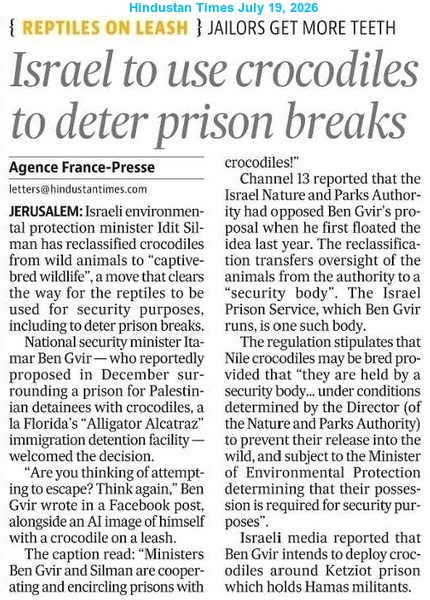
Israel has decided to build a prison surrounded by a moat in order to prevent Palestinian prisoners from escaping. The Benjamin Netanyahu Government has also decided to release crocodiles into that moat.
Earlier, Israeli National Security Minister Itamar Ben-Gvir made a proposal in this regard, stressing that the Palestinian detainees should be kept in a facility surrounded by crocodiles. Now, Environmental Protection Minister Idit Silman has confirmed that the government accepted the proposal, saying that he signed a declaration changing the legal classification of crocodiles to “cared-for wild animals”. Reports suggest that the reclassification would allow government agencies, including the Israel Prison Service, to keep crocodiles at their facilities under specified conditions.
The Israel Prison Service has started examining the feasibility of the proposal and has visited zoos to study the handling, as well as care, of crocodiles. Officials involved in the assessment have claimed that crocodile-filled waterways around certain prisons could potentially reduce security costs while increasing deterrence.
Meanwhile, various international Human Rights organisations have raised questions regarding the proposed move by Tel Aviv. It may be noted that both Ben-Gvir and Silman are widely recognised as hardline figures within the Netanyahu Administration. They allegedly made various derogatory remarks about Palestinian activists in the past, as well.
Incidentally, there are a total of 26 species of crocodiles in the world. Among them, two species – Saltwater crocodile and the Nile crocodile – are formidable apex predators that hold a notorious reputation for occasionally viewing humans as prey. Both species are highly opportunistic, territorially protective, and possess the size and bite force required to take down large mammals.
The Indian Border Security Force (BSF) recently announced that it would explore the feasibility of using venomous snakes and crocodiles as natural deterrents in vulnerable, 175km unfenced riverine and swampy gaps along the 4,096km India-Bangladesh border. The plan aims to curb cross-border infiltration and smuggling, although it remains in the preliminary study phase.
Meanwhile,


Boundless Ocean of Politics on Facebook
Boundless Ocean of Politics on Twitter
Boundless Ocean of Politics on Linkedin
Contact us: kousdas@gmail.com

 ISMC
ISMC
