

A Soft Coup In Iran
Iran laid former Supreme Leader Ayatollah Ali Hosseini Khamenei to rest with full state honours on July 9, 2026 as his burial at the Imam Reza shrine in his hometown of Mashhad concluded a historic, multi-day funeral procession that spanned major religious, as well as political, centres across Iran and neighbouring Iraq.
During the funeral ceremony, Iranian President Masoud Pezeshkian was seen walking beside Ali Khamenei’s coffin, draped in the national flag. Some hardline supporters among the common people standing on both sides of the road reportedly raised slogans, like “Death to the compromiser” and “Traitorous sellout“, against him.
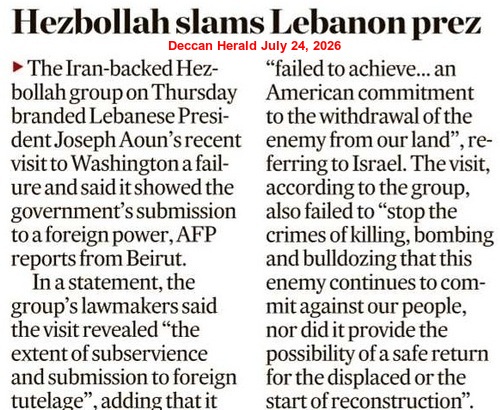
Foreign Minister Seyyed Abbas Araghchi has been seen experiencing an even worse situation in recent times, as well. Amidst the conflict, Tehran agreed to come to the negotiating table in response to a call from US President Donald John Trump. It may be noted that Araghchi was one of the key figures behind the decision to hold talks with the US. The foreign minister also agreed to a ceasefire with Washington DC and to the opening of the blocked Strait of Hormuz. Later, Araghchi was branded a traitorous collaborator (during Khamenei’s funeral procession). In fact, he was forced to leave the funeral procession early.
According to defence analysts, hardliners are seeking revenge for Ali Khamenei’s death at any cost. As hardliners consider the agreement or understanding reached with the US a departure from the ideals of the 1979 Islamic Revolution, they have significant objections to the moderate stance of President Pezeshkian or Foreign Minister Araghchi. Hence, political instability is mounting in the Islamic Republic amidst the war.
The absence of Ali Khamenei’s son, Mojtaba, adds fuel to the fire. Mojtaba Khamenei was appointed as the Supreme Leader by the Assembly of Experts, an 88-member Council of Shia Clerics, soon after the assassination of his father. However, he is widely reported by global intelligence to be severely wounded, isolated and incapacitated following the joint US-Israeli military operation. Mojtaba’s total disappearance from public view has left the Islamic Revolutionary Guard Corps (IRGC) to govern the country by default. As he effectively rules from a secure, hidden location, communicating via physical couriers instead of digital networks; hardliners, taking advantage of his absence, have engaged in a silent coup.
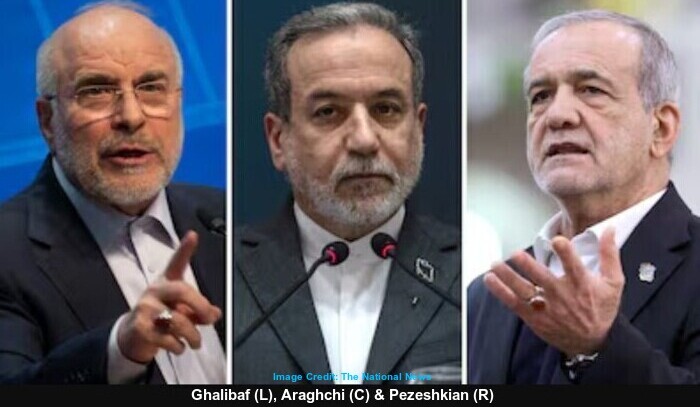
Iranian-American historian Arash Azizi recently told CNN that Chief Negotiator Mohammad Bagher Ghalibaf, President Pezeshkian and Araghchi became the most visible faces in charge of post-war Iran in Mojtaba’s absence. “Without access to the new supreme leader, hardliners who are unhappy with their performance have instead accused them of plotting a coup,” he stressed. Azizi added: “Mojtaba’s continued absence means that they don’t have access to him and also that Ghalibaf and allies are effectively in charge of the country. The ultra-hardliners have, thus, accused Ghalibaf and Pezeshkian of plotting a coup against Mojtaba.”
Interestingly, Mahmoud Nabavian, a radical Iranian lawmaker, asked on X just days before Ali Khamenei’s funeral: “Warning to the people of Iran: Is a coup on the way??” A couple of days later, he wrote: “In these moments of farewell to the martyred Imam (Khamenei), we raise the banner of vengeance for his blood and stand firm against the coup.”
Hardliners have accused President Pezeshkian, Ghalibaf and Araghchi of staging a “soft coup” by advancing indirect talks and a ceasefire with the US without parliamentary oversight. The allegations have led to accusations that top leaders are hiding the specifics of the agreements from lawmakers. Hence, demands for their removal from the top administrative level have begun to gain momentum in Iran.
Meanwhile,

Boundless Ocean of Politics on Facebook
Boundless Ocean of Politics on Twitter
Boundless Ocean of Politics on Linkedin
Contact us: kousdas@gmail.com

 ISMC
ISMC
