

Ancient Egyptian Princesses Were Skilled In Archery
Ancient Egypt still fascinates millions, as archaeologists estimate that upwards of 70% of historical sites remain entirely undiscovered, hiding beneath the sands or lost in remote desert regions. Archaeologists, after analysing bones of some mummies, recently claimed that ancient Egyptian princesses were proficient in the art of warfare.
Dahshur, a vital royal necropolis containing some of Egypt’s oldest, largest and best-preserved pyramids, is located approximately 40km south of Cairo. One can reach the area in the western basin of the Nile by road from Cairo in an hour. Archaeologists discovered six mummies inside a pyramid in Dahshur. Most of the mummies belong to the royal family, although the identities of a few could not be determined.
Archaeologists have claimed that the one male mummy was an obscure 13th Dynasty pharaoh, while three – Ita, Khenmet and Itaweret – were probably daughters of the 12th Dynasty Pharaoh Amenemhat II, who ruled approximately between 1929 and 1895 BC. They have identified one mummy as that of Sathathormeryt, a fourth sister to the three princesses. The other one was also a princess, but was not one of the sisters.
In fact, those mummies were discovered by French archaeologist Jean-Jacques de Morgan a century ago (in 1895). The Dahshur royal remains, including King Hor and Princess Nub-hotep, were brought to the Egyptian Museum in Tahrir by Madame Fouquet in 1915. Stored in wooden boxes, they were lost and forgotten for over a century before being rediscovered in 2020 during collection sorting.
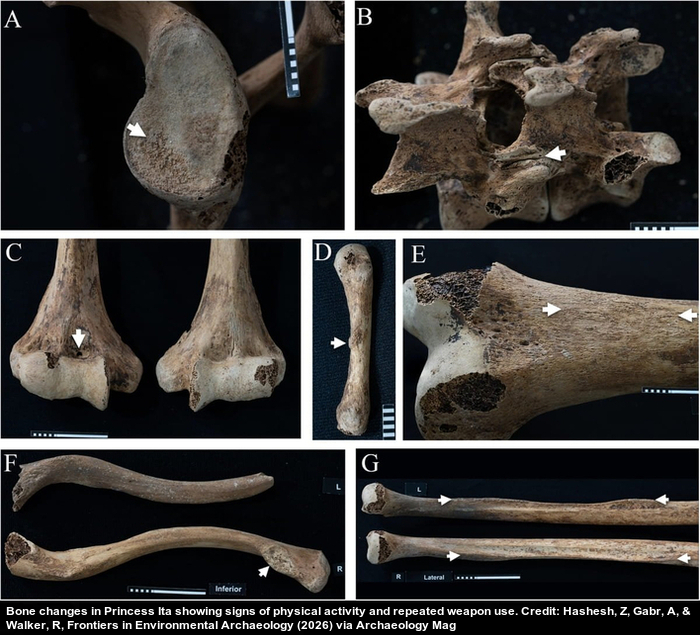
In 2020, archaeologist Zeinab Hashesh from Beni-Suef University rediscovered the remains of six Middle Kingdom royals. Hashesh and her colleagues examined those remains for the past six years. Their research paper has recently been published in the Frontiers in Environmental Archaeology journal.
When Morgan first discovered those 4,000-year-old mummies, a number of weapons, such as gem-studded swords, bows and maces, were found alongside them. Until now, such weapons were typically found only with the mummies of ancient Egyptian men. Hence, the discovery of weapons alongside female mummies a century ago was not accorded much significance. One of the reasons for this is the belief in the afterlife held by the people of Ancient Egyptian civilisation. Based on that very notion, they made a mistake by assuming that weapons were placed alongside the mummies of princesses as a part of ritual practice.
Meanwhile, research by Hashesh and her colleagues has revealed completely different facts. They have claimed that Ancient Egyptian princesses were well-trained in martial arts and warfare. After studying skeletal remains of royal women from the Middle Kingdom, they found robust muscle attachments consistent with intensive, long-term weapons handling, like archery and using daggers.
Both King Hor and Princess Nub-hotep featured robust upper-body muscle attachments consistent with repetitive, high-intensity actions, like drawing a bowstring. Hashesh said: “These princesses were active practitioners of hunting or athletic skills rather than merely symbolic owners of the weapons found in their tombs.” She also said that characteristics of the female mummies showed they had performed intensive martial activities. The Lead Researcher stressed: “These princesses were not leading sedentary lives of luxury. They were well-conditioned athletes whose bodies were hardened by the same skilled force and disciplined movement as the men of their time.” According to Hashesh, they have found clear evidence of “robust muscle attachments“, where connective tissue once joined the muscle and the bone, and some telling skeletal developments. For instance, enlarged areas of the forearm bones indicated that Itaweret had often drawn bows.
Hashesh continued: “Princess Ita was a young woman aged between 28 and 34 with strong upper-body muscle attachments, suggesting she habitually used weapons like maces or daggers. However, Princess Khenmet was a woman in her late 30s or 40s who showed signs of thinning bones, but had very robust ligament attachments. Princess Itaweret was a young woman aged between 20 and 34 who survived broken ribs and foot fractures; but her skeleton shows she was a skilled archer.“
However, it remains unclear whether Ancient Egyptian princesses actually took to the battlefield, or primarily used these weapons for ritual, status or hunting. In ancient Egyptian civilisation, it was believed that the soul could achieve eternal life through proper training. Across different eras, the Ancient Royal Egyptian training often involved rigorous preparation for high-stakes leadership, estate management and survival in the battlefield. In all likelihood, it was the training the princesses were given.
Meanwhile,









Boundless Ocean of Politics on Facebook
Boundless Ocean of Politics on Twitter
Boundless Ocean of Politics on Linkedin
Contact us: kousdas@gmail.com

 ISMC
ISMC
