

Impact Of Bengal Poll On India’s Security Policy
Prime Minister Narendra Modi’s Bharatiya Janata Party (BJP) scripted a historic mandate in 2026 Assembly Elections in the eastern Indian Province of West Bengal on May 4, 2026. The BJP won 207 seats in the 294-member Provincial Assembly, while former Chief Minister Mamata Banerjee‘s Trinamool Congress (TMC) Party managed to win only 80 seats. The BJP has also won the Assembly Elections in Assam, the neighbouring province.
Political analysts are of the opinion that the victory of the BJP in eastern Provinces of West Bengal and Assam will have a great impact on India’s foreign policy, especially as both these provinces are the crucial connectors to the Act East Policy of New Delhi. Also, the Modi Administration has got an opportunity to strengthen national security by tackling infiltration and safeguarding the strategically important Siliguri Corridor (also called the Chicken’s Neck) in the north of West Bengal. It may be noted that Assam shares a 267.5km-long international border with Bangladesh, while West Bengal shares a 2,217km international border.
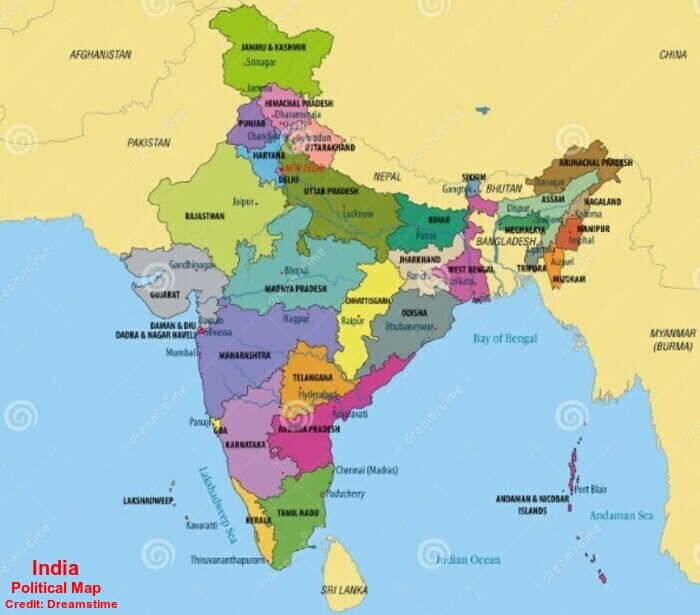
As expected, Bangladesh and Pakistan were closely monitoring the election in West Bengal as Islamabad often sends terrorists to India via Bangladesh. They arrive in different parts of the South Asian country to carry out terror attacks from Kolkata, the capital of West Bengal. Former Chief Minister Banerjee was reluctant to hand over 127km of land to the Border Security Force (BSF) of India for India-Bangladesh border fencing, creating trouble for the Modi Government. With the BJP coming to power in West Bengal, this issue will be resolved soon.
Ahead of the Provincial Election, Prime Minister Modi stressed: “Siliguri (a city in West Bengal) is one of the most important gateways for India’s security. The Siliguri Corridor is integral to Mother India. I want to give you an example of the TMC’s misdeeds when it comes to the security of the nation. In the country, there is a tukde-tukde gang. This gang had issued a threat related to the Siliguri Corridor. They have spoken about separating the northeast from the country. To pursue its appeasement agenda, the TMC supports such people on the streets and in the Parliament.“
For his part, former Foreign Secretary Harshvardhan Shringla stated: “The Siliguri Corridor is a stretch of land that connects the northeastern part of the country with the rest of India. It is a very narrow stretch of 22km. The Darjeeling Constituency is perhaps the only constituency in the world that has three international borders. It links up with Nepal in the west, Bhutan in the east and Bangladesh in the south. If you go a little bit north, you will also come to the border with China.” He added: “So, it is a very sensitive part of our country, and there are very important security-related concerns here, which, given the strategic nature of the location, issues like security, infiltration of foreign nationals, the security-related concerns that are very evident here and are very important in the narrative that is evident in the elections.“
Read: Suddenly Realising That The Entire System Is Corrupt
Shringla told NDTV: “West Bengal, under the TMC dispensation, completely neglected the security aspects of its responsibilities. On the contrary, they used it to further their political ends to the detriment of our national interest. So, what is happening here is that there is infiltration through parts of the border that are not fenced. As you know, we have a 4,000km border with Bangladesh, which is our largest border with any other country. A quarter of this border is not yet fenced, and that is mainly in the state of West Bengal. And the reason for that is that the state refused to give land, which is necessary for the construction of that fence. Land allocation has not been done, and one of the resolves of the BJP in their manifesto is that within 45 days of coming to power in West Bengal, they will provide the land, and fencing will begin in West Bengal. In other words, we have to fence off the border to ensure that infiltration is not happening.“
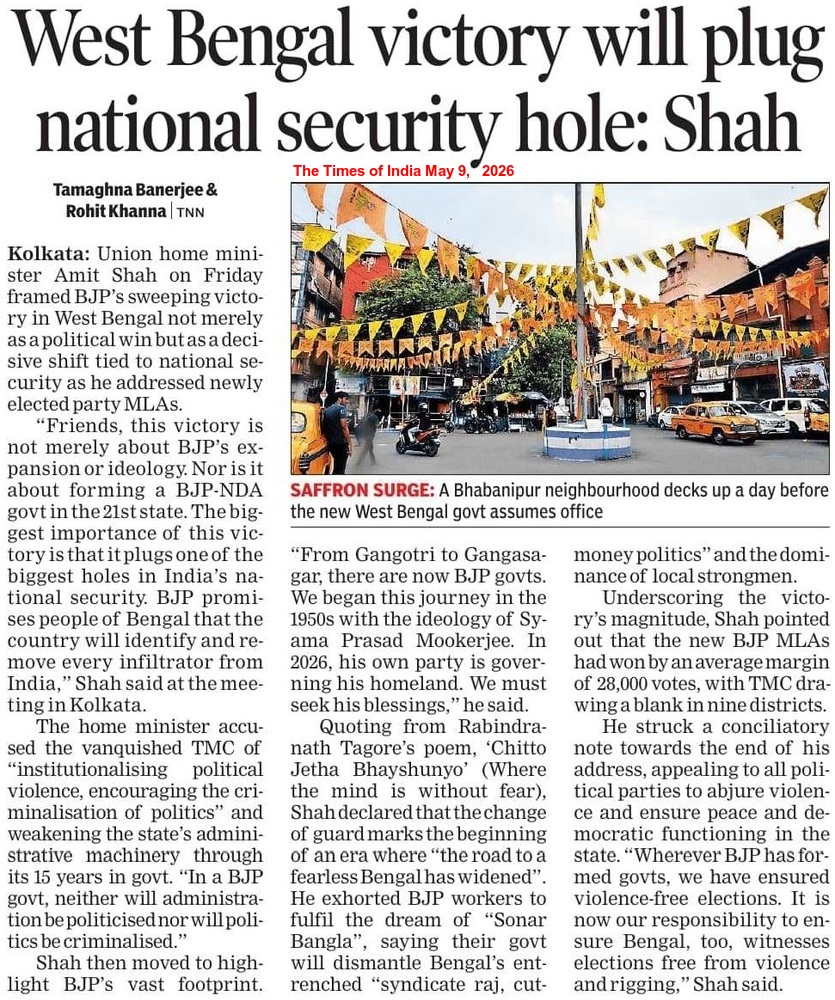
Meanwhile, the BJP’s victory in the 2026 Assembly Elections is a significant milestone in the history of West Bengal. This election has not only brought a new ruling party to the province, but also ushered in a new era in every sense of the term. It has established within the mainstream of West Bengal a political and social culture whose impact will be far-reaching. The BJP has uprooted the TMC Government, run by Chief Minister Mamata Banerjee, which ended the 34-year rule of the Left Front in 2011 and dominated provincial politics until the 2026 Assembly Elections held in April.
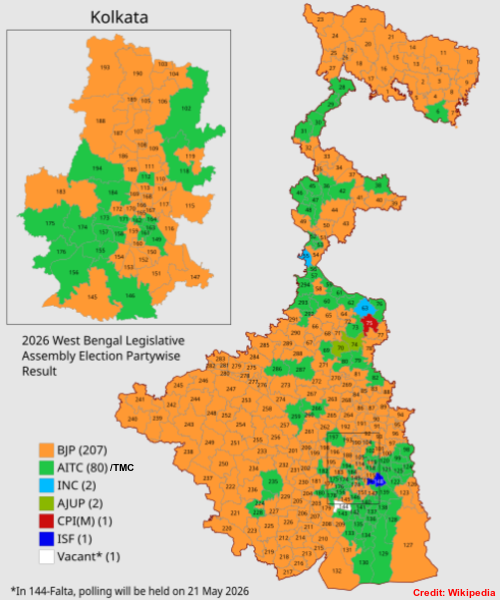
Although Banerjee and her TMC Party have offered a different interpretation of this massive public mandate, the results bear an imprint of surging public anger against her style of governance. Political analysts have characterised the outcome as a “powerful and emphatic verdict” against the ruling TMC, signalling a deep-seated public exhaustion with corruption, arrogance and unethical governance. The outcome of the election has also revealed the extent to which political violence, deteriorating law and order situation, crime against women and high rates of joblessness have pushed the common people to the brink of impatience. The results have further demonstrated a significant, public rejection of the ruling dispensation, driven by deep-seated frustration over critical governance issues.
This is why West Bengal has undergone a significant political shift, with the BJP winning a majority in the 2026 Assembly Elections, ending the 15-year rule of the TMC. The verdict reflects a No Mamata sentiment, characterised by a massive voter turnout (approaching 93%) which analysts attribute to widespread exhaustion with the Banerjee Administration.
For the first time since 1975, a party, which is in power in New Delhi, has formed the government in West Bengal. What Bengal needs now is not merely a mighty ruling party, but a government capable of addressing long-standing economic and social challenges that have resulted in the province’s decline from its former industrial prominence. Hence, the newly-formed BJP Government faces the critical, complex task of addressing those issues.
Read: Degeneration!
Meanwhile,


Boundless Ocean of Politics on Facebook
Boundless Ocean of Politics on Twitter
Boundless Ocean of Politics on Linkedin
Contact us: kousdas@gmail.com

 ISMC
ISMC

1 Comment »