

A Silent Epidemic Rocks India
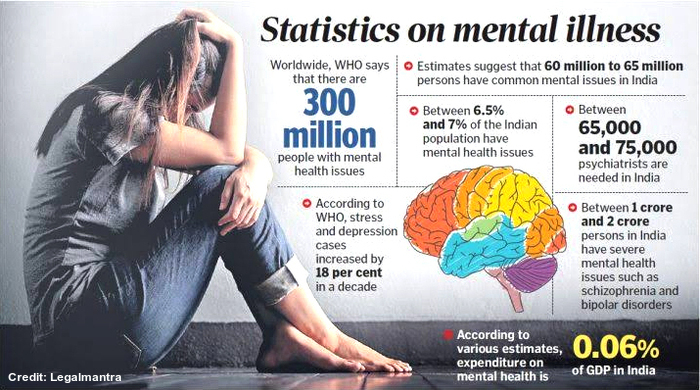
Most Indians are not familiar with the concept of Disability-Adjusted Life Years (DALYs) which are basically a comprehensive metric, measuring the total burden of disease, both mental and physical, representing the number of years lost due to ill-health, disability or early death. One DALY equals one lost year of healthy life. It is calculated as the sum of Years of Life Lost (YLL) and Years Lived with Disability (YLD). In its latest report, the World Health Organisation (WHO) has estimated the mental health burden in India at 2,443 DALYs per 10,000 population.
The Government of India has not conducted any study on this particular issue as the Indian State, like the Indian society, is not much worried about issues related to mental health even in the 21st Century. Meanwhile, a 2015-16 survey by Médecins Sans Frontières (MSF) found that nearly 1.8 million adults (45% of the population) in the Kashmir Valley reported symptoms of mental distress, with 41% experiencing symptoms of depression. The data highlights a severe mental health crisis, with 93% of the population having experienced conflict-related trauma.
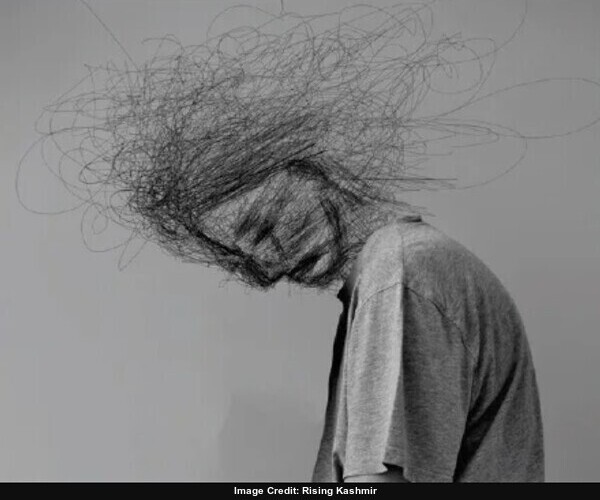
The Institute of Mental Health and Neurosciences (IMHANS) in Srinagar catered to around 0.2 million patients in 2024. Talking to the media, Dr Yasir Rather, a Professor at the Department of Psychiatry, IMHANS, stressed: “As the only tertiary-level psychiatric hospital in the region, the IMHANS catered to around 0.2 million patients in 2024, including those seeking help for both general mental health problems and substance-use disorders.” He added: “This number itself reflects the growing demand for accessible, affordable and stigma-free care.” Based on official data released around World Mental Health Day in October 2025, the Government Medical College (GMC) in Anantnag treated over 0.27 million (270,000) patients for mental health issues in the five years since its inception in 2019. Health experts have called this situation a Silent Epidemic.
According to psychologists, the mental health of people becomes weak and fragile in regions or countries which experience war, war-like conditions, conflict or bloodshed. Similar situations have recently been seen in Gaza, Ukraine and various civil war-torn African nations. Different countries across the globe witnessed a rise in issues related to mental health during the Second World War, as well. However, the fact that the long-term effects of the bloody conflict and terrorism in Jammu and Kashmir have started affecting the minds of the people in the northern part of India is new, as well as frightening. The youth are more affected by DALYs, as they are victims of both the turbulent past of the valley and its uncertain future.
After revoking the special status of Jammu and Kashmir on August 5, 2019 by abrogating the Article 370 of the Indian Constitution that had granted the region significant autonomy, the Government of India claimed that Kashmir became a heaven on Earth. However, the Pulwama (February 14, 2019) and Pahalgam (April 22, 2025) incidents proved that it was an absurd claim. Except for the tourism sector, there has been almost no real development, employment opportunities, financial security or even life security in this region. In a land where public life is still under the watchful eye of security forces at every step and body searching has become a common phenomenon, how can the mind be liberated?
According to WHO estimates, mental health conditions in India are projected to cause a massive economic loss of USD 1.03 trillion between 2012 and 2030. These losses are driven by reduced productivity, absenteeism, increased healthcare costs and premature mortality, particularly among the working-age population. Whether the Government of India is aware of the connection between mental health and the economy is a different issue, but it has become important to stop the epidemic from spreading silently. The only hope is that health workers are doing their job with full responsibility.
Meanwhile,
Boundless Ocean of Politics on Facebook
Boundless Ocean of Politics on Twitter
Boundless Ocean of Politics on Linkedin
Contact us: kousdas@gmail.com

 ISMC
ISMC Boundless Ocean Of Politics