

In Search Of Peace: Hard & Bumpy Road Ahead
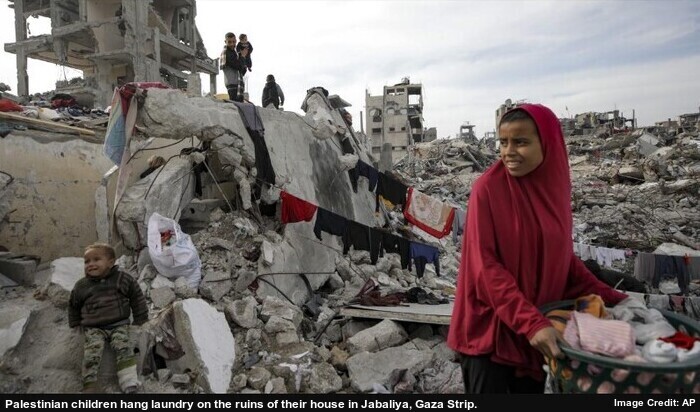
In his The Art of War, Chinese military strategist Sun Tzu (BCE 544 – BCE 496) mentioned: “There is no instance of a nation having benefited from prolonged warfare.” Gaza is a fine example of this in recent times. Currently, a ceasefire is in effect there. Although the US-brokered peace plan, negotiated with Egypt, Qatar and Turkey, ended two years of war between Israel and the Palestinian Hamas Movement, the fragile plan is facing serious challenges. Hence, the progress on long-term peace is uncertain, with recent clashes putting the truce at risk. In such a scenario, tens of thousands of displaced Palestinians have started returning to their homes which have been reduced to rubble.
Interestingly, the growing humanitarian crisis in the region prompted not only the neighbouring Arab Nations, but also the US to put Israel under diplomatic pressure to reach the Gaza Ceasefire Deal. While US President Donald John Trump has played a significant role in brokering the ceasefire; Egypt, Qatar and the United Arab Emirates (UAE), too, have made serious efforts to ensure peace in the war-torn region. It may be noted that both the parties have agreed to President Trump’s proposed peace initiative that includes an immediate ceasefire, the return of Israeli hostages and Palestinian prisoners, the demilitarisation of the Gaza Strip, the deployment of an international stabilisation force, transitional governance by Palestinian technocrats under international supervision, large-scale reconstruction, and a conditional pathway toward acceptance of Palestinian self-determination and recognition of Palestinian Statehood.

Top world leaders are well aware of the fact that maintaining peace in the region is not an easy task, given the lack of trust between Israel and Hamas. Furthermore, the term demilitarisation of Gaza is vague and remains a major point of contention in peace talks due to the lack of specific details and consensus on its implementation, as well as long-term political implications. No one knows who will monitor the process of demilitarisation and how.
Experts are of the opinion that the Benjamin Netanyahu Administration agreed to withdraw troops from Gaza as Hamas returned the Israeli hostages. On October 22, 2025, the Israeli Parliament preliminarily approved a Bill that imposes (Israeli) sovereignty over the occupied West Bank. While Hamas strongly condemned the move, stressing that it “reflects the ugly face of the colonial occupation”, US Secretary of State Marco Antonio Rubio stated that the move threatened the fragile ceasefire deal in Gaza. It proves that the Zionist Regime is ready to violate the ceasefire at any time. Netanyahu violated the ceasefire in March 2025, showing that he hardly needs any excuse to do that. On the other hand, it is unlikely that Hamas, especially after experiencing the total destruction of Gaza in the past couple of years, would accept President Trump’s proposal to disarm. Hence, the situation is still quite fragile.

Another key challenge in rebuilding Gaza’s infrastructure is raising funds, as the UN has estimated that the cost of reconstruction might cross the USD 70 billion-mark. With millions of tonnes of rubble needing to be cleared, financial aid is urgently required to restore homes, schools, hospitals, mosques and other institutions destroyed by the Israeli aggression. While international donors have pledged contributions, various political, security and logistical hurdles impede the process.
The peace initiatives have stopped the bloodshed for the time being, but the road ahead might be hard and bumpy. Without a permanent solution to the Palestinian issue and an end to the Israeli occupation, declarations of Gaza’s reconstruction may amount to empty rhetoric.
The Next Step For The Middle East & Beyond
(EIR, October 16, 2025): October 13, 2025 may turn out to have been an historic day in South-West Asia. Mediators signed a ceasefire deal for Gaza in Sharm el-Sheikh, Egypt, while Hamas released all 20 of the remaining living Israeli hostages and Israel released 2,000 Palestinian prisoners, some of whom had not been seen for decades, to shouts of joy and celebration. Much-needed humanitarian aid, medicine, food and cooking fuel began to flow into Gaza by truckload, in a way that has not happened for a long time. The UN is finally preparing to take over delivery of the hundreds of thousands of supplies blocked until now by Israel, while the disgraced Gaza Humanitarian Foundation, which killed hundreds of Palestinians searching for meals, has been temporarily shut down.
This is indeed a welcome development, if only short-lived. For the moment, a ceasefire has been achieved, the killing has stopped, the hostages have returned. Yet justice has not yet been served, and discussion of a Palestinian State appears non-existent. Israel still refuses to release several high-profile Palestinian leaders, including Marwan Barghouti, who could provide competent and trusted leadership to their people now.

The big question is: What next? Many fear, justifiably, that the fanatics in Prime Minister Netanyahu’s Government will never allow the Palestinians to come back and rebuild their homeland. To them, the editorial of Haaretz of October 10 issues a stark warning: “If Israel resumes fighting once all the hostages are in its hands, it will be nothing less than diplomatic suicide. It won’t be possible to defend the country. Even Trump won’t be able to do so.”
Another Israeli, Gershon Baskin, who has been involved in talks for many years with the Palestinians and also worked with Steve Witkoff, as well as Hamas, on the current agreement, welcomed the new initiative for declaring an end to the war, and not simply a ceasefire, although he expects more guarantees on the Israeli military withdrawal. Writing on October 9, he noted that “this deal could have been done a long time ago”, since Hamas had agreed to the same terms in September 2024 as now, but Netanyahu rejected it, and the Joe Biden Administration did not take it seriously. Voices, such as his and of former Speaker of the Knesset Avrum Burg, need to be heard louder than ever.
Indeed, a fundamental sea change is required to turn this brief but invaluable moment into something truly lasting, not only for the Palestinians, but also for Israel and for the region as a whole. And the current group of leaders around Donald Trump and Benjamin Netanyahu, especially if former British Prime Minister Tony Blair is allowed to play a role, is inadequate at best.

What is crucial now is to build on the dynamic set in motion, to push for realisation of LaRouche’s Oasis Plan which outlines an in-depth reconstruction effort for Palestine and Israel that would provide a positive perspective for mutual economic development in the entire region.
Meanwhile,

Boundless Ocean of Politics on Facebook
Boundless Ocean of Politics on Twitter
Boundless Ocean of Politics on Linkedin
Contact us: kousdas@gmail.com

 ISMC
ISMC Boundless Ocean Of Politics