

Maritime Diplomacy: India Loses Strategic Advantage
US President Donald John Trump imposed tariffs totalling 50% on Indian products, including 25% for New Delhi’s purchases of Russian oil, in August 2025 in an attempt to put New Delhi and Moscow under economic pressure. Now, Washington DC has imposed sanctions on India’s Chabahar Port Project in Iran by ending a rare waiver, prompting New Delhi to weigh its regional strategy against the US penalties. President Trump recently announced that the US withdrew the exemptions granted in 2018 under the Iran Freedom and Counter-Proliferation Act (IFCA) regarding the Chabahar port. The exemptions allowed India and other countries to operate at the Iranian port without risking US penalties. The US State Department has claimed that the move is a part of President Trump’s “maximum pressure” campaign against Tehran, aimed at isolating the Government of Iran.
India, Iran and Afghanistan had signed a trilateral agreement on transport and transit corridor using the Chabahar port during the visit of Indian Prime Minister Narendra Modi to Tehran in May 2016. Since 2018, India has been operating the Chabahar port. The agreement also allowed New Delhi to establish trade routes to Afghanistan and other Central Asian countries bypassing Pakistan, apart from delivering humanitarian aid to those countries.
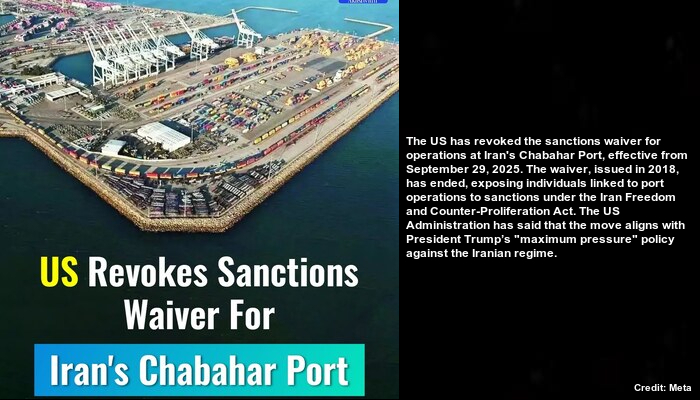
Incidentally, the waiver, issued by the US in 2018, was a strategic plan that helped India to develop, as well as operate, the Chabahar port. At that period of time, the port served as an essential maritime base for providing the then-elected Government of Afghanistan with humanitarian aid and development assistance.
State Department spokesperson Tommy Pigott has stressed that the exemption is no longer justified as it had been carved out to support Afghanistan’s reconstruction, a rationale that “disappeared” after the Taliban takeover. “The revocation is consistent with President Trump’s maximum pressure policy to isolate the Iranian regime,” he added. According to Pigott, another objective of this measure is to disrupt the flow of illicit funds to extremist activities of Iran.
Meanwhile, the US’ withdrawal of waiver has triggered economic, as well as diplomatic, challenges for India. President Trump has made the move just a year after India and Iran signed a 10-year contract for developing and operating the Shahid Beheshti Terminal of the Chabahar port. The US President’s move has not only increased the risk of Indian companies associated with the port development project facing US fines, but also put the future expansion plan of the port and associated investments at risk.
Also, India was strategically using the Chabahar port to counter China’s attempts to expand its influence in Central Asia through the Gwadar port of Pakistan. If sanctions disrupt India’s plans, then China would certainly get an opportunity to achieve its goals without any opposition. It could also affect India’s trade ties with the Islamic Republic.
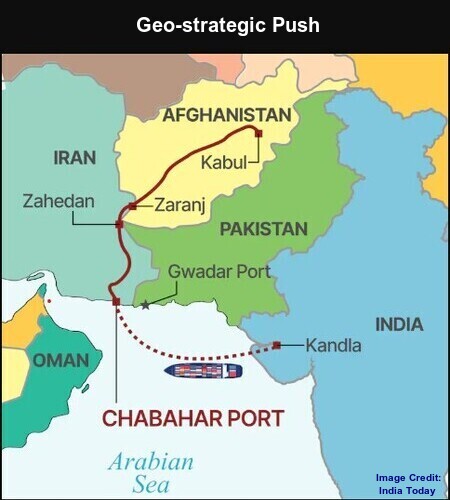
For India, the biggest challenge is how to keep the Chabahar port operational without engaging in a direct conflict with the US.
Meanwhile,

Boundless Ocean of Politics on Facebook
Boundless Ocean of Politics on Twitter
Boundless Ocean of Politics on Linkedin
Contact us: kousdas@gmail.com

 ISMC
ISMC Boundless Ocean Of Politics