

Report: US May Attack Iran Soon
Citing top officials of the Donald Trump Administration, Bloomberg reported on June 18, 2025 that the US started making preparations to launch attacks on Iran. According to the US-based media house, discussions about possible attacks on the Islamic Republic are going on. However, Washington DC may change its plan at the last minute. A senior White House official, on condition of anonymity, has informed Bloomberg that all options are being kept open.
On June 17 (2025), President Trump launched verbal attacks on Supreme Iranian leader Ayatollah Ali Hosseini Khamenei, stressing: “We know exactly where the so-called ‘Supreme Leader’ is hiding. He is an easy target, but is safe there. We are not going to take him out (kill), at least not for now.” He also said: “But we don’t want missiles shot at civilians, or American soldiers. Our patience is wearing thin.“

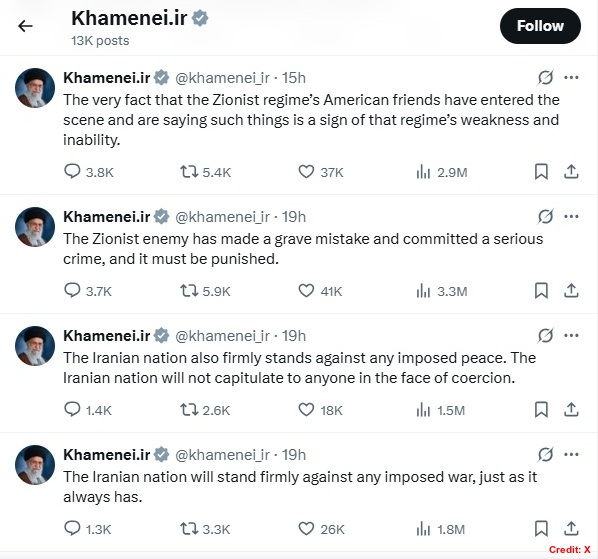
The US President was asked on June 17 whether he would really attack Iran. Trump kept the global community guessing about US military action against Iran, stating: “I may do it. I may not do it. I mean, nobody knows what I’m going to do.” On June 18, Khamenei issued a warning to Israel on X, saying: “The battle begins.“
Meanwhile, The Wall Street Journal has reported that President Trump told his close associates that he wanted to launch a military strike on Iran. According to the report, Washington DC wants to give Tehran some time for halting its uranium enrichment programme before launching the attack. As per the Wall Street Journal report, the Trump Administration has decided to take the next step only after closely monitoring the situation.
On June 18, Sayyid Abbas Araghchi, the Foreign Affairs Minister of Iran, made it clear that his country would never seek nuclear weapons, stating: “Iran has proven in action what it has always publicly committed itself to: we have never sought and will never seek nuclear weapons.” He wrote in a post on X: “If otherwise, what better pretext could we possibly need for developing those inhuman weapons than the current aggression by the region’s only nuclear-armed regime?” Araghchi added: “Just like (Israeli Prime Minister Benjamin) Netanyahu manufactured this war to destroy diplomacy, the world should be highly alarmed about increasing attempts by the failing Israeli regime to get others to bail it out and to expand the flames to the region and beyond.”

A Nuclear War Should Be Avoided
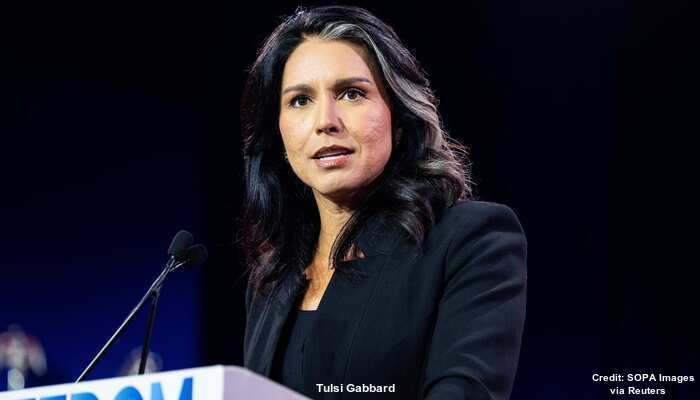
(International Peace Coalition; June 13, 2025): US Director of National Intelligence Tulsi Gabbard recently posted a stark warning of the catastrophic global effects that would be unleashed by nuclear war. She reported on what she learned during her trip to Hiroshima, the site of the first use of a nuclear weapon, and pointed out that today’s nuclear weapons were far more powerful, and that even one could kill millions in minutes. She said that “as we stand here today, closer to the brink of nuclear annihilation than ever before, political elite and warmongers are carelessly fomenting fear and tensions between nuclear powers”.
Gabbard stressed: “So, it’s up to us, the people, to speak up and demand an end to this madness. We must reject that path to nuclear war, and work toward a world where no one has to live in fear of a nuclear holocaust.”
In response to wild denunciations of Gabbard’s statement as “fear-mongering”, “isolationism” or “Russian propaganda”, one of her staffers responded: “Acknowledging the past is critical to inform the future. President Trump has repeatedly stated in the past that he recognises the immeasurable suffering, and annihilation can be caused by nuclear war, which is why he has been unequivocal that we all need to do everything possible to work towards peace.”
The NATO-Russia conflict, including the enormously escalatory June 1 attacks on Russian strategic forces, is not the only danger that threatens the world with the spectre of nuclear war.
What about Iran?
President Trump expressed low confidence that he could work out an agreement with Tehran. He told the Pod Force One podcast: “I don’t know. I did think so, and I’m getting more and more – less confident about it.” The US President further said: “I’m less confident now than I would have been a couple of months ago. Something happened to them, but I am much less confident of a deal being made.”
While Trump acknowledges that “it would be nicer to do it without warfare, without people dying”, it is his own insistence on Iran completely ending its nuclear enrichment that makes a deal all but impossible.
However, even in that case, a proposal from Russia to handle Iran’s nuclear materials may provide a long-shot way out of an otherwise inevitable military showdown. The Iranian press reported that Moscow and Tehran recently signed an agreement on the basis of which Russia would build eight nuclear plants in Iran.
The Netanyahu Administration in Israel continues to threaten military action against Iran, drawing reprimands from President Trump that simultaneously seem to leave the door open to Israeli strikes in the event that negotiations fail. And Iran’s recent reported theft of nuclear and military secrets from Israel may give Tehran more damaging options for a counterattack. Iran has threatened that a US attack would result in Tehran expelling the US from its bases in the region. The US diplomatic presence in the region has already been reduced.
On the third major front of potential conflict, China, there are glimmers of hope alongside the ongoing danger. Following another round of US-China trade discussions in London, the two countries announced progress in getting trade back on track, including a restoration of access to rare earth materials. “Our deal with China is done, subject to final approval with President Xi and me,” announced President Trump.
And in Germany, which is now ranked by public opinion surveys in Russia as the most “unfriendly” country to Russia, prominent members of the SPD, a member of the governing coalition, have published a demand that Germany make a U-turn on its anti-Russia policy.
Tulsi Gabbard stated: “It’s up to us, the people, to speak up and demand an end to this madness.” She is right. It is crucial to recognise the role of the British Empire in fostering conflicts rather than allowing a new paradigm of international relations to replace the Anglo-American hegemonism of much of the last century.
The global community would have to speak out against madness and to speak up in favour of a new global renaissance of peace and development, a new architecture for international relations.
Boundless Ocean of Politics on Facebook
Boundless Ocean of Politics on Twitter
Boundless Ocean of Politics on Linkedin
Contact us: kousdas@gmail.com

 ISMC
ISMC Boundless Ocean Of Politics