

Along The Footsteps Of ‘Dead Poets’…
“I am proud to give my life, my one solitary life…” – Malesela Benjamin Moloise.
It is being thought, as well as discussed, nowadays, that UNESCO failed to realise that poetry could not stop war when the UN agency decided to observe March 21 as World Poetry Day every year way back in 1999 in order to “support linguistic diversity through poetic expression and increase the opportunity for endangered languages to be heard“. Neither many poets can earn their livelihood, nor can they bring back their loved ones by dint of their verses, yet there are many who would still pen verses with passion, and there are others who enjoy those creations!
As per the Ethnologue Guide, there are 7,139 languages in the world in which poetry is written! The number varies, depending on the usage of a language. For example, poetry is no longer written in the K’iche language (or Quichė) of the Mayan Civilisation. Still, some poets often create troubles for the state through their creations.
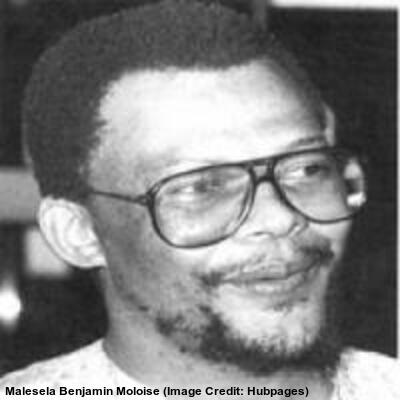
Ancient Roman poet Publius Vergilius Maro (October 15, BC 70 – September 21, BC 19), usually called Virgil or Vergil, was exiled by Roman Empire Gaius Julius Caesar Augustus (also known as Octavian), while Virgil’s compatriot Publius Ovidius Naso (March 20, BC 43 – AD 17/18), also known as Ovid, was banished to Tomis, on the Black Sea, in AD 8 by the exclusive intervention of Emperor Augustus without any participation of the Senate or of any Roman judge. In the western Indian province of Maharashtra, Brahmins (the upper caste people) had reportedly killed Tukaram, a poet belonging to the lower caste. He faced opposition from upper-caste Brahmins four centuries ago. Malesela Benjamin Moloise (1955 – October 18, 1985), a South African poet and political activist, was arrested and subsequently executed by the Government of South Africa in 1983 for being an accomplice in the murder of Phillipus Selepe, a Black Police personnel who had assisted in capturing of three ANC members in the year 1982. However, there were questions and allegations about the legitimacy of the evidence against Moloise, veracity of his confession, and the overall fairness of the trial process. Hitler and Stalin reportedly organised parties at the graveyard of poets. After all these, some people write verses.
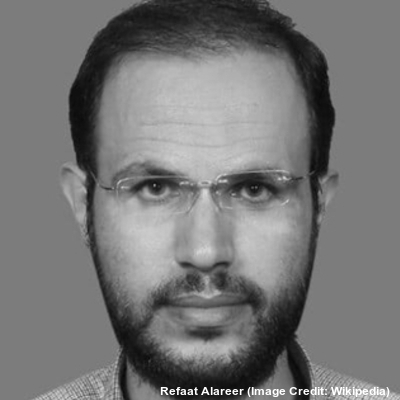
Refaat Alareer (September 23, 1979 – December 6, 2023), a Palestinian writer, poet, professor and activist, used to teach Shakespeare at the Islamic University of Gaza. He called Israel a country of killers, as his verses strongly condemned the Israeli atrocities. In November 2023, Alareer published a poem on X (formerly Twitter) titled ‘If I must die‘ that was shared tens of thousands of times. It concludes with the words: “If I must die, let it bring hope, let it be a tale.” He was killed in an Israeli strike on December 6 (2023). However, his dream lives on, as Alareer established ‘We Are Not Numbers‘ in Gaza.
The Palestinian poets have always been suppressed. The Israeli Armed Forces have traced 13 Palestinian poets with the help of their mobile numbers and killed them since the beginning of the Israel-Hamas War on October 7, 2023. The way poets stage protests today in the Gaza Strip reminds one of the days when great poets blocked the streets of Paris in protest against Hitler’s extermination of the Jews. In the 21st Century, the Israeli bombs are killing the young Palestinian poets! It seems that poetry is stuck in the irony of destiny.
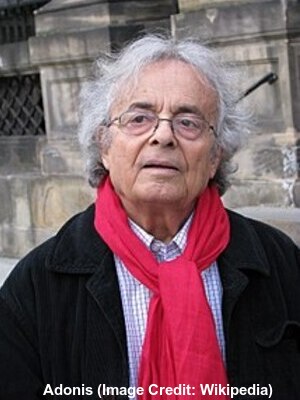
Ali Ahmad Said Esber (popularly known as Adonis or Adunis; born January 1, 1930) is the most famous Syrian poet, essayist and translator who led a Modernist Revolution in the second half of the 20th Century by “exerting a seismic influence” on Arabic poetry (comparable to Thomas Stearns Eliot‘s in the anglophone world). Through his verses, Adonis has made an attempt to mix Surrealism with Sufism. Although his name travels to the Nobel Committee in Stockholm almost every year, he has to write poems while in exile. The state does not want him… he, too, does not want the state. One may be successful in killing a poet, but it is not always possible to wipe the dreams and aspirations of her/his vision and works. When Allen Ginsberg penned Howl in 1954-55, he basically dropped a bomb in the vicinity of the White House! It may be said that the White House had to swallow it because of the influence the beat generation had wielded in American Society at that time, but did not take any action against Ginsberg.
Raúl Armando Zurita Canessa (born January 10, 1950) is the second most famous Chilean poet after Nicanor Segundo Parra Sandoval (September 5, 1914 – January 23, 2018). The Police of former President Augusto José Ramón Pinochet Ugarte tortured Zurita in prison in such a way, the poet could neither sit nor stand at the age of 74. His body still moves uncontrollably. He had to suffer a lot only for writing poetry.
One can invite 300 poets to a literary festival. However, another 300 do not receive an invitation to the same. And, some of them may be geniuses! The most important duty of a poet is to discover another poet. It is possible that the world may not remember the discoverer. However, if s/he could identify one good poet, the second one would become an asset of humanity.
Boundless Ocean of Politics on Facebook
Boundless Ocean of Politics on Twitter
Boundless Ocean of Politics on Linkedin
Contact: kousdas@gmail.com

 ISMC
ISMC Boundless Ocean Of Politics