

COP28 Opens To Controversy Over Fossil Fuels Phase-Out
The 2023 UN Conference on Climate Change was not being totally scripted by the World Economic Forum (WEF) and the Intergovernmental Panel on Climate Change (IPCC). And, it turned out to be much worse, from their standpoint, than last year’s event in Egypt, as the voice of the Global South has become much stronger since then.
The tone for the event, which ran from November 30 to December 12 in Dubai, was given by the President of COP28, Sultan Ahmed Al Jaber, who is the Minister of Industry and Advanced Technology of the United Arab Emirates (UAE), as well as CEO of the Abu Dhabi National Oil Company. Rather than focusing on the phasing-out of fossil fuels, he announced the creation of a loss and damage fund for developing countries that suffer major floods, droughts, typhoons, etc., and pledging USD 100 million from his country.
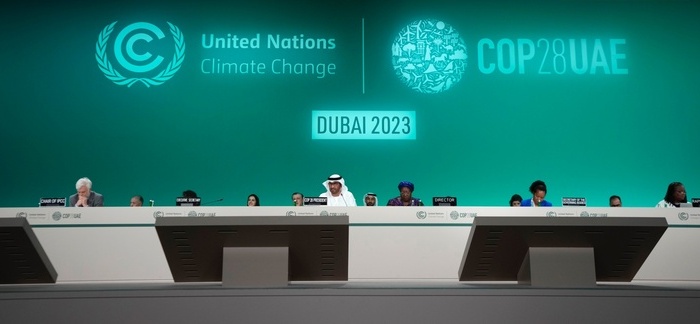
So far, so good for the climate lobby. But then, Dr Al Jaber made another pledge of USD 30 billion on December 1 to a fund to be called Alterra, together with BlackRock, Inc. and Brookfield (operated by former Bank of England head Mark Carney). The aim of this fund is to help fossil fuel companies reach the target of net-zero emissions by 2050. That is a far cry from the UN’s alarmist timetable of an accelerated phase-out of fossil fuels “before it is too late”.
It may be noted that the UAE, which is one of the six new members of the BRICS together with Saudi Arabia, intends to increase its oil production and to develop nuclear energy. Sultan Al Jaber’s pragmatist approach to the energy issue, at odds with the usual doomsday scenarios, had already led to hysterical calls to replace him as president of COP28.

That was even more so the case after a debate he had on November 21 with the former UN Special Envoy for Climate Change Mary Robinson. On that occasion, he stated: “I accepted to come to this meeting to have a sober and mature conversation. I’m not in any way signing up to any discussion that is alarmist. There is no science out there, or no scenario out there, that says that the phase-out of fossil fuel is what’s going to achieve 1.5°C…. Please help me, show me the roadmap for a phase-out of fossil fuel that will allow for sustainable socio-economic development, unless you want to take the world back into caves.” The outcry was such that Sultan Al Jaber did have to speak more moderately at the opening of the COP28, but the message is clear.
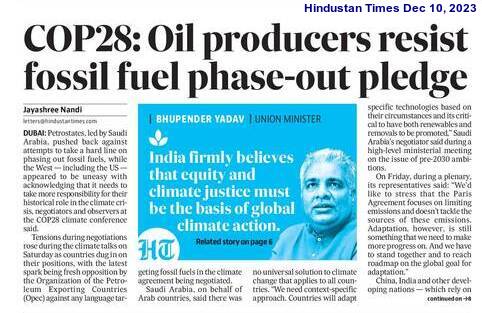
The Indian Government, for its part, has reportedly refused to sign two separate pledges at COP28, calling for the phase-down of coal power, as has China. Meanwhile, the African countries are expected to resist dictates on carbon reduction, as they did last year in Egypt. In a statement issued on November 29, the Africa Energy Chamber, while formally endorsing the COP28 agenda, strongly defended Africa’s right to benefit from its natural resources. “African states also need their fossil fuels, natural gas in particular, to help alleviate the debilitating energy poverty impacting more than 600 million people. The people of Africa have waited long enough for the advantages and opportunities of modernisation….” it stressed.

Another setback to the green fanatics faction was the push for nuclear energy endorsed by many developed countries. During the Climate Change Conference in Dubai, 22 countries from four continents launched the Declaration to Triple Nuclear Energy on December 2 (2023). In addition to the US, which apparently proposed the initiative, the endorsers include 14 European countries.
According to a press release issued by the US Department of Energy, the Declaration “recognises the key role of nuclear energy in achieving global net-zero greenhouse gas emissions by 2050 and keeping the 1.5-degree goal within reach. Core elements of the declaration include working together to advance a goal of tripling nuclear energy capacity globally by 2050 and inviting shareholders of international financial institutions to encourage the inclusion of nuclear energy in energy lending policies”.
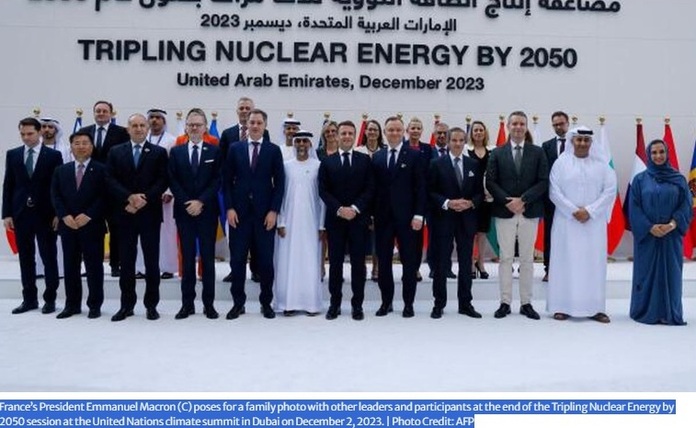
The statement was endorsed by Bulgaria, Canada, Czech Republic, Finland, France, Ghana, Hungary, Japan, Republic of Korea, Moldova, Mongolia, Morocco, Netherlands, Poland, Romania, Slovakia, Slovenia, Sweden, Ukraine, the UAE, the UK and the US. As of this writing, it is unclear if some countries were asked to endorse the Declaration and refused to do so, for whatever reasons, and if others were not invited. However, at the end of the statement, the participants in the pledge “Call on other countries to join this declaration”.
This article was first published in Executive Intelligence Review (EIR) Strategic Alert weekly newsletter (Volume 37, No. 49) on December 7, 2023.
Boundless Ocean of Politics on Facebook
Boundless Ocean of Politics on Twitter
Boundless Ocean of Politics on Linkedin
Contact: kousdas@gmail.com

 ISMC
ISMC Boundless Ocean Of Politics