

Pentagon Warns Of Regional Nuclear War
Elbridge Andrew Colby, the US Under Secretary of War for Policy, recently warned that a regional nuclear conflict could trigger a wider escalation, posing a serious security threat to his country. According to the senior Pentagon official, the consequences of a large-scale nuclear strike on the US would deter countries capable of launching one.
Speaking at the 2026 US Strategic Command Deterrence Symposium, Colby said: “What I would fear more is a regional war.” He stressed that the danger would be “a kind of local war, conventional war that might have local employment, God forbid, of nuclear weapons that could escalate from there as it expanded outward”. He claimed that the decision-making time in such a crisis could be extremely limited.

The senior Pentagon official explained that “one side could misread a military move as preparation for a total attack and respond on a far greater scale than expected”. “That would lead very rapidly to an incredibly pressurised situation that would be almost by definition not in our interests,” added Colby. He further said that the US should give its President credible and rational options as “those choices should deter an adversary without creating an uncontrollable spiral towards nuclear war”. “It’s not taking away options for the president. It’s adding credible options,” he told the audience.
Meanwhile, Colby described the modernisation of the US’ nuclear deterrent as “the single most important initiative for the American military”, stressing that Washington DC needed a survivable and diversified nuclear triad, secure second-strike forces and a deterrence strategy integrated with conventional forces. He continued: “US nuclear-powered ballistic-missile submarines ensure an adversary can never be confident that it could destroy the US’ nuclear forces in a first strike. This second-strike guarantee involves ballistic-missile submarines designed to remain hidden underwater for extended periods while carrying submarine-launched ballistic missiles.”
Colby informed the audience that the Donald Trump Administration did not conduct another nuclear posture review. Instead, it is reviewing nuclear employment guidance, apart from focusing on carrying out modernisation plans. “This is so important, we know where we’re going…now it’s about execution,” he added.
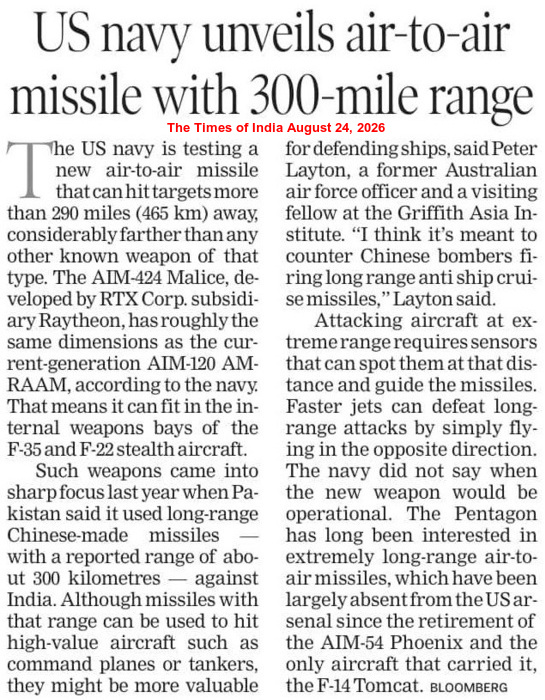
According to Colby, the global geopolitical landscape has changed in the 21st Century. According to the top Pentagon official, the growing nuclear capability of China has created an unprecedented strategic problem. “Unlike during the Cold War, the US now faces two potential nuclear peers – China and Russia,” stated Colby. He added: “I remain cautiously optimistic about the ability for us to maintain effective deterrence in the context of three sort of great power nuclear states. I’m not sanguine about that. If you can try to mitigate these pressures through engagement, through respectful dialogue, that’s totally consistent with being strong.”
Currently, the US maintains a nuclear triad, consisting of land-based intercontinental ballistic missiles, submarine-launched ballistic missiles and strategic bombers.
Meanwhile,


Boundless Ocean of Politics on Facebook
Boundless Ocean of Politics on Twitter
Boundless Ocean of Politics on Linkedin
Contact us: kousdas@gmail.com

 ISMC
ISMC Boundless Ocean Of Politics