

A Different Development In West Asia
The vast Nefud (or Al-Nafud) Desert in northern Saudi Arabia is one of the world’s arid regions. This 65,000sqkm erg – famous for its brick-red, crescent-shaped dunes – is recognised globally for its shifting sands, violent winds and deep history of ancient, prehistoric lakes. Archaeological evidence of human presence in the Nefud Desert is scarce. However, researchers recently traced a lost civilisation there.
There are three distinct regions – Jebel Arnaan, Jebel Mleiha and Jebel Misma – at the southern edge of the Nefud Desert. Researchers have discovered more than 60 images carved on the rocks at all those locations. The monumental archaeological discovery includes life-size, 12,000-year-old rock engravings of camels, aurochs and ibex. These images point to a time when human habitation in this desert was previously unknown. However, the discovery hints that humans successfully navigated and lived in the region long before traditional history suggested.
Rock carvings were found in this desert in the past, as well. However, they dated back to the Neolithic Age, approximately 8,000-year-old. However, the ones discovered recently are even older as they were carved 11,400-12,800 years ago. According to researchers, those images were created in several stages during that period.
Evidence of human presence in this Saudi desert dates back even before traditional out of Africa estimates. A past study discovered human footprints in Nefud Desert that date back approximately 0.1 million years. Researchers are of the opinion that humans used to traverse this region more than 25,000 years ago. Thereafter, people stopped visiting the Nefud Desert. Roughly 10,000 years ago during the Holocene Humid Period, increased monsoon rainfall transformed the normally harsh Saudi deserts into expansive grasslands and networks of freshwater lakes. This Green Arabia phase triggered major population movements into the Nefud Desert, yet again. In other words, the region experienced abandonment during the dry Last Glacial Maximum, leaving the archaeological record blank for the intervening 15,000 years.
The Earth’s temperature dropped dramatically about 19,000-26,000 years ago (a period known as the Last Glacial Maximum) when global average temperatures were roughly 6 Degrees Celsius to 10 Degrees Celsius colder than they are today. At that period of time, the movement of people from one place to another had almost come to a halt across the globe. Coincidentally, the dark or arid phase in the Nefud Desert aligns with broader global cooling events. Hence, the newly discovered rock paintings have shed light on this 15,000-year-long dark period.
This expedition, called the Green Arabia Project, is a flagship archaeological and paleoclimatic study backed by the Saudi Heritage Commission, exploring how early humans and animals migrated between Africa and Eurasia during prehistoric periods. An international team of archaeologists is also involved in this expedition. The team includes experts from various institutions, such as the Max Planck Institute of Geoanthropology, King Abdullah University and University College London.
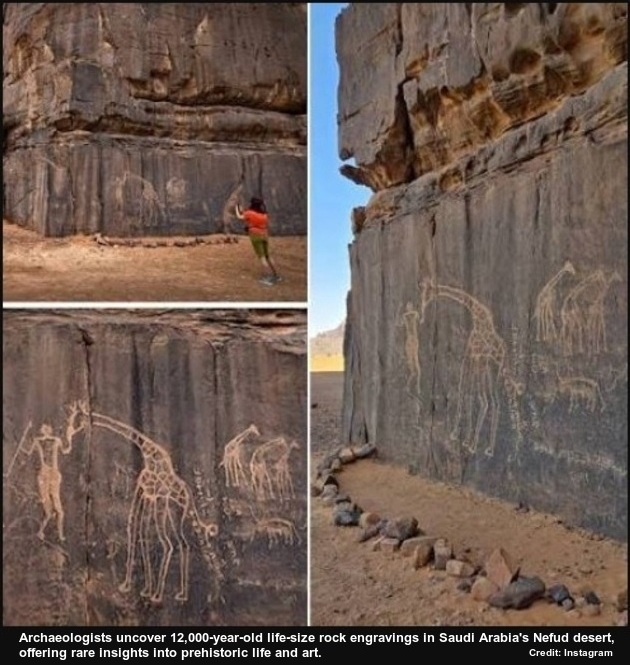
As per an article published in the journal Nature Communications, the 12,000-year-old rock carvings in the Nefud Desert were strategically placed high up on steep cliffs and towering sandstone outcroppings. Drone imagery suggests that the prehistoric artists had to climb the rocky slopes to carve those images. Both their morale and technical skills can be gauged from this.
Interestingly, archaeological surveys show monumental 12,000-year-old rock carvings in the Nefud Desert were carved by ancient hunter-gatherers during a period when seasonal lakes and wetlands returned to the area. Archaeologists believe these engravings served as crucial navigational markers to help nomadic groups survive the harsh, arid environment.
Meanwhile,













Boundless Ocean of Politics on Facebook
Boundless Ocean of Politics on Twitter
Boundless Ocean of Politics on Linkedin
Contact us: kousdas@gmail.com

 ISMC
ISMC
