

Stepping Beyond The Familiar Pattern
Texts do not possess a specific, unidimensional or permanent meaning. Instead, a text is dynamic, with its meaning shifting based on the reader, the cultural context and the time period. Das Kapital is no exception. This foundational theoretical text in Marxist philosophy, economics and politics by Karl Marx (May 5, 1818 – March 14, 1883) only comes alive through the active interpretation of the reader, her/his background, beliefs and experiences. Therefore, it is quite natural to view this 1867 publication as an ongoing, uncertain and multidimensional text. Unfortunately, some of the Orthodox Marxists, upon hearing such remarks, might mockingly label one a Postmodernist.
Still, a section of economists and young researchers discusses Capital: A Critique of Political Economy on a regular basis in the second quarter of the 21st Century. They also feel a compelling urge to pen articles on this particular subject, and their efforts demand due recognition. Kolkata-based economist and scholar Anjan Chakrabarti is one such person who recently edited a book (in Bengali), titled Pujir Oi Louhokpat: Marxer Capital o Bikolpo Poth (The Iron Gate of Capital: Marx’s Capital and Alternative Paths). For a long time, Chakrabarti and his associates have been practicing a post-classical, poststructuralist and class-neutral Marxism. Heavily influenced by the Rethinking Marxism School, their methodology significantly diverges from traditional or orthodox Marxism in three hyper-specific ways: Theories of Overdetermination, Reconceptualising class, and Decentring the State and Capitalism. It may be noted that French philosopher Louis Pierre Althusser (October 16, 1918 – October 22, 1990), in his works, discarded the rigid scientific determinism of Marxism in favour of his later, more open-ended concepts of overdetermination and anti-essentialism.
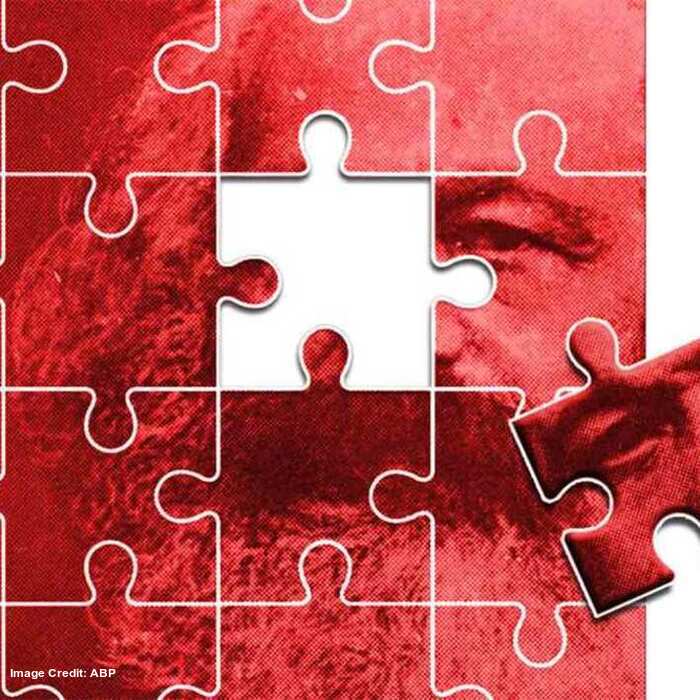
The capitalism of the era in which Marx theoretically dissected the system appears vastly different from 21st Century capitalism. In fact, the 19th Century industrial capitalism analysed by Marx was characterised by localised factories, physical commodity production and brutal working conditions. However, today’s system has evolved into a globalised digital economy, dominated by finance capital, technology and intangible assets. Countless other works by Marx remained in obscurity even a few decades ago. This massive backlog includes his mathematical research and vital economic studies that remained largely unexamined until the 20th Century. Now, they are available in English and those works have helped researchers to come out with various new ideas in recent times.
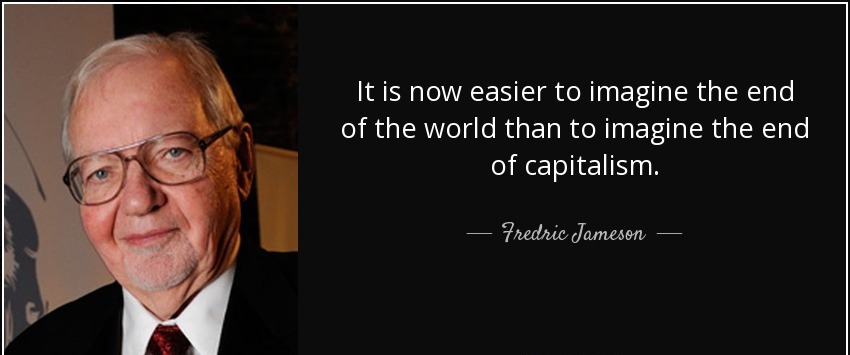
Once, Fredric Ruff Jameson (April 14, 1934 – September 22, 2024) – an American literary critic, philosopher and Marxist political theorist best known for his analysis of contemporary cultural trends, particularly his analysis of postmodernity and capitalism – reportedly said: “It is now easier to imagine the end of the world than to imagine the end of capitalism.” Others, too, opined that capitalism matured enough in Post-industrial society and one should think about the next stage. With this, the intellectual inquiry was steeped in a narrative of transcendence.
Historical Materialism asserts that human societies advance primarily through economic conflict and the stages include Primitive Communism, Ancient Slavery, Feudalism, Capitalism, Socialism and Communism. It is said to be as immutable as science; therefore, it cannot be otherwise. Hence, the next stage is Communism. However, Communism remains inconceivable, even in the realm of imagination. Needless to say, Marxism is not the only idea that emerges from Marx’s works. One encounters such an interpretation as a consequence of forcing the multidimensional thoughts of Marx into a single dimensional idea. In other words, it highlights the frequent tendency of the so-called Marxists to reduce his thoughts to rigid, single-issue frameworks. Marxists often forget that Marx’s own thinking evolved dramatically over a lifetime of shifting historical events.
You may also like: On Techno-Feudalism
Orthodox Marxism’s foundational reliance on 19th Century scientific positivism, historical teleology and economic reductionism has left it vulnerable to well-founded critiques of scientism, essentialism and determinism. To overcome these flaws and to seek an alternative path, one must proceed by following the principles of possibility articulated by Marx, aiming to construct a non-essentialist and non-determinist Marxism. Meanwhile, the narrative of transition from capitalism, too, gradually began to shift in the discourse of scholars. However, there is hardly any place for dystopia in Postmodern or Post-industrial discourse. Instead, the disappearance of grand Post-capitalist Theories from mainstream discourse reflects the rise of Capitalist Realism, the pervasive cultural belief that it is easier to imagine the end of the world than a coherent alternative to the market economy. What is taking place in the contemporary world can be described as a descent into feudalism (or Digital Serfdom). Some call it a transition from capitalism to Techno-feudalism or Digital-feudalism or Information feudalism. Renowned Greek economist Ioannis Georgiou ‘Yanis’ Varoufakis is one of them.
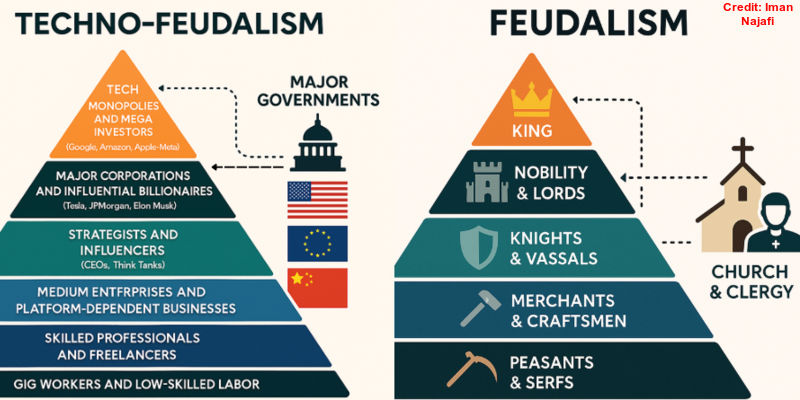
The central concept of Techno-Feudalism is economic or cloud rent, and not profit. However, this sort of rent has no connection with the land. It can be applicable to any means of production. The owner no longer incurs any additional cost to make this resource available in the market. Yet, it continues to generate profit. There are quite a few such products in the era of modern digital technology. The volume, as well as scope, of these products are so vast that they influence various sectors of economy. The income generated from the rent (it is more appropriate to call it rent rather than profit) is skyrocketing. Within this process of rent-based income, one seems to discern certain parallels with what Marx termed primitive accumulation. It also helps one to arrive at David Harvey‘s concept of accumulation by dispossession that describes how modern capitalism maintains wealth and power not just by producing goods, but by stripping public, private or communal assets, and transferring them into the hands of a wealthy few. Harvey’s concept is highly popular in discussions in the Developing World.
As Orthodox Marxism is afflicted by the flaws of scientism, essentialism and determinism, the question arises here: What would the alternative approach be, one that is neither essentialist nor determinist? Most importantly, would it be possible to understand the contemporary socio-economy by following that method? The outline of such a method is not clear at this moment. It cannot be, as the objective of the alternative draws us into a complex, multifaceted journey of discovery. Anjan Chakrabarti and his associates have been practicing this kind of non-deterministic and class-neutral Marxist approach for a long time.
Analysing different aspects of modern society, like the nature of finance capital, global value chains, the new labour code, and the state’s perspective on poverty or agriculture, from a Marxist standpoint warrants separate discussions. In this publication, Chakrabarti has stressed on a class-neutral analysis of theatre organisations, as well!
The issue of unpaid domestic labour and broader unpaid care work by female members of a family has occupied a central position in Western feminist discourse for several decades. In this book, authors have mentioned contributions of Marxist feminists to this particular issue. The cornerstone of Marxist Political Economy is the Mode of Production which requires the conversion of human labour into a commodity to generate profit. Although the Orthodox Marxists have often ignored domestic labour (as it does not produce commodities for the market), the Marxist feminists have considered how domestic labour could be directly incorporated into the analytical framework. While a class-based approach successfully highlights the structural exploitation in traditional labour markets, applying it to domestic labour presents a fundamental challenge: the bourgeoisie-proletariat duality is precisely what makes domestic labour unique and difficult to fit into standard Marxist frameworks. Chakrabarti and his co-authors have shown the way to overcome this problem.
Other significant issues are the pervasive expansion of Artificial Intelligence (AI) and digital technologies. Four chapters of this book discuss how to shed light upon the changing nature of aspects related to exploitation through the lens of class division. These aspects do not come directly to the fore. Those working in the Information Technology (IT) sector are generally not considered labourers. However, a cooperative theoretical endeavour can offer a direction in such a situation.
Therefore, this practice should be continued.
Meanwhile,

Boundless Ocean of Politics on Facebook
Boundless Ocean of Politics on Twitter
Boundless Ocean of Politics on Linkedin
Contact us: kousdas@gmail.com

 ISMC
ISMC
