

US-Iran War: Syria Emerges As Europe’s ‘Saviour’
Buried beneath the Syrian desert lies a pipeline that used to supply crude oil to a Europe grappling with various crises in the post-Second World War era. However, there has been zero oil flow through this pipeline in the last four decades.
Post-Second World War Europe faced an acute energy crisis as the continent was reduced to ruins. Saudi Arabia stepped forward to help Europe at that period of time. Nearly 16,000 workers of Aramco, the Saudi oil company, took three years to lay a pipeline extending from Saudi oil fields through Jordanian, Syrian and Lebanese deserts and mountains to the Mediterranean port of Sidon. The 1,648km-long pipeline, made of steel, was called the Trans-Arabian Pipeline (Tapline). After the completion of the project in 1950, the Tapline started transporting 500,000 barrels of crude oil per day to Europe, bypassing the Suez Canal.
However, the Tapline saw its strategic importance diminish from the late 1960s onwards due to a combination of geopolitical instability, regional conflicts and the technological emergence of super-tankers, which made maritime transport more economical. The pipeline ceased oil operations in 1990 following the outbreak of the first Gulf War.
Now, Ahmed Hussein al-Sharaa (also known by his nom de guerre Abu Mohammad al-Julani), the Syrian President and former rebel commander, is planning to reactivate the Tapline. He made a decision in this regard after his recent meeting with German Chancellor Joachim-Friedrich Martin Josef Merz in Berlin. During his visit to Germany, he advised Europe to utilise its own infrastructure for energy, instead of relying on others’.
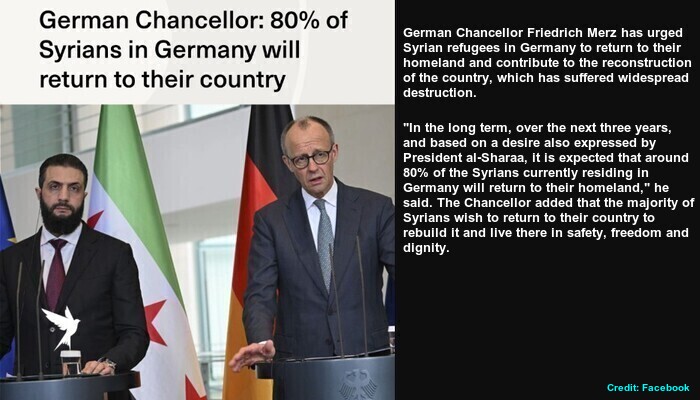
Syria requires investment in the energy sector as a part of post-civil war reconstruction of the Weast Asian country. The al-Sharaa Administration has claimed that Damascus would take the responsibility for supplying energy from West Asia to Europe via the Mediterranean Sea, stating that it would be possible to deliver oil and gas to Europe while bypassing the Strait of Hormuz and the unstable Red Sea. According to al-Sharaa, it is necessary to reactivate the defunct Kirkuk-Baniyas pipeline (Iraq) and Tapline (Saudi Arabia) for this purpose. The Syrian President recently put forward this proposal on a global platform and Germany has shown interest in it.
However, experts believe that while reactivating the Tapline could offer strategic advantages as an alternative export route, it would not serve as a full substitute for the massive, daily volume of oil and gas supplied from the Gulf region, especially given escalating global demand. According to experts, al-Sharaa, the head of the Interim Government of Syria, is determined to establish his country as a key player amidst the conflict situation in West Asia and to earn foreign currency. Many have expressed doubts regarding the extent to which his proposal would gain acceptance or prove fruitful.
Meanwhile,

Boundless Ocean of Politics on Facebook
Boundless Ocean of Politics on Twitter
Boundless Ocean of Politics on Linkedin
Contact us: kousdas@gmail.com

 ISMC
ISMC Boundless Ocean Of Politics