

A German Officer, A Jewish Man & A Piano
A German officer found a starving Jewish man hiding in the ruins of Warsaw. Instead of killing him, he asked a question that changed everything.
Warsaw became a graveyard in November 1944 after the Nazis crushed the Polish uprising. Buildings lay shattered, while streets were empty except for patrols hunting survivors. Władysław Szpilman (December 5, 1911 – July 6, 2000) had been hiding for months. Before the war, he had been Poland’s most celebrated pianist, playing Chopin on Warsaw Radio while the city danced. Now, he was a ghost, surviving on scraps in abandoned buildings.
Then the footsteps came. Captain Wilhelm Adalbert Hosenfeld (May 2, 1895 – August 13, 1952) of the Wehrmacht discovered Szpilman in an attic. The starving man froze as he thought that his end was near. However, Hosenfeld did not raise his weapon. Instead, he asked: “What are you doing here?” Szpilman told him that he used to be a pianist. Hosenfeld’s eyes changed. He pointed to a dusty piano in the corner and said: “Play something.“
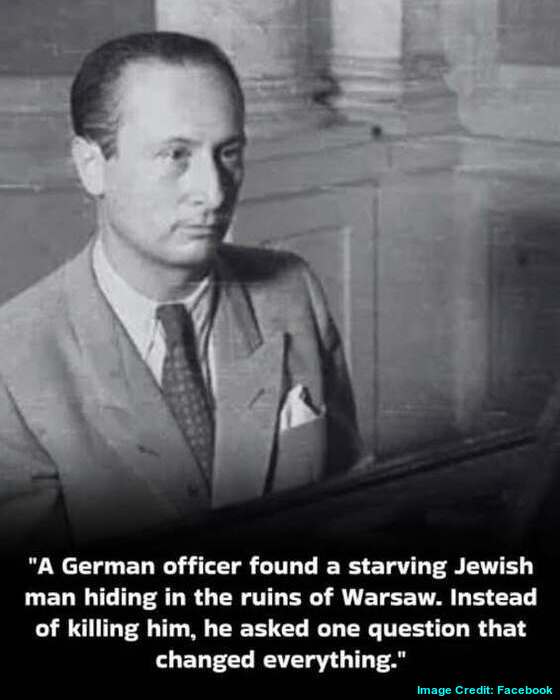
So there, in the frozen ruins of a destroyed city, a Jewish man who had not touched his piano in years played Chopin’s Nocturne in C-sharp minor. His fingers moved from memory. The melody filled the bombed-out room. When the last note faded, Hosenfeld stood in silence. Then he asked where Szpilman was hiding. Not to arrest him, but to help him. For weeks, Hosenfeld returned secretly, bringing bread, jam and a warm coat. Helping a Jewish man meant execution if discovered. He came anyway.
In December, Hosenfeld visited one last time as German forces prepared to retreat. He left extra food and his own military blanket. “Hold on,” he told Szpilman, adding: “The Soviets are coming. The war will end soon.” Szpilman gave him his name. “Remember it. If you ever need help – Szpilman, Polish Radio,” he stressed. He never saw Hosenfeld again.
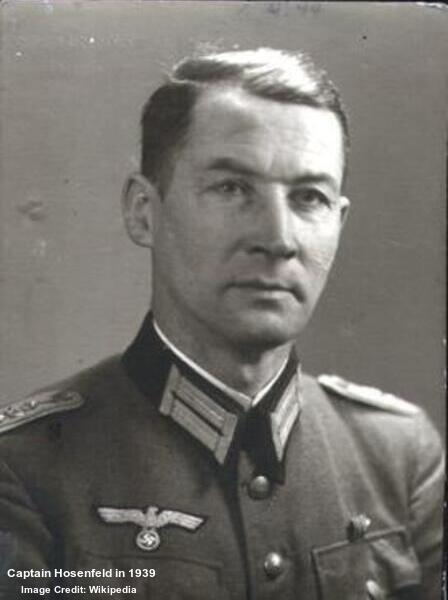
Szpilman survived and returned to Warsaw Radio. His first broadcast after liberation? Chopin’s Nocturne in C-sharp minor, the same piece he had played for the German officer who saved his life. Hosenfeld did not survive. Captured by the Soviet forces, he was convicted as a war criminal simply for being a German officer. The Soviet authorities ignored testimonies about his humanitarian acts.
Szpilman spent years trying to save Hosenfeld. He contacted officials, wrote letters and begged anyone who would listen. It was not enough. In 1952, Captain Hosenfeld died in a Soviet prison camp at the age of 57. He never learned that the pianist he had rescued tried everything to rescue him in return.
Decades later, Szpilman’s memoir became the film The Pianist, winning three Academy Awards. In 2009 (57 years after his demise), Hosenfeld was finally recognised by Yad Vashem (Israel’s official memorial institution to the victims of the Holocaust) as Righteous Among the Nations. His family accepted the honour on his behalf as he never lived to receive.
One question. One piece of music. Two men on opposite sides of history’s greatest horror – connected by a moment when humanity won. Szpilman, who passed away at the age of 88, spent his final years making sure the world remembered the German officer who had chosen mercy when he could have chosen murder. Because sometimes the most powerful resistance is not a weapon. It’s a piano.
Collected from the Facebook page of The Forgotten Ledger.
Meanwhile,








Boundless Ocean of Politics on Facebook
Boundless Ocean of Politics on Twitter
Boundless Ocean of Politics on Linkedin
Contact us: kousdas@gmail.com

 ISMC
ISMC Boundless Ocean Of Politics