

‘Military Buildup Not To Save Collapsing EU Economies’
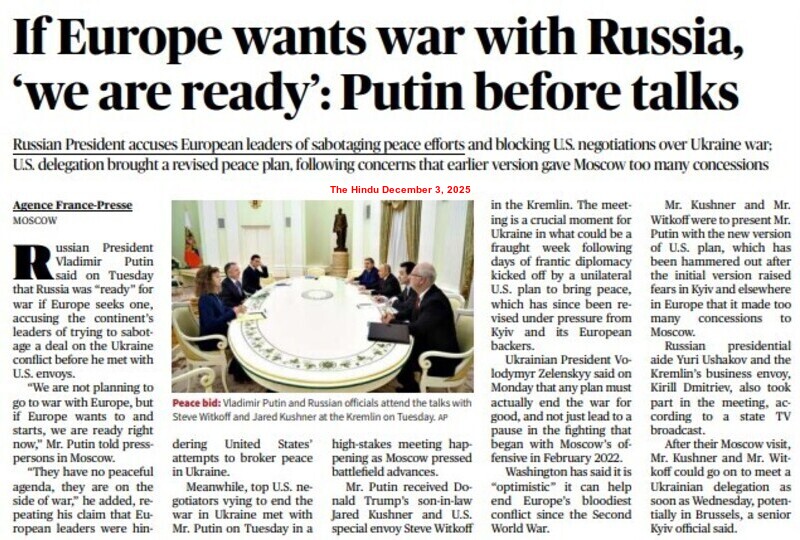
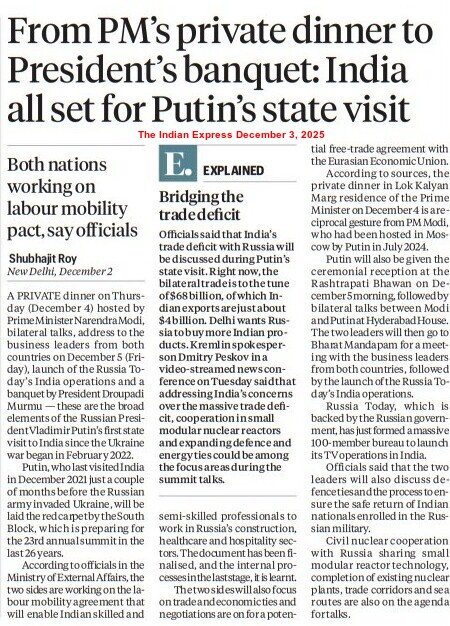
Steven Charles Witkoff, the US Presidential Envoy, met Russian President Vladimir Vladimirovich Putin in Moscow on December 2, 2025, toward confirming terms that could be the basis of settlement of the Ukraine conflict. It followed upon the four-hour-long meeting between US leaders and a Ukrainian delegation, headed by Rustem Umerov, the head of National Security and Defence Council (of Ukraine), at Witkoff’s Florida golf and residential club. No definitive break or resolution has come about for either success or failure of the process of US engagement in talks, but the process is valuable and the reality has a way of intervening.
There is no use-value in prognosticating about exactly when and what may result at any particular time in this diplomatic process, which itself is nevertheless useful, in large part because of the context of reality asserting itself. Ukraine cannot continue with the mortal losses it is suffering in being used by the Western geopolitical interests as a proxy against Russia. It is a harsh reality. Demanding Ukraine continue the war, when a resolution can be found, is immoral insanity.
On display in Brussels, at the EU Foreign Affairs Council (Defence) Meeting of Ministers on December 2, was exactly that: immoral insanity. EU High Representative for Foreign Affairs and Security Policy Kaja Kallas delivered a mad-woman speech about how Europe must continue to back Ukraine to the hilt, and moreover, continue itself to arm and make ready against Russia. According to Kallas, Europe has already contributed USD 187 billion to Ukraine and must continue such support. She praised the Netherlands for announcing that it would build an arms production centre in Ukraine. She also praised the specific EU war preparation programmes, such as the Defence Readiness Roadmap and the Military Mobility Package.
Chairman of the NATO Military Committee Admiral Giuseppe Cavo Dragone (of Italy) went even further. In an interview with the Financial Times on December 1, he said that even a pre-emptive strike against Russia was among the many things NATO was thinking about. Though Admiral Dragone stressed, as a feint, that such a strike “is further away from our normal way of thinking and behaviour”, he nevertheless clearly raised the prospect as a favourable option.

Helga Zepp-LaRouche, the widow of US political activist Lyndon LaRouche and the founder of the LaRouche Movement‘s Schiller Institute, denounced this kind of madness among “top European leaders”, stating: “We are run by madmen.” Characterising the world situation, she stressed: “We have a strategic picture of maximum tension, dangers and potentials.” The situation “requires our intervention”, added Zepp-LaRouche.
The actions of NATO, too, can be described as “institutionalised madness”. NATO Director General Mark Rutte met Kallas on the sidelines of the EU Foreign Affairs Ministers Meeting on December 2, supporting her crazy declarations. Moreover, Rutte spoke with Japanese Prime Minister Sanae Takaichi in a 20-minute call on December 1, pledging what amounts to Global NATO expansion. Later, the Prime Minister’s Office issued a statement, mentioning: “Takaichi highlighted that the security of the Euro-Atlantic and the Indo-Pacific is inseparable and cooperation between Japan-NATO and NATO-IP4 (Japan, Australia, New Zealand and the Republic of Korea) is strategically important. In response, Director General Rutte supported such views and both leaders concurred on working together to elevate our cooperative relationship to new heights through concrete cooperation.”
Zepp-LaRouche took the gloves off against NATO in an interview with a Chinese Media Group, broadcast widely on CGTN on December 1. She identified the expansion of NATO as the fundamental cause, triggering the Ukraine conflict, and then painted the broad picture. “Although NATO claims its original intention was peaceful, after the military interventions in Afghanistan, Iraq, Syria, Libya and other countries, NATO’s so-called ‘peaceful conduct’ becomes untenable,” she said.

Zepp-LaRouche also pointed to the solution, addressing Europe, but with a point universally applicable. “Overall, I think we need to achieve a transformation in the way of thinking in Europe, because wherever you look, whether it’s Venezuela, the Middle East or Ukraine, all these conflicts would become much easier to resolve if Western countries could change their mindset, turn to cooperation with Global South countries and the global majority, and return to diplomacy,” she insisted.

It may be noted that a White House meeting was underway on December 2 evening, commissioned by President Donald John Trump, to provide him “options” for further actions in the Caribbean against Venezuela. The prospects are grim, given the known stance for brute force by the advisers of the US President.

The Schiller Institute published this article on December 3, 2025.
Meanwhile,


Boundless Ocean of Politics on Facebook
Boundless Ocean of Politics on Twitter
Boundless Ocean of Politics on Linkedin
Contact us: kousdas@gmail.com

 ISMC
ISMC Boundless Ocean Of Politics