

Increasing The Bargaining Power
Russian President Vladimir Vladimirovich Putin is all set to arrive in India for a two-day visit on December 4, 2025.
It may be noted that Soviet leaders Nikita Sergeyevich Khrushchev and Nikolai Alexandrovich Bulganin made a high-profile visit to India in November 1955, as their trip included large public receptions and tours of major Indian cities, including New Delhi, Mumbai, Bangalore, Chennai and Kolkata. During the visit, Khrushchev reportedly told the first Prime Minister of India, Pandit Jawaharlal Nehru: “We are so near that if ever you call us from the mountain tops, we will appear at your side.“

Khrushchev made the comment at a time when the rivalry between the erstwhile Soviet Union and China was at its peak, with the two countries fighting over the legitimate leadership of the International Communist Movement after the demise of Joseph Vissarionovich Stalin. Hence, the Kremlin was looking for new friends in Asia. Earlier, Stalin had taken initiatives to establish diplomatic ties with India even before the South Asian nation achieved independence from the British colonial rule in August 1947. However, he viewed Nehru and his policy of non-alignment with suspicion and initial hostility. From Stalin’s Marxist-Leninist perspective, any national liberation movement not strictly aligned with communist principles was considered a potential tool of Western imperialism or capitalism. Interestingly, his stance towards India evolved over time as it moved from an initially negative view to a more cooperative relationship, culminating in the Soviet using its veto power at the UN in India’s favour on the Kashmir dispute in 1951.
The relationships between India and the Soviet Union changed under the leadership of Khrushchev (after the death of Stalin in 1953). The Kremlin helped India to build the Bhilai Steel Plant in 1955. This project was a key part of India’s post-independence industrialisation efforts, and provided technical expertise, equipment and resources for its construction. The Soviet Union also signed an agreement with India to supply equipment to the latter and New Delhi used to purchase them in Indian currency in order to save foreign currency.
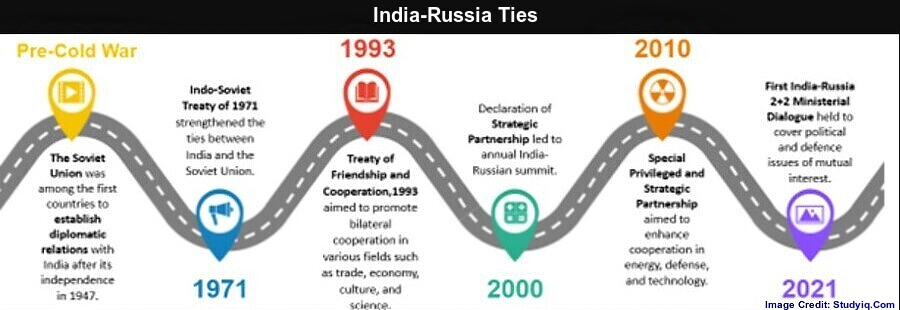
The Soviet further strengthened ties with India during the 1962 Sino-Indian War. Moscow emerged as (India’s) main arms supplier as the Kremlin wanted to counter the growing influence of China over India. Nearly 70% of India’s weapons came from the Soviet between 1962 and 1966, while Britain and the US supplied just 23%.
The Indo-Soviet Treaty of August 9, 1971 can be considered the pinnacle of bilateral relations because of its strategic importance, comprehensive provisions for cooperation and role in shaping regional dynamics. Signed in New Delhi, the treaty symbolised a high level of cooperation, addressed shared interests in the face of geopolitical challenges and provided India with a crucial security guarantee during the 1971 India-Pakistan War. The treaty became a solid foundation of India’s foreign policy as it significantly shaped strategic autonomy of the South Asian country and its relationship with the Soviet Union. Although it was not a military agreement, the treaty provided India with security assurance. At that period of time, India’s preparations to formally get involved in the 1971 Liberation War of Bangladesh were heavily influenced by the developing alignment between the US, Pakistan and China. India’s diplomatic strategy focussed mainly on securing its own alliances to counter this potential trilateral threat and the Soviet emerged as its most reliable diplomatic partner.

India and the Soviet Union came closer during the Cold War, when the US-influenced Western World was reluctant to maintain cordial ties with New Delhi mainly because of its non-aligned policy. Instead, the US strengthened defence ties with Pakistan by signing some accords, including the Southeast Asia Treaty Organisation and the Central Asia Treaty Organisation. The US’ decision to supply arms to Pakistan prompted India to cement ties with the Soviet. Moscow also provided significant support to New Delhi on various international issues on the global stage. Until 1991, the Soviet Union was India’s largest trading partner and a leading foreign investor, playing a crucial role in developing its heavy industries, like steel, power and oil. This close economic relationship was supported by a unique Rupee-Rouble arrangement that allowed India to use its limited foreign exchange reserves for other vital needs.
After the collapse of the Soviet Union in 1991, India began importing defence equipment from France, Israel, the US and other Western countries. India’s arms imports still come predominantly from Russia, although the percentage has significantly declined. For the period 2020-24, Russia accounted for 36% of India’s arms imports, making it the single largest supplier, but a much smaller share than the 76% it held in 2009.
India has strengthened ties with the US in the past few decades in order to counter the growing influence of neighbouring China in Asia. Incidentally, India’s membership in the Quad alliance (Australia, Japan, India and the US) is a cornerstone of its strategy to balance China’s influence in the Indo-Pacific Region, which contributes to existing tensions with Beijing and, indirectly, with Moscow. Currently, India maintains a policy of multi-alignment or strategic autonomy, engaging with all major global powers based on its national interests rather than fully committing to a single bloc. The changing equation has prompted Russia to look for new allies in Asia and Moscow has started maintaining friendly ties with both Beijing and Islamabad. The US and China, too, have decided to boost cooperation with Pakistan in various fields, putting India under tremendous diplomatic pressure.
In such a scenario, President Putin shall arrive in India on December 4, 2025. The Narendra Modi Administration in New Delhi is expected to make serious efforts to further strengthen diplomatic relations with Russia during his visit, apart from announcing various joint projects. Each and every country is now forging new relationships to increase bargaining power. Therefore, the ties between Russia and Pakistan may also become stronger in the coming days. India needs to keep this in mind.
Meanwhile,

Boundless Ocean of Politics on Facebook
Boundless Ocean of Politics on Twitter
Boundless Ocean of Politics on Linkedin
Contact us: kousdas@gmail.com

 ISMC
ISMC Boundless Ocean Of Politics