

A Diplomatic Setback
India faces complex challenges in navigating the shifting global geopolitical landscape. In what may be seen as a huge diplomatic setback for New Delhi, the recent withdrawal of the South Asian nation from the Ayni Airbase in Tajikistan has ended its key overseas military presence in Central Asia. India officially handed the base over to Tajikistan in 2022 after the expiration of a bilateral agreement, and has since withdrawn all its personnel and equipment. Reports suggest that Russia has taken over operations at this strategically important airbase.
India and Tajikistan signed an accord in 2002 for the renovation, as well as joint operation, of the Ayni Airbase, locally known as the Gissar Military Aerodrome. With this, Ayni became the first and only real overseas military facility of India. The airbase allowed India to enjoy a rare and valuable strategic position for intelligence gathering, surveillance and regional power projection against neighbouring Pakistan and China due to its proximity to the Wakhan Corridor (about 20km away) and the border of Pakistan-occupied-Kashmir (PoK). Apart from using it as an ideal centre for counter-terrorism coordination, India also countered the Pakistani influence in the region from this base.
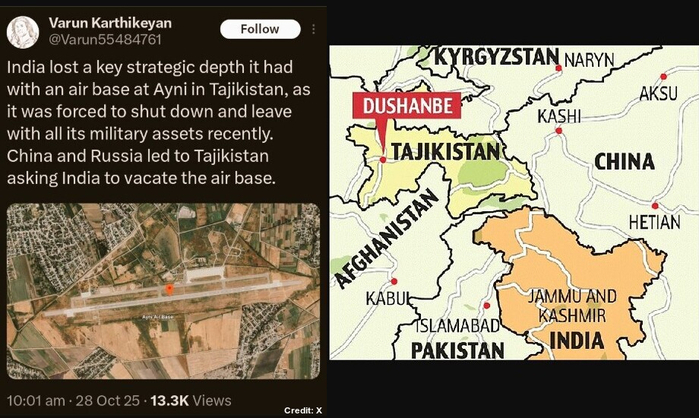
The Tajik airbase further helped India to prepare the blueprint of its Connect Central Asia Policy of 2012 for strengthening economic, energy and security ties with the region. New Delhi made a sincere attempt to get access to Central Asia by developing extensive land and maritime supply chains through projects, such as the International North-South Transport Corridor (INSTC) and the Iranian port of Chabahar, bypassing Pakistan. The move also paved the way for India to increase its influence in Eurasian geopolitics.
However, Dushanbe informed New Delhi in 2021 that the former would not renew the lease after 2022. After the Russian invasion of Ukraine on February 24, 2022, the Kremlin’s reliance on China increased, reshaping the strategic calculus of Eurasian geopolitics. Moscow and Beijing are believed to put Dushanbe under diplomatic pressure to prioritise their regional security integration. As Russia used to consider the sole overseas military facility of India in Tajikistan as a diplomatic obstacle, the Kremlin might have asked Dushanbe not to renew the lease.
China, which shares borders with Tajikistan, also viewed the presence of India as a potential security and surveillance risk. Hence, political analysts believe that the decision to block India’s access to the Ayni Airbase was a predetermined one.
In fact, the Tajik airbase was a symbol of India’s ambition to play a larger strategic role beyond South Asia. However, the resurgence of the Taliban in 2021 and the changing regional dynamics gradually reduced the importance of this base. India’s military presence in Central Asia has effectively ended, with the lease not being renewed. It seems that New Delhi’s next steps in the region would determine whether the withdrawal is a temporary arrangement or a long-term strategic vacuum.
Meanwhile,



Boundless Ocean of Politics on Facebook
Boundless Ocean of Politics on Twitter
Boundless Ocean of Politics on Linkedin
Contact us: kousdas@gmail.com

 ISMC
ISMC Boundless Ocean Of Politics