

Israel May Attack Turkey
The Israel Defence Forces (IDF) conducted an airstrike in Leqtaifiya District of Doha on September 9, 2025, targeting some officials of the Palestinian Hamas Movement, housed in a Qatari Government residential complex. Earlier, the Hamas delegation arrived in Qatar to discuss an active ceasefire proposal presented by the US. However, the Israeli attack eliminated five Hamas members, a security official of Qatar and multiple civilians. It was Israel’s first known attack in Qatar and its first direct strike on a member-country of the Gulf Cooperation Council (GCC). Reports suggest that Turkey would be the next target of the Zionist Regime as Israeli Prime Minister Benjamin ‘Bibi’ Netanyahu has claimed that some Hamas leaders are hiding in Turkey. Hence, West Asia, known in history as a crossroads of civilisations, is all set to turn into a theatre of war.
The Israel-Turkey conflict has a long history as Ankara has refused to recognise the existence of the Jewish Nation since its birth in 1948. Furthermore, Turkey is a staunch supporter of a separate Palestinian State. Tel Aviv has alleged that Turkish President Recep Tayyip Erdoğan has not only allowed Hamas leaders to stay in his country, but also helped them to raise funds and expand their organisation.
Meanwhile, Ankara is on high alert as Tel Aviv plans to carry out a Qatar-style military operation inside Turkey in the pretext of eliminating the Hamas officials. Admiral Zeki Aktürk, the Press and Public Relations Adviser at the Turkish Defence Ministry, has said that Israel would “further expand its reckless attacks, as it did in Qatar, and drag the entire region, including its own country, into disaster”. According to sources close to Tel Aviv, Mossad has been quite active in tracking down top Hamas leaders staying in Turkey.
According to defence analysts, it would not be that easy for Israel to target Turkey using the Qatar model as the Eurasian nation is way ahead of Qatar in terms of military strength. President Erdoğan has not completely handed over the responsibility for his country’s security to the US, unlike Qatar. Instead, he is constantly trying to increase the capabilities of the Turkish Armed Forces. In addition, President Erdoğan has decided to rebuild the old Ottoman Empire by exerting diplomatic influence on Islamic nations. Most importantly, the Turkish Army has the Russian S-400 Triumf mobile surface-to-air missile system that would help Ankara to destroy the Israeli fighter jets in mid-air if they violate the former’s airspace.

Turkey has been developing its indigenous, twin-engine, fifth-generation stealth fighter, the TAI TF Kaan (formerly TF-X), for several years. It also possesses the Bayraktar TB2, a highly successful Unmanned Aerial Vehicle (UAV) or drone used for intelligence, surveillance, reconnaissance and precision strikes. The Bayraktar TB2 is considered a game changer due to its effective use in various conflicts, notably the Syrian Civil War and the Nagorno-Karabakh War (between Armenia and Azerbaijan), where it showcased the significant impact of armed drones on modern warfare.
Turkey is also a member of the North Atlantic Treaty Organisation (NATO), a US-led military alliance. Ankara can demand the activation of Article 5 of the North Atlantic Treaty, if it is attacked by Israel or any other entity, as Article 5 clearly states that an armed attack against any member is considered an attack against all. Once Turkey invokes Article 5, NATO members will then collectively decide on the necessary measures, including armed force, to restore and maintain collective security. The NATO alliance has plans and procedures for responding to attacks, with the decision to act and the specific actions taken requiring consensus among the member states. Also, Turkey possesses the second-largest military in NATO (following the US), primarily due to its significant number of active personnel that is greater than the combined forces of several other member-states. This substantial manpower makes Turkey a vital contributor to the collective security and strategic capabilities of the alliance.
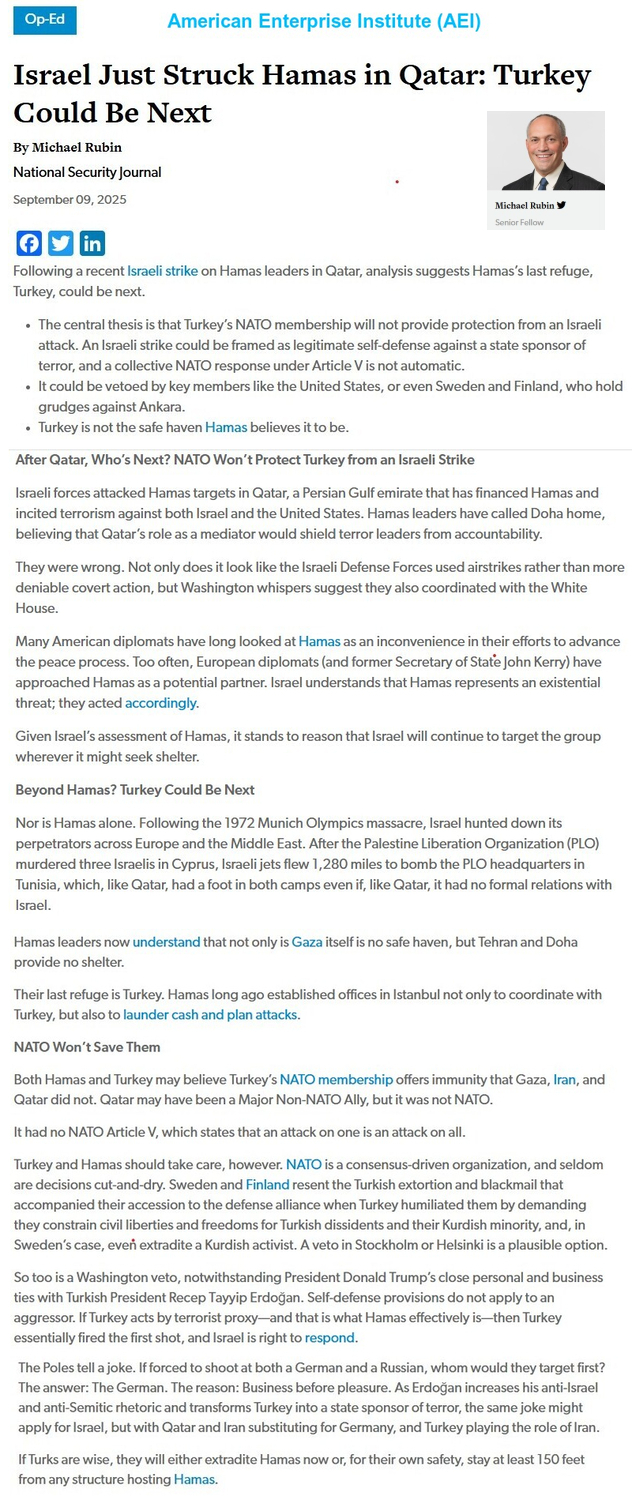
Neighbouring Syria could be one of Israel’s biggest obstacles in its drive to eliminate Hamas leaders inside Turkey. An Islamist rebel group, called Hayat Tahrir Al-Sham (HTS), commenced an 11-day offensive under the leadership of Ahmed Hussein al-Sharaa (also known by his nom de guerre Abu Mohammad al-Julani) in December 2024 and triggered the fall of the Regime of Bashar al-Assad, bringing an end to over 50 years rule by al-Assad family. Now, al-Sharaa is serving as the interim President of Syria. According to analysts, Turkey provided the HTS with covert support during the Syrian civil war. In August 2025, the two countries signed an agreement on the basis of which Turkey would build (and use) an airbase in Syria. Since the signing of this agreement, the Erdoğan Government has been on the radar of Mossad as Israel considers the accord a major security threat. The Zionist Regime has also strengthened ties with Greece and Cyprus, the two arch-rivals of Turkey.
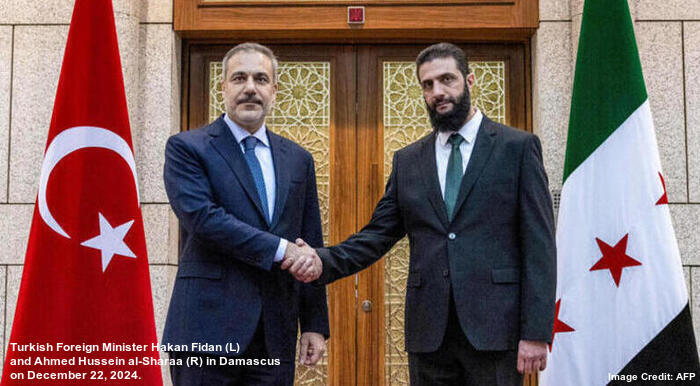
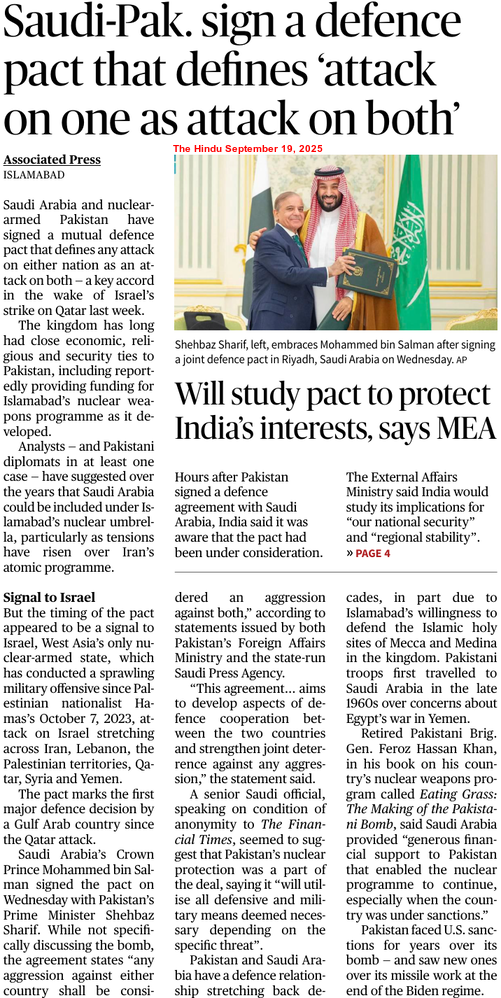
Israel is well aware of the fact that an armed conflict with Turkey would spread to the Mediterranean region, if it ultimately targets Hamas officials inside the Turkish territory. To avoid such a situation, Mossad could use assassins to selectively eliminate the leaders of the Palestinian outfit. It may be noted that Qatar hosted an emergency summit of the Arab and Gulf leaders on September 15, 2025 to discuss a collective response to the Israeli aggression and President Erdoğan attended the summit. The Arab and Gulf leaders decided to create a NATO-style military alliance, the Arab Unified Army, during the summit. However, there are doubts about how effective it would be as there are several US military bases in different parts of West Asia. Hence, Washington DC would never allow the Arab Nations to form a military alliance against Israel.
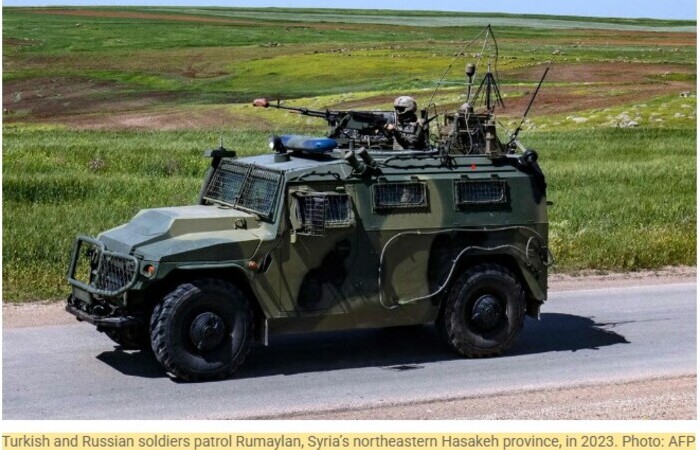
Russia, too, is closely monitoring the current developments in West Asia as an armed conflict between Israel and Turkey could lead to a breakup of NATO. In that case, Moscow would have the opportunity to expand its influence in the region. The Kremlin has been trying to counter the US’ influence in West Asia for a long time. That is why President Vladimir Vladimirovich Putin is not seen criticising Israel even after the Iran-Israel War, in spite of Russia’s close ties with the Islamic Republic.
Meanwhile,

Boundless Ocean of Politics on Facebook
Boundless Ocean of Politics on Twitter
Boundless Ocean of Politics on Linkedin
Contact us: kousdas@gmail.com

 ISMC
ISMC Boundless Ocean Of Politics