

The Postmodern Architecture Of Genocide
The Bengal Famine of 1943 claimed the lives of an estimated three million people in British India. The famine was primarily caused by a combination of factors, including wartime policies of the Colonial British Government, crop failures and the disruption of food supply lines. According to a section of historians, Sir Winston Leonard Spencer Churchill (November 30, 1874 – January 24, 1965), the then Prime Minister of Britain, triggered the famine in an attempt to ensure a steady supply of food items to the British soldiers at battlefields during the Second World War. In a sense, it was a well-planned genocide. In fact, the economy not only drives a war, but also triggers genocide which is often used as a weapon during war.
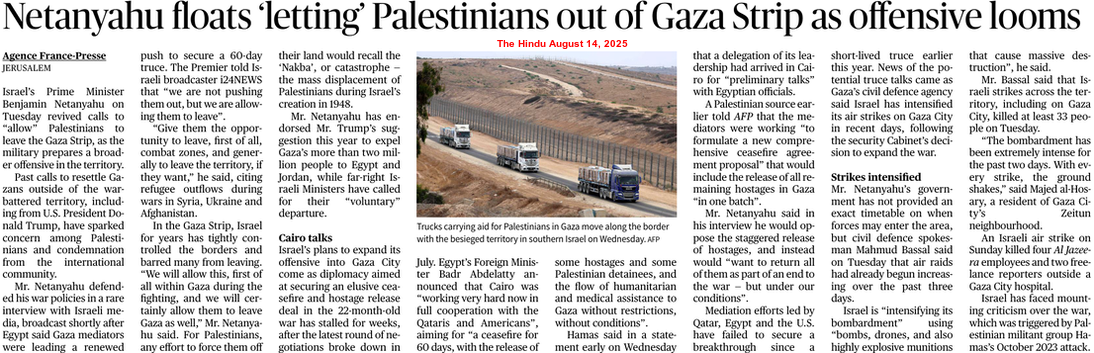
In the 21st Century, Israel has created a similar situation in Gaza to serve its vested interests. The Gaza Strip is currently experiencing a famine. In March 2025, the UN experts mentioned in a report that Israel carried out “genocidal acts” against the Palestinians by systematically destroying women’s healthcare facilities during the conflict in Gaza and also used sexual violence as a war strategy. The International Criminal Court (ICC), too, issued arrest warrants for top Israeli officials, including Prime Minister Benjamin ‘Bibi’ Netanyahu and his former Defence Minister Yoav Gallant, on charges of war crimes and crimes against humanity. However, no actions have been taken against them mainly because of the US.
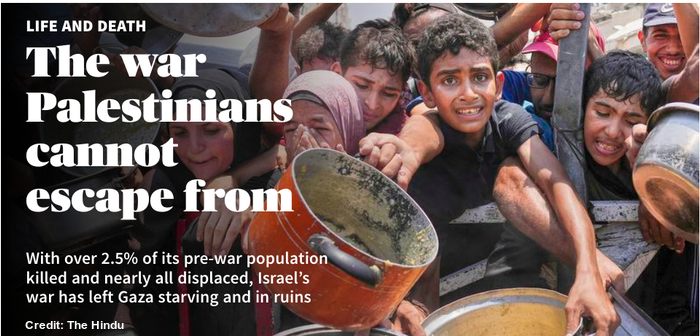
The international community dreamed of decolonisation across the globe in the 1950s, with a number of countries achieving independence from European colonial powers. This period was marked by the rise of anti-colonial movements, the weakening of colonial powers after the Second World War and the emergence of international bodies, like the UN. However, people did not notice the birth of a Colonial Power in West Asia. As colonisation means looting and war, Palestine became the new victim of colonialism with the establishment of the State of Israel on May 14, 1948.
The settlement pattern in Gaza is a clear indication that Palestine is a colony of Israel. While the Israeli lords are settled in the quiet high towers of the mountains, the crowded Palestinian settlements are situated in the valley. Highways are open to the Israelis, but the Palestinians have to cross around 12 checkpoints to enter Israel! One can find Israel’s different treatment of Jewish settlements to nearby Palestinian communities throughout the West Bank, including East Jerusalem. According to a report published by the Human Rights Watch (HRW), there is a “two-tier system of laws, rules and services that Israel operates for the two populations in areas in the West Bank under its exclusive control, which provide preferential services, development and benefits for Jewish settlers, while imposing harsh conditions on Palestinians“.

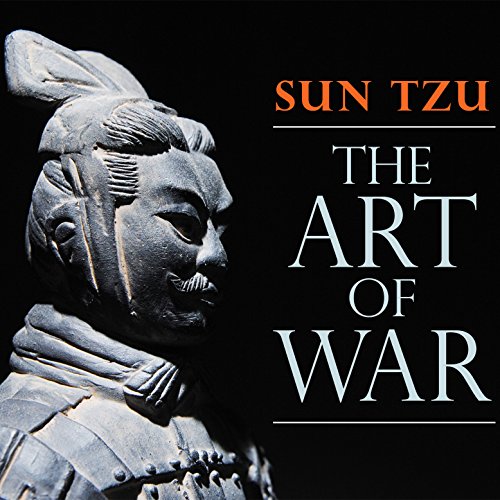
The Israel-Palestine conflict has been going on for almost a century. Palestinians not only refused to leave their own land, but also maintained their strong resistance. They, too, have committed war crimes. However, Israel enjoys an advantage as armed conflict has gradually become dependent on capital, technology and strategy which have replaced the art and philosophy (of war). At the same time, a new architecture of war has been created.
The field of application of this architecture is an open space. The main purpose of the architecture is to turn any empty space into a place to carry out construction works. Postmodern Philosophy developed some important propositions about space in the 20th Century. This philosophy further presented alternative ideas by breaking down the conventional concepts of inside-outside, high-low, front-rear, etc. For so long, people had no idea that practical application of all these abstract ideas would be possible. Now, the Right-Wing camp has embraced Postmodern Philosophy, widely considered as a product of the Leftist School, and started using it in battlefields.
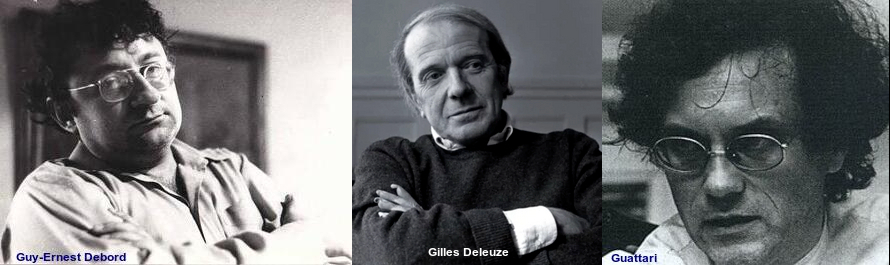
Former Palestinian settlements in the Gaza Strip were a maze of alleys. It was really difficult for the Israelis to trace, as well as identify, the danger in those congested areas. The Israeli Army did not dare to carry out search operations in Gaza in the past. Hence, the Israeli Armed Forces sought help from the French postmodern thinkers, such as Gilles Louis René Deleuze (Jan 18, 1925 – Nov 4, 1995), Pierre-Félix Guattari (March 30, 1930 – Aug 29, 1992) and Guy-Ernest Debord (Dec 28, 1931 – Nov 30, 1994). They have become popular figures at Israeli military training centres.
The fundamental similarities between architecture and war cannot be ignored as both emphasise the occupation, as well as control, of a space. Israeli defence experts are well aware of the fact that old military doctrines would not work in Palestinian territories and they would have to abandon conventional wisdom in order to eliminate the Palestinian soldiers. Hence, they have started to look at inside and outside in an unconventional manner, apart from reversing the traditional linguistic usages that coordinate the streets as outside and the houses as inside. Thus, the Israeli forces have learnt to consider dangerous alleys as inside.
It has helped the Israelis to construct new avenues to reach the Palestinian homes. First, they created a detailed map of the Palestinian territories with the help of satellite and drone images. It allowed them to get a clear idea not only about the streets and houses, but also about the items kept inside those houses! Thereafter, the Israeli forces carried out operations with hammers, explosives, bulldozers and tanks inside Gaza and West Bank. Instead of entering through the main door, the Israeli soldiers have started creating an entrance by damaging one of the walls of the bedroom. Palestinians, sleeping in their room, are awakened by a loud noise at night only to find armed Israelis standing on all sides of their bed! Israeli soldiers often lock some Palestinians in a room of their own residence for an indefinite period and kill the rest. It has become increasingly difficult for the Palestinians to guess how the Israelis would enter their houses. In fact, this masterful use of the unexpected postmodern strategy is the key to Israeli success. The movements of soldiers, swarming like bees, are not at all monotonous. Instead, they have become multi-linear, starting from different points simultaneously.
As far as urban planning or architectural discourse are concerned, the term, Urbicide, has become quite popular in recent times. Derived from urban and the Latin occidere (to kill), Urbicide refers to the deliberate destruction or damaging of a city, either directly or indirectly. It encompasses actions that kill a city by physically destroying it or by undermining its social, cultural and economic structures, making it uninhabitable or unrecognisable. The Israelis have popularised this concept in the Palestinian territories with the help of hammers, explosives, bulldozers and tanks. They are wiping out an entire civilisation by destroying homes, roads, trees and farmlands. The Israelis uprooted nearly a hundred Palestinian villages between 1948 and 2000. They have also established numerous settlements in the occupied Palestinian territories in the past 25 years. With this, the very existence of a sovereign Palestine has become meaningless.
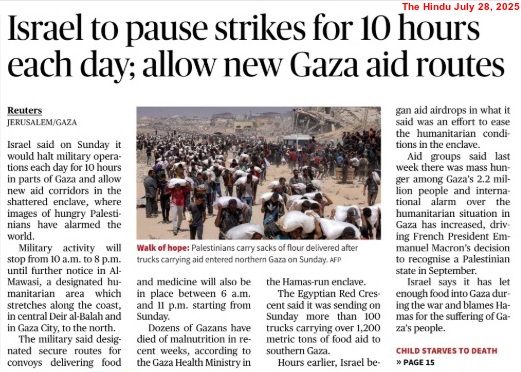
According to observers, what is happening in Gaza can be called the Economy of Genocide or the Architecture of Genocide. Beneath the apparent chaos lies the blueprint of a massive urbicide campaign. As per the blueprint, the Gaza Strip is now divided into two parts. Israel has prompted the Gazans to vacate the northern part by carrying out military operations. It is worth noting that most of the fertile agricultural lands are there in the northern part of Gaza. After evacuating the area with heavy artillery, the Israeli forces are entering northern Gaza with large payloaders. They are also storing the scattered ruins of Palestinian houses with a plan to use them as raw materials while constructing future Jewish settlements there. Thus, the Palestinians gradually become foreigners in their own land as Palestine becomes Israel.
The UN Human Rights activists often use the term Forensic Architecture. Forensic architects analyse the rubble and structural damage of buildings in war-torn areas to understand the nature of destruction and potentially identify evidence of war crimes or Human Rights violations. By studying the patterns of damage and the materials used, they can reconstruct events, determine the intent of the attackers and provide crucial evidence for investigations and legal proceedings.

It is quite challenging to collect evidence of war crimes committed by a powerful nation, like Israel. Eyal Weizman, an Israel-born British architect, is doing this job in Palestine on behalf of Human Rights activists. By doing so, Weizman, the Director of the research agency Forensic Architecture at Goldsmiths, University of London, has emerged as one of the greatest enemies of the Zionist Regime.
Boundless Ocean of Politics on Facebook
Boundless Ocean of Politics on Twitter
Boundless Ocean of Politics on Linkedin
Contact us: kousdas@gmail.com

 ISMC
ISMC Boundless Ocean Of Politics
3 Comments »