

Masquerade
A fine example of how an authoritarian ruler can force her/his countrymen to live in chains under the guise of apparent simplicity is Italy in the 1930s. The Fascist Rule was established through straightforward parliamentary procedures, without any political violence, tension or repression.
On January 3, 1925, Prime Minister Benito Amilcare Andrea Mussolini (July 29, 1883 – April 28, 1945) delivered a speech in the Italian Chamber of Deputies that is widely considered as the very first moment of Fascist Rule in the south-west European country. With this speech, he took personal responsibility for the actions of his Blackshirts and effectively consolidated power, marking a significant step towards the establishment of a Fascist Dictatorship. The speech was delivered in a usual manner by the Prime Minister. However, his strong and assertive tone secured its place in history due to its impact on Europe in the next couple of decades. Later, Mussolini and Adolf Hitler left an indelible mark on the world. Interestingly, the majority failed to realise the importance of that speech in 1925. In other words, the reign of fascism did not begin with a Big Bang, but with a whimper.

It may be noted that socialist leader Giacomo Matteotti (May 22, 1885 – June 10, 1924; elected Deputy of the Chamber of Deputies thrice in 1919, 1921 and 1924) was assassinated inside the Chamber few months before Il Duce (The Leader) delivered the speech. There was a heightened state of anxiety and apprehension in Italy following the high-profile killing. In an attempt to normalise the situation, Mussolini mentioned (while delivering the speech): “The speech I am about to deliver before you cannot perhaps be strictly classed as a parliamentary speech. Let it be known in any case that I am not seeking this political vote. I do not want it: I have had many.“
At that period of time, the Article 47 of the Italian Constitution used to allow any person to question, as well as criticise, a minister, apart from filing a case against her/him in the Supreme Court. As Il Duce was well aware of that constitutional right, he asked members of the Parliament whether they would like to use that right against him. Interestingly, the House remained quiet. Their silence buried all the questions and criticisms in Italy, and the Fascist Regime was established in full glory. In the next two decades, no one dared to raise her/his voice against any decision or action made by Mussolini.
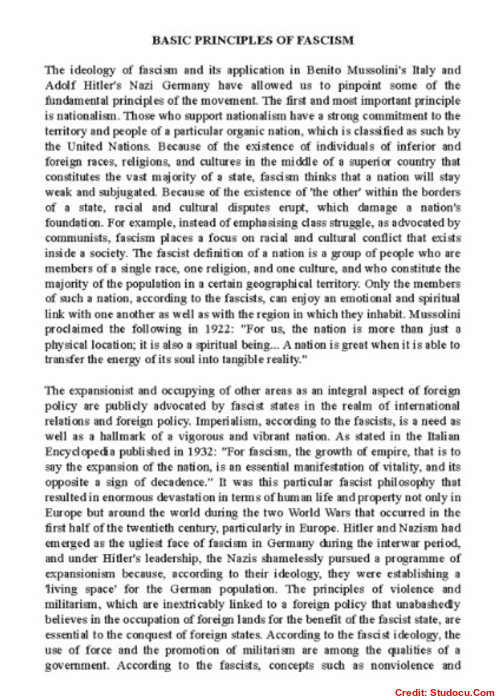
Yet in that speech, Mussolini repeatedly mentioned that he was aware of the rights of opposition leaders. He told the House: “I said to the opposition: ‘I recognise your ideal rights, your contingent rights. You may surpass Fascism with your experience; you may put under immediate criticism all the measures of the Fascist Government’.” The silence of the entire House impressed the leader, apart from encouraging him to add some comments about his sensational success. At the same time, he reintroduced the death penalty that was outlawed in Italy in 1881. Mussolini’s government expanded the number of crimes punishable by death, particularly those against the state. However, the capital punishment was again abolished for most crimes in 1947, with the final abolition for all crimes taking place in 1994.
While delivering the speech, Mussolini further promised to bear the responsibility of all mistakes, successes and glory for the sake of the nation. However, he curtailed press freedom and banned opposition political institutions within a few days. He did all these in an easy, as well as efficient, manner, prompting the global community to praise his administrative skills.

Certainly, it was not that easy for the international community to know the real information or the harshest truth as it was wrapped in simplicity. It is difficult to understand the paradoxical nature of perception and understanding even in the 21st Century. Hence, one can easily understand how difficult it was a century ago.
Boundless Ocean of Politics on Facebook
Boundless Ocean of Politics on Twitter
Boundless Ocean of Politics on Linkedin
Contact us: kousdas@gmail.com

 ISMC
ISMC Boundless Ocean Of Politics