

The Wizard Of Grey Twilight
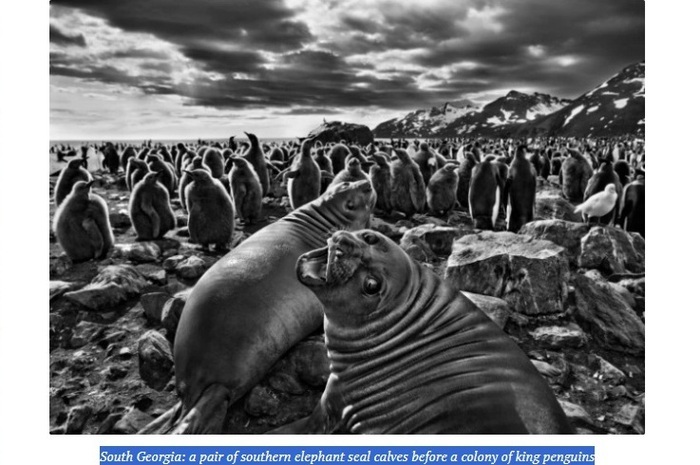
Genesis, the series of photography by Brazilian photojournalist Sebastião Ribeiro Salgado Júnior (February 8, 1944 – May 23, 2025), shows a scene on South Georgia Island in the South Atlantic that features a colony of hundreds of king penguins, with two southern elephant seal pups in the foreground. One of the seal pups is looking directly into the camera lens. This iconic, as well as mind-blowing, image was part of Salgado’s larger Genesis project, aimed at documenting the natural beauty and untouched landscapes of the Earth.
The image makes one think about the role of humans in climate change. It instantly builds a bridge between humans and thousands of animals living on a remote island, highlighting the pride of humanity. The expression of one of the seal pups is quite resonant especially in light-and-dark sheds. Here lies the appeal of Genesis, which carries the imprint of Salgado’s unique genre. At the same time, the photograph is also a heartbreaking one.
Salgado was not just a photojournalist, but also a thinking personality. He started thinking planetarily before the term planetary was introduced into theoretical practice. As Salgado was a Brazilian national, his perspective was sympathetic to the so-called Global South. After earning a Master’s Degree in Economics from the University of São Paulo in 1968, he began his PhD in Paris in 1969. He, as a student, suffered a lot for taking part in protests against the dictatorship, and was unable to return home for a decade as the concerned authorities in France seized his passport.
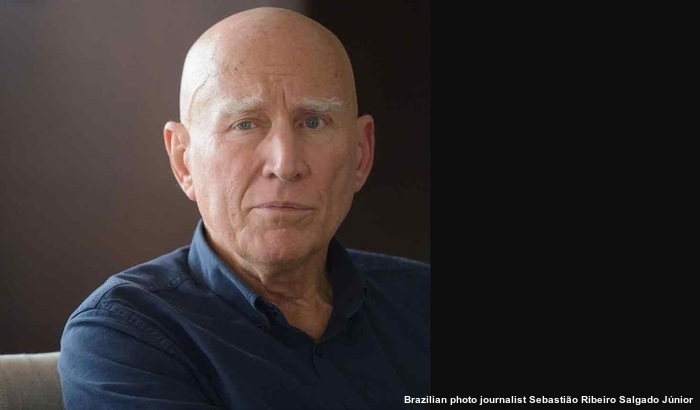
Salgado discovered his talent in photography in the early 1970s while clicking pictures with his wife’s (Lélia Wanick Salgado) camera. Later, he joined the International Coffee Organisation as an economist and often travelled to Africa on missions for the World Bank. It was during his travels to Africa when Salgado first started taking photography in a serious manner. He decided to abandon his career as an economist and switched to photography in 1973, working initially on news assignments before veering more towards documentary-type work. Salgado initially worked with the Sygma photo agency and visited the Portuguese-speaking African countries for professional purposes. Later, he joined the Paris-based Gamma agency and toured entire Europe, Africa and Latin America as a photographer. In 1979, Salgado started working as a photojournalist for Magnum Photos, the international cooperative of photographers.

The world of photography shall always remember Salgado for his Workers: An Archaeology of the Industrial Age, Migrations, Genesis and Amazônia. He also clicked some photos of the assassin’s attack on former US President Ronald Wilson Reagan (February 6, 1911 – June 5, 2004) in 1981. He arrived in Washington DC to cover President Reagan’s speech to industrialists in March 1981. However, he left the venue before the event ended. Salgado literally walked towards the gunpoint as he started following the President when Regan was leaving the venue. He got an opportunity to click some pictures of the assassin because he was in the right place at the right time.
Salgado left Magnum in 1994 and formed his own agency, Amazonas Images, with his wife Lélia in Paris mainly to showcase his work. Lélia was in charge of the layout and overall presentation of his collection. They did a great job. In 1990, Salgado had to take charge of his family farm in the Rio Doce Valley (Brazil). The rainforest was almost destroyed there when they returned home. As Lélia encouraged him to concentrate on reforestation, Salgado founded the Instituto Terra in 1998 mainly to promote reforestation, water resource conservation and to create awareness among locals on these issues. They successfully restored a part of the Atlantic Forest in Brazil, turning 17,000 acres of land into a nature reserve.

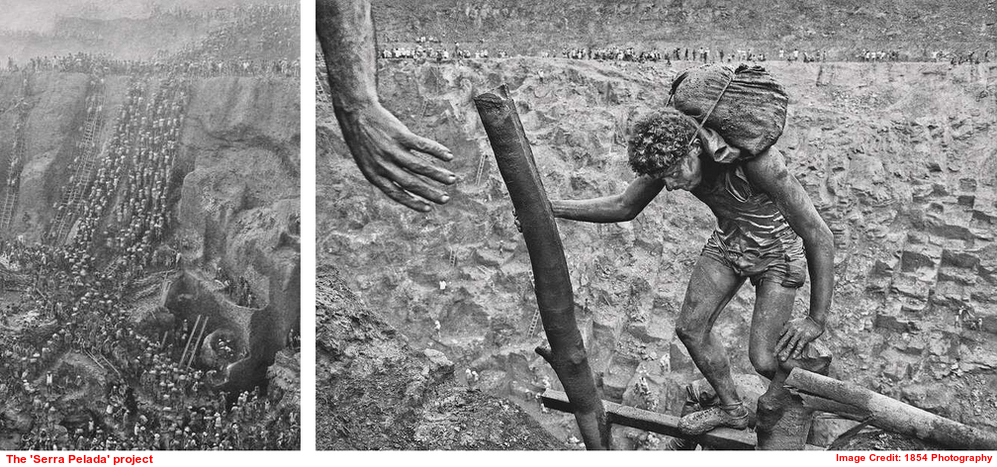
In an interview, Salgado stressed that his goal as a photographer was to “touch the soul“, emphasising that his works went beyond technical skill and made an attempt to connect with the emotions, as well as experiences, of his subjects. The exhibition of his photography triggered all sorts of reactions, from tears to extreme protests. His photograph of a gold mine in famine-stricken Africa, titled Serra Pelada, or the Genesis portrays the fragility of people, nature and wildlife. He exposed the helplessness of people on large frames mainly in dark-and-light sheds in his own style and they became collectors’ items. No wonder, Salgado’s creativity irked many. He developed the style by spending a long time in a particular place in an attempt to become intimate with the subject as much as possible. The moment the famine-stricken people appeared in front of his camera or the miners were captured by his lens, they became a part of his project.
By planting trees in the rainforest, the Salgado couple realised that nature has an amazing ability to slowly heal its wounds and to restore the lost biodiversity. This realisation gave birth to Genesis; a treasure trove of photographs clicked in different parts of the globe. One can discover the interdependence of nature, animals and humans in the complementarity of fauna and nature that are clearly visible in the images of the abundant Chinese penguin colony in North Antarctica or the world’s largest albatross colony on the western edge of the Falkland Islands or in the twilight of South Sudan. One of Salgado’s notable series features Dinka cattle herders in Sudan, where he captured images of people with long-horned cattle in ethereal dust clouds.

Salgado’s photographs, in different shades of grey, remind one that humans, just like animals, are living beings. A slight change in nature shall completely destroy the ecological balance, as well as human civilisation.
Boundless Ocean of Politics on Facebook
Boundless Ocean of Politics on Twitter
Boundless Ocean of Politics on Linkedin
Contact us: kousdas@gmail.com

 ISMC
ISMC Boundless Ocean Of Politics