

The Fear Comes True
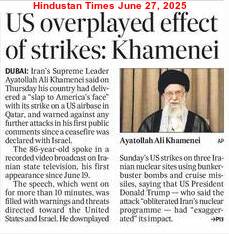
Putting an end to all speculations, the Parliament of Iran approved a Bill on June 25, 2025 to suspend cooperation with the International Atomic Energy Agency (IAEA). The Bill, which should be approved by Iran’s unelected Guardian Council to become law, states that any future inspection by the IAEA would need approval by the Supreme National Security Council. Tehran claimed that the recent Israeli and US airstrikes on its nuclear sites prompted the Parliament to make the decision. The Islamic Republic also made it clear that it would not abandon its civilian nuclear programme under any circumstances. Tehran further ruled out nuclear talks with the US, rejecting President Donald John Trump‘s recent claim in this regard.
Tehran issued a statement, mentioning that the IAEA refused to condemn the attacks on the Iranian nuclear sites because the UN nuclear watchdog was biased. Talking to the media, Parliament Speaker Mohammad Baqer Qalibaf stressed that the IAEA had refused even to appear to condemn the attack on Iran’s nuclear facilities and “has put its international credibility up for sale“. According to the Speaker, a June 2025 IAEA resolution declaring Iran in breach of its non-proliferation obligations encouraged Israel to attack the Iranian nuclear facilities. In fact, Tehran threatened to leave the Treaty on the Non-Proliferation of Nuclear Weapons (NPT) immediately after the US attack.
The NPT was opened for signature in 1968 and officially entered into force on March 5, 1970. The treaty aims to prevent the spread of nuclear weapons, promote cooperation in the peaceful uses of nuclear energy and further the goal of nuclear disarmament. The treaty supports the right of all signatories to access nuclear technology for peaceful purposes under safeguards overseen by the IAEA. On the other hand, Article 10 of the NPT outlines the procedure for a state party to withdraw from the treaty. The Article clearly states that each party has the right to withdraw if it decides that extraordinary events, related to the treaty’s subject matter, have jeopardised supreme interests of that country. The withdrawal takes effect three months after the depositary receives notification, which must also include a statement of the extraordinary events.
It may be noted that Iran has not been on the list of signatories to the NPT since 1968. Although Tehran did sign the NPT in 1968, it was not immediately a signatory. The treaty entered into force in 1970 and Iran ratified it in 1970, becoming a signatory upon ratification. Since then, the West Asian nation has been accused of not fully cooperating with the IAEA regarding its nuclear material collection and other nuclear-related activities. One should not forget that each and every country, which uses, stores or manages nuclear materials, is required to report its status to the UN nuclear watchdog.
It is also a fact that Tulsi Gabbard, the US Director of National Intelligence, told the Senate Intelligence Committee on March 25, 2025: “The American intelligence community assessed that Iran was not actively pursuing a nuclear weapon, although Tehran refused to cooperate with the IAEA.” Hence, it is quite difficult to understand the cause of the Israel-Iran War. Israel and the US attacked the Iranian nuclear facilities without any provocation, despite the fact that the Islamic Republic has remained a signatory to the NPT for decades. Therefore, Iran’s NPT exit would be unfortunate, but not unexpected.
Needless to say, Iran would not be obligated to comply with the requirements of the NPT if it withdraws from the treaty. In the absence of IAEA safeguards, UN inspectors and the rest of the world would remain unaware of Iran’s nuclear programme. In other words, it would become easier for Tehran to secretly develop nuclear weapons. Furthermore, Iran’s potential withdrawal from the NPT could set a negative precedent, encouraging other nations to consider abandoning international agreements, especially those related to arms control.
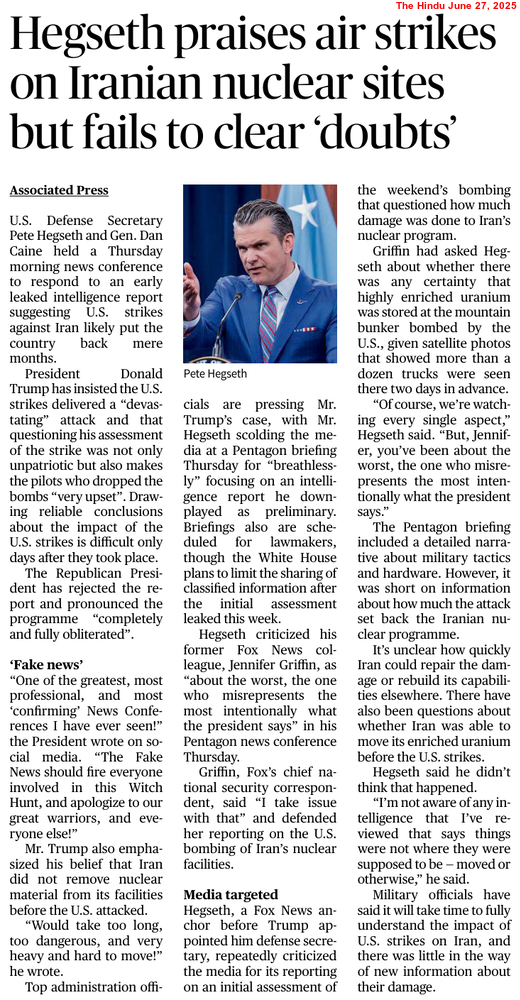
The international community would have to wait to see whether the US and Israel’s decision to attack the Iranian nuclear facilities would hurt their own (vested) interests in the future.
Boundless Ocean of Politics on Facebook
Boundless Ocean of Politics on Twitter
Boundless Ocean of Politics on Linkedin
Contact us: kousdas@gmail.com

 ISMC
ISMC Boundless Ocean Of Politics