

Indo-Pak Ceasefire & The Trump Card
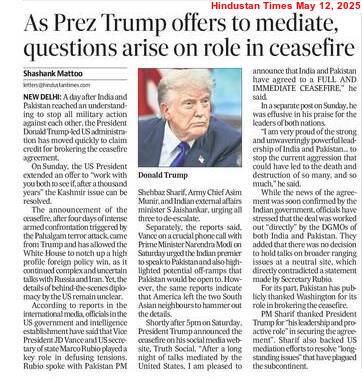
Ahead of Indian Prime Minister Narendra Modi‘s first address to the nation after Operation Sindoor, US President Donald John Trump claimed on May 12, 2025 that he put both India and Pakistan under immense pressure by threatening of ending trade with them in order to stop the armed conflict. The US President stressed that India and Pakistan were told they would get no trade with the US, if they refused to de-escalate. He further said that no one else could handle trade the way he does, stating that the reason behind the ceasefire agreement between the two arch-rivals was trade.
It may be noted that President Trump announced a ceasefire between India and Pakistan on May 10, 2025 even before New Delhi and Islamabad issued any official statement in this regard. And on May 11, he wrote on X: “While not even discussed, I am going to increase trade, substantially, with both of these great Nations. Additionally, I will work with you both (India and Pakistan) to see if, after a ‘thousand years’, a solution can be arrived at concerning Kashmir.“
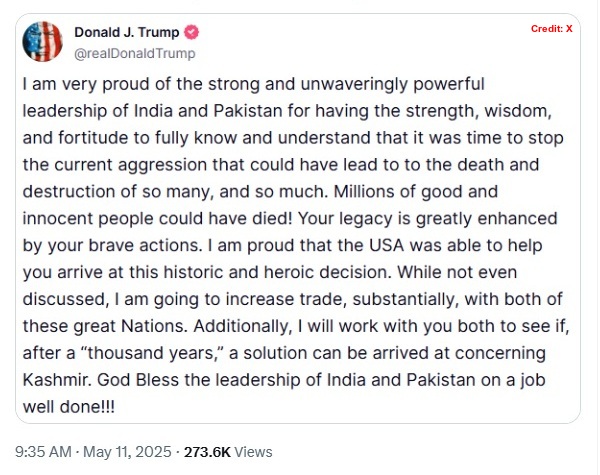
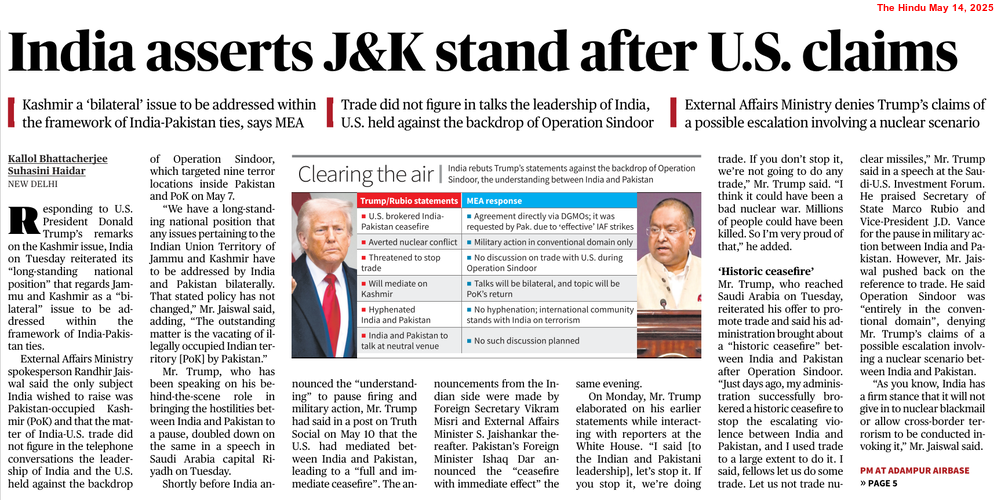
As expected, such comments made by the US President have embarrassed the Narendra Modi Administration as India made it clear long ago that it would never accept any third-party mediation on the Kashmir issue. Although New Delhi did not officially reject Trump’s proposal for mediation, Prime Minister Modi announced on May 12 that India would hold no discussions with Pakistan on the Kashmir issue, except to dismantle its terrorist infrastructure and return the Pakistan-occupied-Kashmir (PoK).
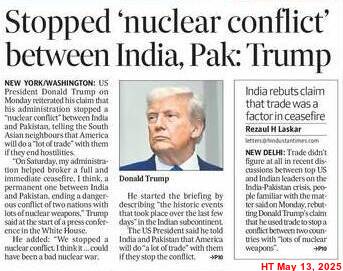
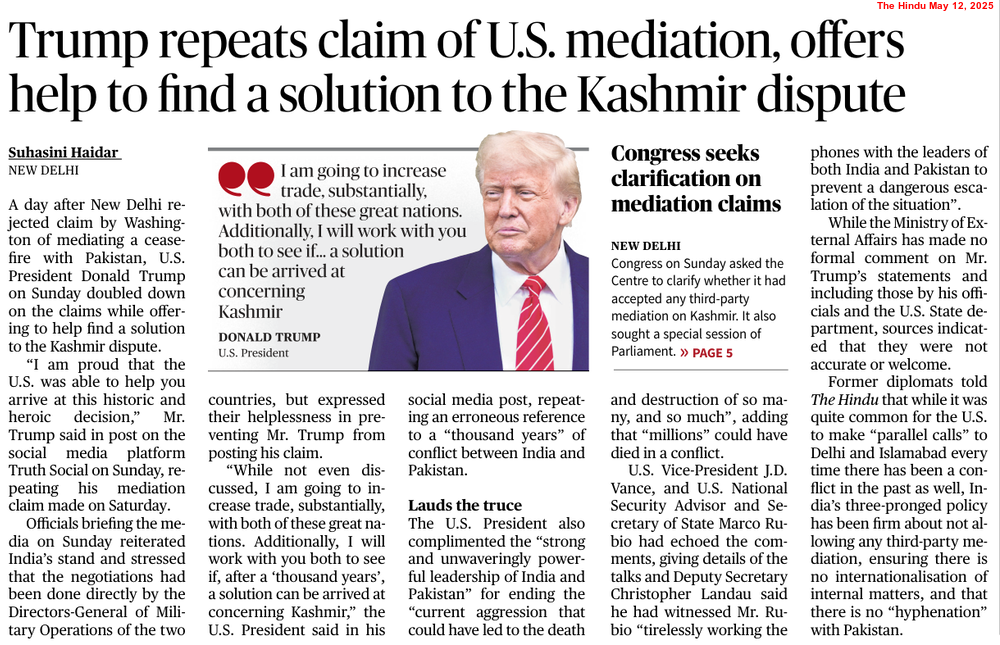
Trump also mentioned that his administration played the role of a mediator between India and Pakistan to end the military standoff after the April 22 Pahalgam terror attack that claimed 26 innocent lives. Meanwhile, Prime Minister Modi informed his countrymen that the “ceasefire is conditional“, stressing that Pakistan, shaken by the damage inflicted upon its airbases and terror infrastructure it has created, made a direct plea to Director General of Military Operation (DGMO) of the Indian Army Lieutenant General Rajiv Ghai for a ceasefire. He asserted that India only agreed to pause Operation Sindoor and that Pakistan would continue to be under watch, suggesting that all bets would be off, if Islamabad did not stop its support to terrorism.
Political analysts are of the opinion that the US President is basically trying to protect Pakistan as he has a big plan. Washington DC (especially the Republicans) has a soft corner for Islamabad because it has always used the South Asian nation for serving its vested interests in Asia. The fourth round of talks between the Iranian and US negotiators to resolve disputes over Tehran’s nuclear programme ended in Oman on May 11, with further negotiations planned as Tehran publicly insisted on continuing its uranium enrichment. In case of a failure (of the next round of talks), the US may get involved in an armed conflict with the Islamic Republic. Then, the US Air Force would have to use the Pakistani air bases. Given the current state of geopolitics in West Asia, maintaining peace between India and Pakistan has become crucial for Washington DC. Hence, the US has also prompted the International Monetary Fund (IMF) to clear a loan of USD 2.3 billion for Pakistan, apart from providing Islamabad with missiles!
Perhaps, Iran had prior information that Pakistan-sponsored terrorists would launch a Hamas-style attack in Pahalgam on April 22, 2025 (and India would retaliate). Tehran would get some more time for negotiations (with the US on its nuclear programme), if India and Pakistan would continue the conflict. The conflict in the Indian Subcontinent could also make it difficult for the US to get access to the Pakistani air bases.
Interestingly, Iran offered itself as mediator, amid rising tensions between India and Pakistan, immediately after the April 22 Pahalgam terror attack. Although India rejected the offer, Tehran made a serious attempt to normalise (its own) ties with neighbouring Pakistan with this move. Had Iran managed to mediate in India-Pakistan relations, Islamabad would hesitate to allow the US to use its soil against Iran (if the situation arises), believe experts. Saudi Arabia and the United Arab Emirates (UAE), too, requested both India and Pakistan to de-escalate tension. Saudi Minister of State for Foreign Affairs Adel bin Ahmed Al-Jubeir arrived in New Delhi on May 8, in the backdrop of India hitting terror targets inside Pakistan. His visit coincided with the arrival of Iranian Foreign Minister Sayyid Abbas Araghchi in the Indian capital for a day-long visit. Both the foreign ministers held separate talks with their Indian counterpart Dr Subrahmanyam Jaishankar. Later, the Saudi Foreign Ministry mentioned in a statement that Adel bin Ahmed Al-Jubeir’s visit to India (and Pakistan) on May 8-9 took place upon the directives of the leadership of the Kingdom of Saudi Arabia.
It seems that the changing regional geopolitical landscape would become more understandable within a few months.
Boundless Ocean of Politics on Facebook
Boundless Ocean of Politics on Twitter
Boundless Ocean of Politics on Linkedin
Contact us: kousdas@gmail.com

 ISMC
ISMC Boundless Ocean Of Politics