

The Importance Of Hyphen In Diplomacy
Sometimes, history repeats itself in a cruel manner. For example, one can mention the Pahalgam terror attack (in Kashmir) on April 22, 2025.
Former US President William Jefferson ‘Bill’ Clinton, along with his daughter and mother-in-law, visited India way back in 2000. He was scheduled to visit Jaipur and Agra during his stay in the South Asian country. His visit was quite important for India as whenever a US President visited the country before 2000, he also made a stop in neighbouring Pakistan. New Delhi was against hyphenation of the names of India and Pakistan together in this way. India still considers it as a denial of distinct identities and a potential misrepresentation of separate histories of the two countries. Interestingly, Clinton was the first US President to exclude Pakistan from his itinerary during his trip to the Indian Subcontinent. Hence, Atal Bihari Vajpayee, the then Prime Minister of India, was excited about the visit.
President Clinton arrived in India on March 21, 2000. Just a day before his arrival, some Pakistan-backed terrorists launched an attack in Anantnag District of India-administered-Kashmir, killing 36 innocent civilians. Naturally, Prime Minister Vajpayee and President Clinton discussed Pakistan-sponsored terrorism in Kashmir during their meeting and the scenario prompted Washington DC to place India and Pakistan in the same bracket.
Twenty-five years later, Pakistan-backed terrorists gunned down 26 tourists in Pahalgam a day after US Vice President James David Vance, along with his Indian-origin wife Usha and their three children, arrived in India on a four-day trip. Vance and his family met Prime Minister Narendra Modi at his official residence in New Delhi upon their arrival. Incidentally, the US Vice President also visited Jaipur and Agra before leaving for Washington DC.

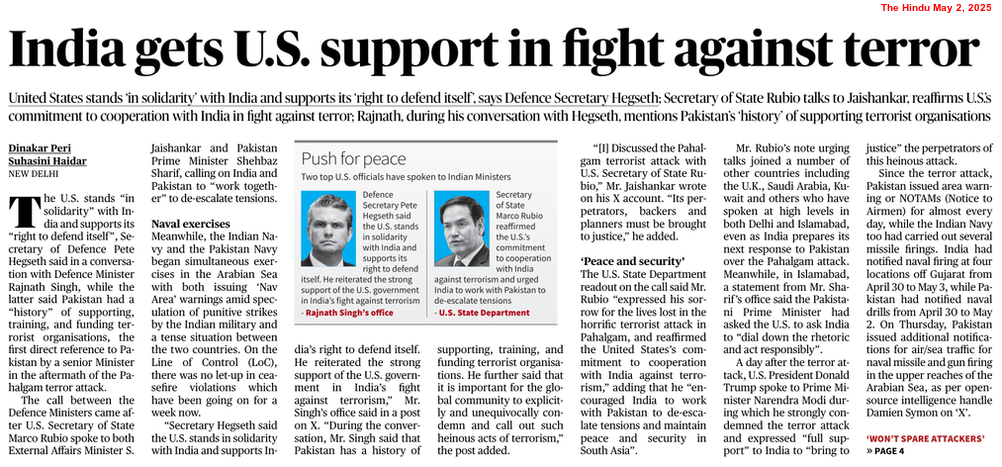
There are three clear motives behind the terrorist attack in Pahalgam. The incident took place at a time when the Modi Government was trying hard to prove that India resolved the Kashmir issue by revoking Article 370 of the Indian Constitution (which allowed Kashmir to enjoy a special status), holding elections in Kashmir, and sending a message of peace to the Kashmiri people. Secondly, the terrorists carried out the operation during the visit of a US leader in order to embarrass India on the global stage. Thirdly, Islamabad made an attempt to provoke New Delhi to retaliate by helping The Resistance Front (TRF), an offshoot of Pakistan-based terror outfit Lashkar-e-Taiba (LeT), to carry out the attack. If India’s retaliation turns into a long-term conflict, then Kashmir would become an international issue yet again, and India and Pakistan would be pronounced together with a hyphen. It would also allow the Pakistani Army to rediscover its relevance in national politics.
Click to watch: Former Pak Army officer Major Adil Raja claims that the Pahalgam terror attack was orchestrated by Pak’s General Asim Munir for personal gain
A hyphen has immense importance in diplomacy and it is evident in Russia-Ukraine War or Israel-Hamas conflict. Whether the names of India and Pakistan would be pronounced separately, or connected by a hyphen, is a difficult challenge that the Indian diplomats have been facing for years. The Pahalgam terror attack has once again presented the Narendra Modi Administration with a serious challenge. The situation of India is somewhat similar to that of Israel. On October 7, 2023, hundreds of Hamas fighters launched a surprise attack on Israel with rockets and armed drones, killing nearly 1,200 people and kidnapping at least 240. Along with Israelis, the victims included citizens of the US and more than 30 other countries (almost all with dual Israeli citizenship). The Zionist Regime launched a war against the Palestinian Hamas Movement in response to attacks on innocent civilians and the conflict is still going on. Although the Israeli armed forces have carried out genocide in the Gaza Strip, Israel and Palestine have become hyphenated (as contingent). With this, the Gaza conflict has become increasingly relevant to the global community. Benjamin ‘Bibi’ Netanyahu has failed to separate Israel from Palestine, in spite of his best efforts.

A large section of Prime Minister Modi’s Bharatiya Janata Party (BJP) believes that capturing Pakistan-occupied-Kashmir (PoK) is the only way to end Islamabad’s support to terrorism. They want Modi to teach Pakistan a lesson just as (former Prime Minister of India) Indira Gandhi had dismembered Pakistan in 1971 (by helping the people of Bangladesh to create an independent nation). However, one should keep in mind the presence of China in PoK. An attack by the Indian Army in PoK would effectively mean simultaneously risking war on the borders with Pakistan and China. Hence, the Opposition parties in India have stressed on the need for a moderate response (or retaliation).

In the 21st Century, India relies mainly on Russia and Israel to boost its security, as well as defence strength. Both Moscow and Tel Aviv contacted New Delhi immediately after the Pahalgam terror attack. However, these two countries are preoccupied with their own long-running wars at home, and not in a position to supply weapons and military equipment to India. In such a situation, India would have to depend on France, the US and other countries for defence support, if necessary.

Therefore, it has become quite difficult for India to completely dehyphenate Pakistan in the current global geopolitical landscape. Defence analysts are of the opinion that India should wait for the right time to strike back or to activate back-channel diplomacy in order to address the conflict discreetly.
Boundless Ocean of Politics on Facebook
Boundless Ocean of Politics on Twitter
Boundless Ocean of Politics on Linkedin
Contact us: kousdas@gmail.com

 ISMC
ISMC Boundless Ocean Of Politics