

4 Rebel Groups Join Hands In Pakistan
After Balochistan and Khyber Pakhtunkhwa, the rebellion against the dominance of Punjab Province (across Pakistan) has spread to Sindh, as well! Reports suggest that the Sindhudesh Liberation Army (SLA), a militant organisation based in the Sindh Province of Pakistan, has joined hands with three Baloch rebel groups. The scenario could make the future of Chinese investment in the South Asian country uncertain.
The Balochistan Liberation Army (BLA) hijacked the Jaffar Express in Bolan on March 11, 2025 and took all the 440 passengers on board hostage as the train was travelling from Quetta to Peshawar. Incidentally, the BLA announced the formation of a new joint force with two other armed Baloch groups, the Balochistan Liberation Front (BLF) and the Baloch Republican Guards (BRG), just a week ago. Significantly, the SLA also announced its participation in the joint force, the Baluch National Freedom Movement (locally known as Baluch Raji Ajohi Sangar or BRAS).
It is for the first time (in the history of Pakistan) that rebels from Sindh have joined hands with the Baloch rebel groups. Political analysts are of the opinion that the development would create troubles not only for Pakistan, but also for China.
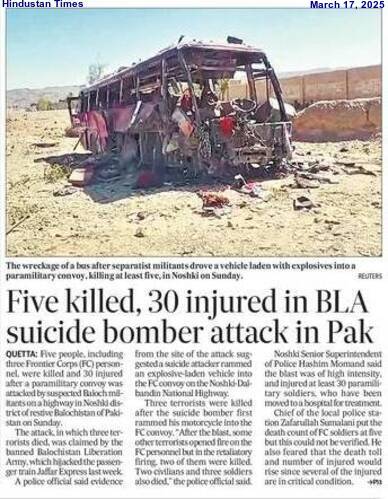
In 2024, the Baloch rebels signed an agreement with the Pakistani Taliban (formally called the Tehreek-e-Taliban-e-Pakistan or TTP) and Jaish al-Fursan, the two outfits active in Khyber Pakhtunkhwa, in the presence of the top Taliban leadership in neighbouring Afghanistan. Since then, insurgent attacks on the Pakistani Army and Frontier Corps paramilitary forces have increased in those two provinces.
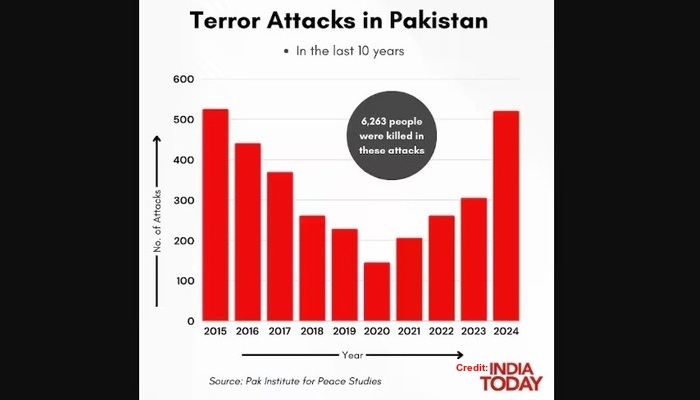
A deadly explosion rocked the Maulana Abdul Aziz Mosque in South Waziristan of Khyber Pakhtunkhwa, injuring several people, including Maulana Abdullah Nadeem, the district chief of Jamiat Ulema-e-Islam (JUI), on March 14, 2025. Next day, four people, including a cleric, were injured in a blast at a seminary-cum-mosque in Urmur Bala Village in Peshawar District.
Baloch rebels have demanded that China be removed from the Gwadar Port and the China-Pakistan Economic Corridor (CPEC) projects, accusing Beijing of looting natural resources of the Pakistani province. It may be noted that the Karakoram Highway, a 1,300km-long national highway, connects Xinjiang Uyghur Autonomous Region of China with the Pakistani Provinces of Punjab, Khyber Pakhtunkhwa, Gilgit-Baltistan and Balochistan. This highway is a major part of China’s One Belt One Road initiative. Although both Beijing and Islamabad have claimed that the CPEC is a milestone as far as bilateral relations are concerned, the BLA believes that the highway helps China to loot natural resources of Balochistan. Interestingly, the SLA, too, has asked the Government of Pakistan not to allow China to use the Karachi port of Sindh Province.
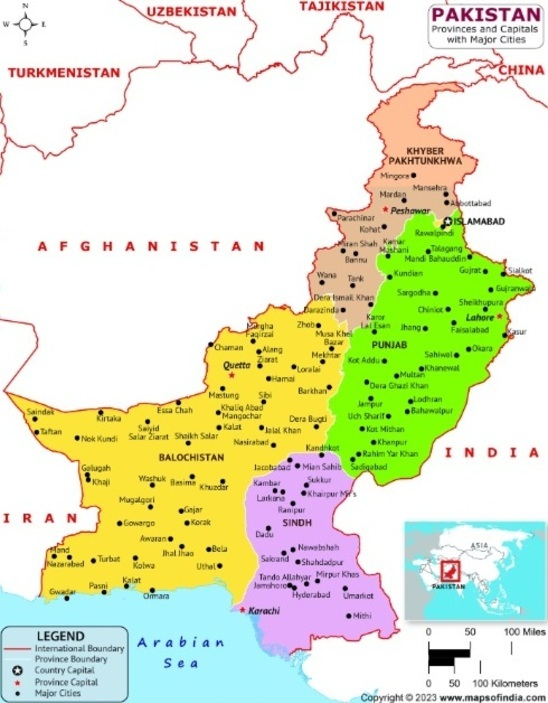
The Baloch and Sindhi groups have stated that the domination of Punjab Province in the federation is detrimental to all other ethnic groups. Hence, they have decided to unify their forces under a centralised command in order to intensify operations against Pakistan.
Meanwhile, Rana Sanaullah, the former Interior Minister of Pakistan, has described the security situation in Balochistan as alarming, stressing that strict action against rebels is inevitable. He has argued that bolstering the military presence is crucial to preserve national security and to counter potential threats. According to a section of analysts, the remarks of Sanaullah reflect broader political and law-and-order issues in Balochistan.
Boundless Ocean of Politics on Facebook
Boundless Ocean of Politics on Twitter
Boundless Ocean of Politics on Linkedin
Contact us: kousdas@gmail.com

 ISMC
ISMC Boundless Ocean Of Politics