

No Solution Within Palestine Alone
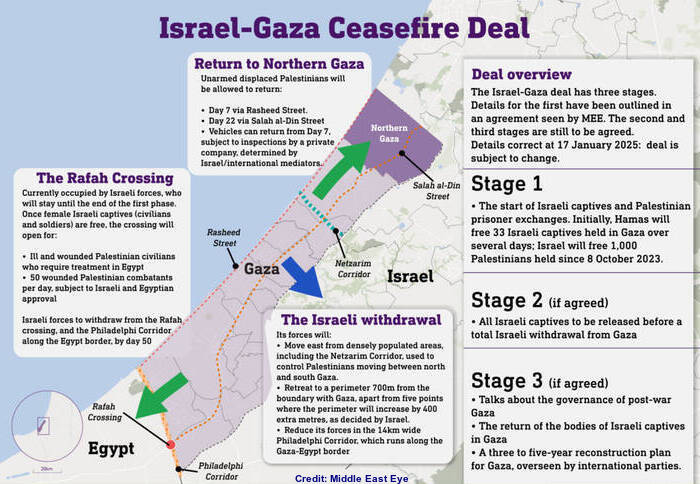
Among the contemporary complex issues, one issue that seems to have been resolved is the Gaza crisis as Israel signed a ceasefire agreement with the Palestinian Hamas Movement. However, the global community is doubtful whether the ceasefire would ensure long-term peace in the Gaza Strip!
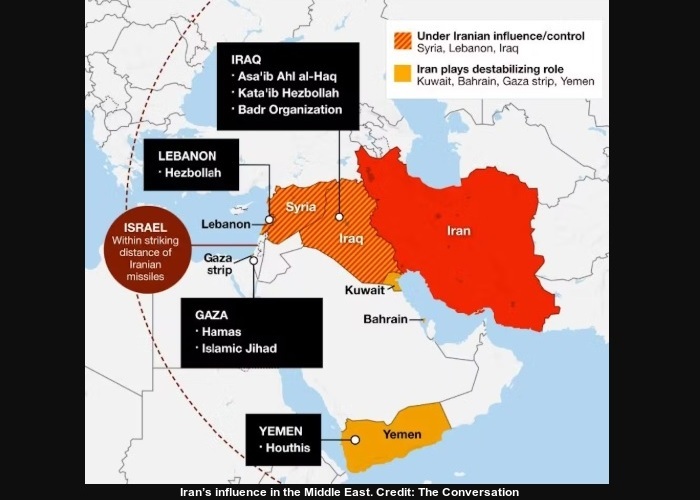
It should be noted that the impact of the year-long Israel-Hamas conflict has not been limited to West Asia only. Instead, the conflict influenced global diplomacy and geopolitics. For example, one can mention the armed conflict between Iran and Israel. Right now, West Asia is divided into two dominant camps. The Iran-influenced Axis of Resistance Groups that includes Hezbollah (Lebanon), Hamas (Palestine), the Islamic Resistance in Iraq (IRI) and the Houthis (Yemen) which are waging a war against Israel that receives support from the US and the so-called European bloc. The Palestine issue is just a part of this rivalry that also involves various equations centred around the Islamic Republic.
Its geographical location and mineral resources have helped Iran to emerge as one of the most important regional powers. For the major world powers, gaining control over Iran is like hitting the jackpot. In 1953, the US and the UK overthrew Mohammad Mosaddegh, the elected Prime Minister of Iran, through a military coup and installed Mohammad Reza Pahlavi, the last monarch of Iran (Persia), in power to serve their own political interests. The West started considering Iran as an enemy only after the Islamic Revolution took place in 1979 under the leadership of Ayatollah Ruhollah Musavi Khomeini.
In Global Geopolitics, the two words – power and interest – have different dimensions. Hence, the US has always tried to create troubles for Iran and imposing economic sanctions is one of the methods. It is quite obvious that relations between Tehran and Washington DC would touch a new low especially after the return of Donald John Trump to the White House. As the Islamic Republic has increased its influence in West Asia, the US has started providing Israel with all sorts of help to counter Iran. Therefore, it would be a mistake to analyse the Iran-Israel conflict from the perspective of the Palestinian crisis only. Iran, too, is well aware of the fact that while the US is the Greater Evil for Tehran, it is extremely important to keep its ally, Israel (the Lesser Evil), under control and the only way out is to back anti-Israel outfits.
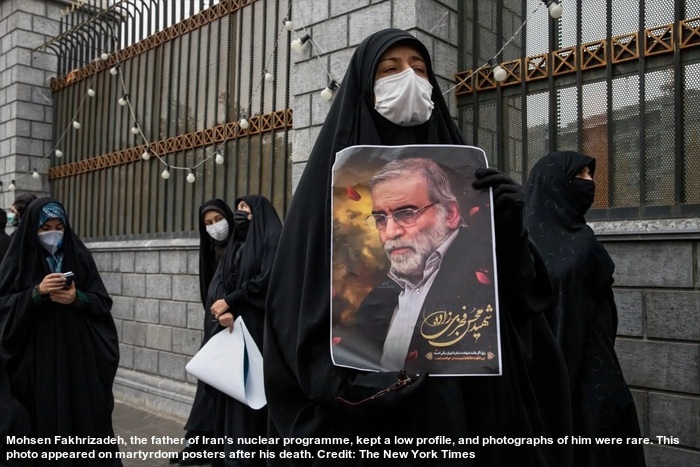
Although a kind of shadow war has been going on between Iran and Israel for the past decade, neither side got involved in direct conflict with the other. However, the Zionist Regime prompted the Islamic Republic to launch missile attacks on Tel Aviv in October 2024 by eliminating Mohsen Fakhrizadeh Mahabadi, the chief of Iran’s nuclear programme, in November 2020 and conducting an airstrike on the Iranian Embassy complex in Damascus in April 2024. Now, the problem has become a more complex one. Currently, Iran is not in a quite advantageous position as various issues have rocked internal politics of the Islamic Republic. Since 2019, mass protests have been going on in Iran over rising fuel prices and the government’s decision to make wearing the hijab mandatory for women at public places. The current global image of Iran is not at all positive. Hence, it becomes important for Tehran to maintain its political status only by portraying itself as the protector of West Asia, as well as the broader Arab interests.
The fall of Bashar al-Assad Regime in Syria has further complicated the situation. Although Ayatollah Ali Hosseini Khamenei has claimed that the ongoing political transition in Syria would not affect the Axis of Resistance, Syria was an important base for the Axis in terms of geopolitics. It may be noted that Iran, Russia and Turkey started the Astana Process (talks aimed to support the framework in accordance with the UN Security Council Resolution 2254 with an agreement between Iran, Russia and Turkey to form a joint monitoring body in order to take necessary steps for enforcing the Resolution 2254 ceasefire) in Syria. In fact, the security, as well as stability, of Syria depends on the stability of Iraq, Jordan and Lebanon. Now, Iran’s Syria policy depends entirely on the policy to be adopted by the Hayat Tahrir al-Sham (HTS) towards Tehran. The top political leadership in Tehran is well aware of the fact that the US, Israel and Turkey have considerable influence over the Syrian outfit. Hence, Iran is constantly monitoring the political developments in Syria. For Iran and the entire West Asia, a lot depends on the future of Syria.
By attacking the Sanaa International Airport of Yemen on December 26, 2024, Israel has made clear that the Houthis are its next target (after Hamas, Hezbollah and Syrian outfits). As Israel is clearly in a privileged position in the current situation, it has a plan to stamp its authority in West Asia. The Zionist Regime knows that neither the US nor any European country would take action against it for carrying out genocide in different parts of West Asia. The Israelis have signed the ceasefire agreement with Hamas as they have realised that they could gain nothing from Gaza in near future. Hence, Tel Aviv has started concentrating on other groups of Axis.

As expected, the US has welcomed Israel’s rise in West Asia because it is not possible for President Trump to declare a war against Iran. Instead, the US wants Israel to launch a war against the Islamic Republic. Israel, too, has realised that an indirect attack on Iran would be more effective than a direct attack. Hence, the Israelis have started targeting the Iran-backed outfits in neighbouring countries. The advantage of this policy is that it would directly damage those outfits, creating troubles for Iran (indirectly). As the authority of Iran in the region depends on the strength of the anti-Israel groups, the Israeli move would ultimately help the US to increase its influence in West Asia and Africa. Hence, the interests of Israel and the US are the same.
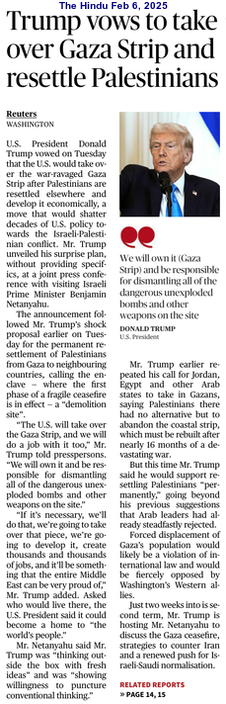
Meanwhile, President Trump has decided to help Israel to reshape the political map of West Asia. Although such a move would benefit both Israel and the US, Iran and other Arab nations would not allow it to happen easily. In such a scenario, the Gaza ceasefire could not ensure long-term peace in the region. Maybe, a new regional power would emerge in the coming days and change the entire equation.
Boundless Ocean of Politics on Facebook
Boundless Ocean of Politics on Twitter
Boundless Ocean of Politics on Linkedin
Contact: kousdas@gmail.com

 ISMC
ISMC Boundless Ocean Of Politics